


















Lesson 6 of 44 · Pinyin, Tones and Greetings
Pinyin initials and finals
Learn all 21 pinyin initials and the main finals with mouth positions, English respellings, IPA and examples, plus the spelling rules for y, w and ü.
Pinyin looks like English, but it is not English. The letters are a code for Mandarin sounds, and once you know the code you can read any word aloud. This lesson teaches the code in two halves: the initials, which start a syllable, and the finals, which complete it. We go slowly, because the little differences between sounds such as j, zh and z are exactly what make a learner sound clear.
What you will learn
- the 21 initials and how to place your mouth for each group
- the main finals and the patterns that connect them
- why b, d, g and p, t, k are a matter of air, not voice
- the spelling rules for y, w, ü and the hidden vowels in iu, ui and un
Key terms
Aspirated describes a consonant with a puff of air after it, such as p in "pie". Unaspirated has no puff, such as p in "spy".
Retroflex means the tongue tip is curled back (zh, ch, sh, r).
Glide is a quick i, u or ü sound before a vowel, as in "yes" or "wet".
Nasal final is a final that ends in n or ng.
Initials: where the sound is made
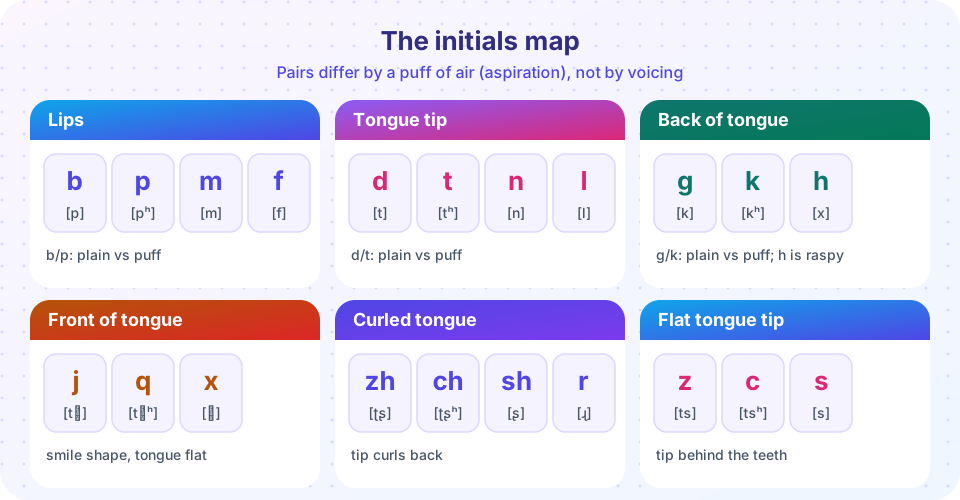
The 21 initials fall into groups by place in the mouth. The IPA symbols in brackets are approximate guides.
Lips: b p m f. The letter b is not the English b. It is a plain, unaspirated [p], like the p in "spy". The letter p is the same sound with a strong puff of air [pʰ], like the p in "pie". Hold a hand or a thin tissue in front of your mouth: p should move it, b should barely. The letters m [m] and f [f] are as in English.
Tongue tip: d t n l. The same plain/puff pair: d is an unaspirated [t] ("sty"), t is aspirated [tʰ] ("tie"). Then n and l are as in English.
Back of the tongue: g k h. The pair g [k] ("sky") and k [kʰ] ("kite"), plus h [x], which is a raspy sound from the back of the mouth, a little like the ch in Scottish "loch", but lighter.
Front of the tongue: j q x. These three are made with the tongue flat and the lips spread, as if smiling. The letter j [tɕ] is like a soft "j" in "jeep" without the voice. The letter q [tɕʰ] is the same with a strong puff, like "ch" in "cheese". The letter x [ɕ] is a soft "sh", like the start of "she" with your tongue forward. These three never meet the vowel u, only ü, which is why they are written with u (see below).
Curled tongue: zh ch sh r. Curl the tongue tip up and back. The letter zh [ʈʂ] is like "j" in "jar" without voice. The letter ch [ʈʂʰ] is a puffed "ch", like "church". The letter sh [ʂ] is a curled "sh". The letter r [ɻ] sits between English "r" in "red" and the "zh" of "measure".
Flat tongue tip: z c s. The tongue tip rests behind the lower front teeth. The letter z [ts] is like "ds" in "adds" without voice. The letter c [tsʰ] is like "ts" in "cats" with a puff. The letter s [s] is as in English.
The great trap is that Mandarin's contrast between b and p, d and t, g and k, zh and ch, z and c, j and q is aspiration (a puff of air), not voicing. English speakers hear b and p as "voiced vs unvoiced", but in Mandarin both are unvoiced. Practice both ways until your hand tells you which is which.
Here are initials with a word each. Say each aloud.
| Initial | Example | Meaning |
|---|---|---|
| b | 爸爸 bàba | dad |
| p | 朋友 péngyou | friend |
| m | 妈妈 māma | mom |
| f | 飞机 fēijī | airplane |
| d | 大 dà | big |
| t | 他 tā | he |
| n | 你 nǐ | you |
| l | 老师 lǎoshī | teacher |
| g | 哥哥 gēge | older brother |
| k | 看 kàn | to look |
| h | 好 hǎo | good |
| j | 家 jiā | home |
| q | 请 qǐng | please |
| x | 谢谢 xièxie | thank you |
| zh | 中国 Zhōngguó | China |
| ch | 吃 chī | to eat |
| sh | 是 shì | to be |
| r | 人 rén | person |
| z | 在 zài | to be at |
| c | 菜 cài | dish, vegetable |
| s | 四 sì | four |
Try the explorer below: click an initial to see its respelling, IPA, mouth tip and example.
Finals: the rest of the syllable
A final is everything after the initial, apart from the tone. There are about 35 finals, but they are built from just six simple vowels and a few patterns.
Six simple finals.
- a [a] is "ah" as in "father": 他 tā.
- o [o] is a rounded "aw/oh": 摸 mō (to touch). After b, p, m, f it sounds like "wo", but after other letters the written form is uo, as in 我 wǒ.
- e [ɤ] is an unrounded "uh", the vowel of "put" said with spread lips: 喝 hē (to drink). In some combinations it sounds like "eh".
- i [i] is "ee": 你 nǐ. After z, c, s and after zh, ch, sh, r, the letter i stands for a buzzing vowel, as in 四 sì and 是 shì. Do not say "ee" there.
- u [u] is "oo": 书 shū.
- ü [y] is "ee" said with rounded lips: 女 nǚ.
Vowel pairs. ai (like "eye": 爱 ài), ei (like "ay": 美 měi), ao (like "ow": 好 hǎo), ou (like "oh": 都 dōu).
Nasal finals. an (like "ahn": 山 shān), en (like "un" in "under": 人 rén), ang (like "ahng": 忙 máng), eng (like "ung": 朋 péng), ong (like "oong": 中 zhōng). Final n is made with the tongue tip touching the ridge behind the teeth; final ng is made at the back of the mouth and the tongue tip does not touch.
i-glides. ia (家 jiā), ie (谢 xiè), iao (小 xiǎo), iu (六 liù), ian (天 tiān, said "tyen"), in (您 nín), iang (想 xiǎng), ing (请 qǐng), iong (用 yòng).
u-glides. ua (花 huā), uo (多 duō), uai (快 kuài), ui (对 duì), uan (关 guān), un (春 chūn), uang (床 chuáng).
ü-glides. üe (月 yuè), üan (远 yuǎn), ün (云 yún).
er [ɚ] is a curled "are" with no consonant: 儿子 érzi (son), 二 èr (two).
Do not memorize the list in one go. Learn each final inside a real word and the pattern will soak in.
Spelling rules you must know
Three small rules cover most of the "why is it spelled like that?" questions.
1. y and w replace i, u and ü at the start. A syllable cannot begin with the bare letters i, u, ü, so pinyin writes y or w: i becomes yi, ia becomes ya, ie becomes ye, ian becomes yan, in becomes yin, ing becomes ying; u becomes wu, ua becomes wa, uo becomes wo, uan becomes wan; ü becomes yu, üe becomes yue, üan becomes yuan, ün becomes yun.
2. ü loses its dots after j, q, x (and y). After j, q and x only ü can occur, so the dots are dropped: ju, qu, xu, and yu. It is still said as ü. After n and l, both u and ü exist, so the dots stay: nǚ (女, woman) vs nù, lǜ (绿, green) vs lù.
3. Three finals hide a vowel after an initial. The finals iou, uei and uen shrink to iu, ui and un when written after a consonant: liù (六), duì (对), chūn (春). You still say the hidden vowel: liù is really "lee-oh-oo" quickly, and duì is "dway". Without an initial, they are written you, wei and wen.
One more detail: when a syllable that starts with a, o or e follows another syllable, an apostrophe shows the break, so that Xī'ān (西安, two syllables) differs from xiān (先, one).
Press Run (or Ctrl + Enter) to see the result here.
Program input · what you'd type while the program runs
Type the answers before you press Run, one per line. Each time the program reads a line (with input()), it gets the next line from this box.
Common misconceptions
"q sounds like k, x like ks." Not at all. The letter q is a puffed "ch" and x is a soft "sh". Words like 请 (qǐng, please) begin with a puffed "ch" and 谢 (xiè, thanks) with a soft "sh".
"zh is a mispronounced j." It is a different place of articulation: zh is curled, j is flat. 知 zhī and 鸡 jī differ in tongue shape as well as in the letter.
"u and ü are the same." They are different vowels. Round your lips for both, but say "ee" for ü and "oo" for u. Compare 女 nǚ (woman) with 怒 nù (anger).
"i always sounds like 'ee'." After z, c, s and zh, ch, sh, r, the letter i stands for a buzzing vowel (四 sì, 是 shì).
Check your understanding
Quick check · 5 questions
of 5 answered You scored / 5 · perfect!
-
1. How do b and p differ in Mandarin?
Both are unvoiced. Mandarin contrasts a plain sound (b) with an aspirated one (p). -
2. Which initial is a soft 'sh' made with a flat tongue and a smile?
The letter x [ɕ] is made with the front of the tongue. The letter sh is curled, and s is flat tongue tip. -
3. How is 'ü' spelled when it begins a syllable?
ü at the start becomes yu, as in 鱼 yú (fish), and it is still pronounced ü. -
4. Why is 'ju' written without the two dots?
After j, q, x the letter u stands for ü. After n and l the dots stay so that nǚ and nù can be told apart. -
5. What does the final 'iu' in liù really contain?
iu, ui and un are short forms of iou, uei and uen. You still say the hidden vowel.
Summary
- The 21 initials fall into six groups by place in the mouth; contrasts such as b/p are about aspiration, not voice.
- j q x (flat tongue), zh ch sh r (curled tongue) and z c s (tongue tip) are the three groups learners most often mix up.
- Finals combine six simple vowels with glides and nasals (n, ng).
- y and w replace i, u, ü at the start; ü loses its dots after j, q, x; iu, ui, un hide a vowel.
Next: Tones and tone changes
Track your progress
Create a free account to tick off lessons and pick up where you left off on any device.
of Mandarin Chinese for Beginners lessons completed