


















Lesson 35 of 44 · Conversation and Culture
Chapter 8 Overview: Conversation and Culture
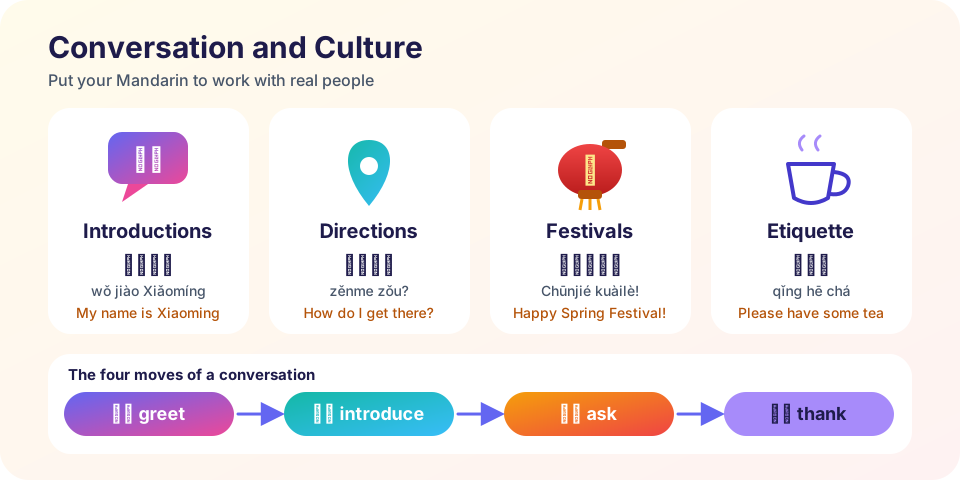
A map of chapter 8: introducing yourself and your family, asking for directions, using transport, and understanding Chinese etiquette and festivals, with a sample dialogue.
By now you have the tools of real communication: pinyin and tones, basic sentence patterns, numbers, time and a growing stock of characters. Chapter 8 puts them to work. You will introduce yourself and your family, ask for directions and ride public transport, and learn the unwritten rules that make a conversation feel polite and natural: how to address people, how gifts and festivals work, and what to do at a Chinese dinner table. Language and culture cannot be separated, and a little cultural knowledge goes a long way toward sounding like a considerate guest.
What you will learn
- How to introduce yourself, say where you are from and what you do, and talk about your family.
- How to ask where something is and understand the answer.
- How to take the subway, bus, taxi and train.
- How to address people politely, and what customs matter at the table, at festivals and when giving gifts.
- How Mandarin differs across regions, and why that should not worry you.
Key terms
自我介绍 (zìwǒ jièshào): self-introduction.
问路 (wènlù): asking the way.
礼貌 (lǐmào): politeness, manners.
普通话 (pǔtōnghuà): "the common speech", Standard Mandarin.
The chapter in slides
Meeting people
Getting around
Manners
Festivals
A first taste: meeting a new classmate
| Speaker | Chinese | Pinyin | English |
|---|---|---|---|
| 小美 | 你好!我叫小美。你叫什么名字? | Nǐ hǎo! Wǒ jiào Xiǎoměi. Nǐ jiào shénme míngzi? | Hello! I'm Xiaomei. What's your name? |
| 大卫 | 我叫大卫。我是美国人。你是哪国人? | Wǒ jiào Dàwèi. Wǒ shì Měiguó rén. Nǐ shì nǎ guó rén? | I'm David. I'm American. Where are you from? |
| 小美 | 我是中国人,我家在上海。 | Wǒ shì Zhōngguó rén, wǒ jiā zài Shànghǎi. | I'm Chinese. My home is in Shanghai. |
| 大卫 | 很高兴认识你!请问,图书馆在哪儿? | Hěn gāoxìng rènshi nǐ! Qǐngwèn, túshūguǎn zài nǎr? | Nice to meet you! Excuse me, where is the library? |
| 小美 | 一直走,在左边。我带你去吧。 | Yìzhí zǒu, zài zuǒbian. Wǒ dài nǐ qù ba. | Go straight, on the left. I'll take you there. |
| 大卫 | 谢谢你! | Xièxie nǐ! | Thank you! |
Within six lines you meet all four moves: greet (你好), introduce (我叫…, 我是…人), ask (图书馆在哪儿?) and thank (谢谢你). The chapter develops each move.
What each lesson covers
- Introductions, family and small talk: names, nationality, jobs, family words, age and the Chinese zodiac.
- Directions and transport: asking the way, turns and landmarks, taking subways, buses and taxis.
- Culture and etiquette: forms of address, table manners, gifts, red envelopes, festivals and regional language variation.
- Chapter 8 review: a summary poster and a ten-question quiz.
How to study this chapter
Read each dialogue aloud twice: first with the English translation hidden, then with the pinyin hidden. Then swap in your own details: your name, your country, your city. A dialogue that has your own facts in it is far easier to remember than one about a stranger. If you can, practice with a language partner or tutor, because conversation is a skill built by speaking with real people, and a course alone cannot replace that.
Do not wait until your Chinese is "good enough". Keep a small notebook of phrases you hear and want to try; real conversations are the best source of new material. Most Chinese speakers are delighted by any effort a foreigner makes, and a few sentences said with the right tones will earn you smiles and corrections you can learn from.
Check your understanding
Quick check · 3 questions
of 3 answered You scored / 3 · perfect!
-
1. Which sentence introduces your name?
我叫… (wǒ jiào …) means 'My name is …'. -
2. What does 图书馆在哪儿? ask?
在哪儿 asks where something is; 图书馆 is the library. -
3. What is 普通话?
普通话 (pǔtōnghuà) is the standard form of Mandarin.
Summary
- Chapter 8 turns your grammar and vocabulary into real conversations.
- A natural conversation follows four moves: greet, introduce, ask, thank.
- Culture and language go together: forms of address, gifts, meals and festivals matter.
Track your progress
Create a free account to tick off lessons and pick up where you left off on any device.
of Mandarin Chinese for Beginners lessons completed