


















Lesson 18 of 44 · Measure Words and Questions
Question words: who, what, which, where, how many, how, why
Learn the Mandarin question words 谁, 什么, 哪, 哪儿, 几, 多少, 怎么 and 为什么, how they replace the answer in a sentence, with dialogues and drills.
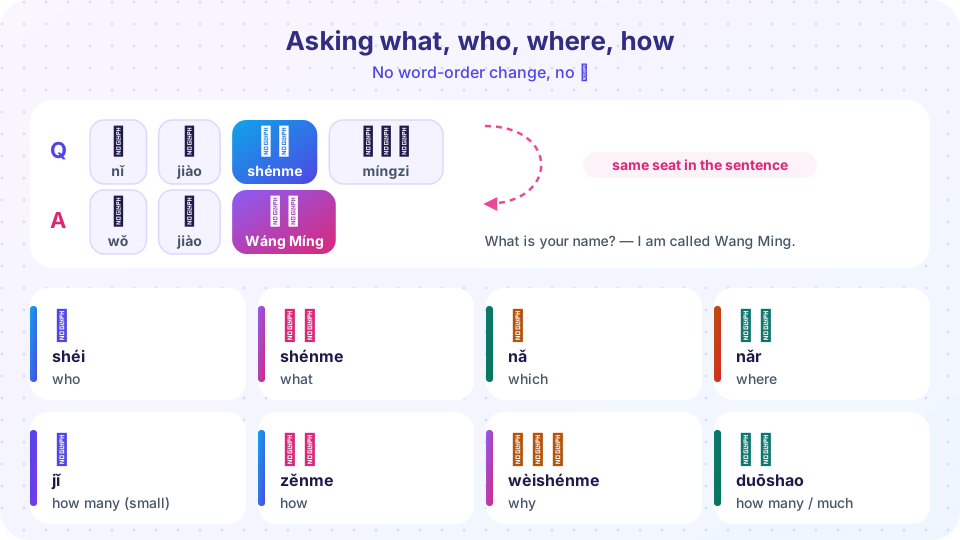
English moves its question words to the front: "What is your name?", "Where do you live?" Mandarin does the opposite. The question word goes exactly where the answer would go. If the answer to "What is your name?" is 我叫王明 (wǒ jiào Wáng Míng), then the question is 你叫什么名字? (nǐ jiào shénme míngzi?), with 什么名字 sitting where 王明 sits. Once you grasp this one principle, all the question words become easy: learn the word, drop it in the slot, and you are done.
What you will learn
- the swap principle: question word = the answer's slot
- eight question words: 谁, 什么, 哪, 哪儿, 几, 多少, 怎么, 为什么
- how to choose between 什么 and 哪, and between 几 and 多少
- how to answer and how to build short conversations
Key terms
Question word (疑问词, yíwèncí) stands for the unknown information.
Slot means the position in the sentence where the missing information would normally go.
几 (jǐ) asks for a small number (usually under ten); 多少 (duōshao) asks for any quantity.
因为 (yīnwèi) means "because", the usual answer to 为什么.
The principle: the question word takes the answer's seat
| Answer | Question |
|---|---|
| 我叫王明。Wǒ jiào Wáng Míng. | 你叫什么名字?Nǐ jiào shénme míngzi? |
| 他是我朋友。Tā shì wǒ péngyou. | 他是谁?Tā shì shéi? |
| 我住在上海。Wǒ zhù zài Shànghǎi. | 你住在哪儿?Nǐ zhù zài nǎr? |
There are three consequences. First, no word-order change: you do not move the question word to the front. Second, no 吗: the question word already makes it a question, so adding 吗 is wrong. Third, the answer is easy: just replace the question word with the information.
The eight question words
谁 (shéi, also shuí): who. 他是谁? (Who is he?) 谁是你的老师? (Who is your teacher?) As a subject it stays at the front because the answer would also come first: 谁来了? (Who came?). For "whose", add 的: 这是谁的书? (Zhè shì shéi de shū? Whose book is this?)
什么 (shénme): what. 你喝什么? (Nǐ hē shénme? What do you drink?) It can also modify a noun: 什么书 (what book), 什么时候 (shénme shíhou, when; literally "what time"), 什么意思 (shénme yìsi, what does it mean).
哪 (nǎ): which. It asks you to pick from a known set and is always followed by a measure word or a noun: 哪个 (nǎ ge, which one), 哪本书 (nǎ běn shū, which book), 哪国人 (nǎ guó rén, which country's person; where are you from). Do not confuse 哪 (nǎ, third tone, with the mouth radical 口) and 那 (nà, fourth tone, "that").
哪儿 / 哪里 (nǎr / nǎlǐ): where. 你在哪儿? (Where are you?) 你家在哪儿? (Where is your home?) 哪儿 is common in the north and in speech; 哪里 is neutral and also used in the south. Both are fine.
几 (jǐ): how many (small number). It is followed by a measure word: 你有几个朋友? (How many friends do you have?). Special fixed forms: 几点 (jǐ diǎn, what time), 星期几 (xīngqī jǐ, which day of the week), 几月几号 (jǐ yuè jǐ hào, what date). 几 usually expects a number under ten, so it fits counts like people in a family.
多少 (duōshao): how many, how much (any quantity). 你们班有多少学生? (How many students are in your class?) 这个多少钱? (Zhège duōshao qián? How much is this?) With 多少 the measure word is optional.
怎么 (zěnme): how (in what way). 你怎么去学校? (How do you get to school?) 这个字怎么读? (Zhège zì zěnme dú? How do you read this character?) The related 怎么样 (zěnmeyàng) asks "how is it?": 今天天气怎么样? (How is the weather today?), 中文怎么样? (How is Chinese?).
为什么 (wèishénme): why. 你为什么学中文? (Why do you study Chinese?) The answer often starts with 因为 (yīnwèi, because): 因为我喜欢中国文化 (Yīnwèi wǒ xǐhuan Zhōngguó wénhuà. Because I like Chinese culture.)
A handy extra: 多大 (duō dà) asks about age or size. 你多大? (How old are you? to a peer), 你几岁? (to a young child), 您多大年纪? (to an older person, respectfully).
什么 or 哪?
Both mean a kind of "what", but 哪 means "which one out of a known set".
| Question | Use |
|---|---|
| 你喝什么? What do you drink? | Open choice, no set in mind |
| 你喝哪个? Which one do you drink? | Choosing among visible options |
| 你是哪国人? Which country are you from? | Choosing among countries |
| 你学什么? What do you study? | Open: any subject |
And 几 or 多少? Use 几 for small counts you expect to be under ten (family members, days of the week) and 多少 for anything else or when you have no idea.
Dialogues
Dialogue 1: getting to know someone
| Speaker | Chinese | Pinyin | English |
|---|---|---|---|
| A | 你叫什么名字? | Nǐ jiào shénme míngzi? | What is your name? |
| B | 我叫李华。你呢? | Wǒ jiào Lǐ Huá. Nǐ ne? | I'm Li Hua. And you? |
| A | 我叫王明。你是哪国人? | Wǒ jiào Wáng Míng. Nǐ shì nǎ guó rén? | I'm Wang Ming. Which country are you from? |
| B | 我是加拿大人。你住在哪儿? | Wǒ shì Jiānádàrén. Nǐ zhù zài nǎr? | I'm Canadian. Where do you live? |
| A | 我住在上海。你家有几口人? | Wǒ zhù zài Shànghǎi. Nǐ jiā yǒu jǐ kǒu rén? | I live in Shanghai. How many people in your family? |
| B | 四口人。 | Sì kǒu rén. | Four. |
Dialogue 2: a short shop talk
| Speaker | Chinese | Pinyin | English |
|---|---|---|---|
| A | 请问,这个多少钱? | Qǐngwèn, zhège duōshao qián? | Excuse me, how much is this? |
| B | 十块。 | Shí kuài. | Ten yuan. |
| A | 太贵了!那个呢? | Tài guì le! Nàge ne? | Too expensive! And that one? |
| B | 那个五块。 | Nàge wǔ kuài. | That one is five yuan. |
New words: 块 (kuài) is the everyday word for yuan, the Chinese currency; 这个 (zhège) is "this one" and 那个 (nàge) "that one", which the next lesson covers. Numbers and money get a whole chapter later.
Asking politely and listening well
Question words can sound blunt on their own, so Mandarin speakers soften them. Begin with 请问 (qǐngwèn, "may I ask"): 请问,你叫什么名字? A very useful softener is 一下 (yíxià, "a little", "a moment"): 我想问一下,洗手间在哪儿? (Wǒ xiǎng wèn yíxià, xǐshǒujiān zài nǎr? I'd like to ask, where is the restroom?). With an older person, use 您 instead of 你: 您住在哪儿?
Listening is the mirror image of asking. When someone speaks to you, first catch the question word: it tells you what kind of answer is expected. If you hear 谁, answer with a person; 哪儿, a place; 几 or 多少, a number; 为什么, a reason that starts with 因为. Then find the slot and fill it. Even if you miss most of the sentence, spotting the question word and repeating the verb often keeps the conversation going.
Try it
First, the slot game. Each item shows an answer with one part highlighted. Choose the question word that would ask for it.
Second, a Python tool that makes the question from an answer by replacing the highlighted slot. It also swaps the subject from I to you.
Press Run (or Ctrl + Enter) to see the result here.
Program input · what you'd type while the program runs
Type the answers before you press Run, one per line. Each time the program reads a line (with input()), it gets the next line from this box.
Common misconceptions
"Put the question word first, like English." In Mandarin it stays in the slot: 你住在哪儿?, not "哪儿你住在?".
"Add 吗 to be polite." Never with a question word. 你叫什么名字吗? is wrong.
"什么 and 哪 are the same." 哪 selects among a known group; 什么 is open.
"几 asks any number." 几 expects a small number. Use 多少 for large or unknown amounts, and for money.
"谁 only means who as subject." It works anywhere a person's name could go: 你找谁? (Who are you looking for?).
Check your understanding
Quick check · 6 questions
of 6 answered You scored / 6 · perfect!
-
1. Where does the question word go in Mandarin?
你住在哪儿? keeps the statement's order: the question word replaces the answer. -
2. Which sentence means 'Where do you live?'
哪儿 sits where the place would be, and no 吗 is used. -
3. How do you ask the price of something?
多少钱 (duōshao qián) is the standard way to ask how much something costs. -
4. Which question word fits 你有___个朋友? when you expect a small number?
几 (jǐ) asks for a small number and takes a measure word. -
5. What does 你为什么学中文? ask?
为什么 means why. The usual answer begins with 因为. -
6. Which sentence is wrong?
吗 cannot be added to a question that already has a question word.
Summary
- The question word takes the place of the answer: no inversion and no 吗.
- 谁 (who), 什么 (what), 哪 (which), 哪儿 (where), 几 (how many, small), 多少 (how many/much), 怎么 (how), 为什么 (why).
- 哪 picks from a known set; 几 expects a small number; 多少钱 asks the price.
- Answer by replacing the question word with the information; 为什么 is answered with 因为.
Next: 这, 那 and 的
Track your progress
Create a free account to tick off lessons and pick up where you left off on any device.
of Mandarin Chinese for Beginners lessons completed