


















Lesson 39 of 44 · Conversation and Culture
Chapter 8 Review: Conversation and Culture
Review chapter 8: introductions, family words, directions and transport, politeness, gifts and festivals, with a role-play game, a phrasebook and a quiz.
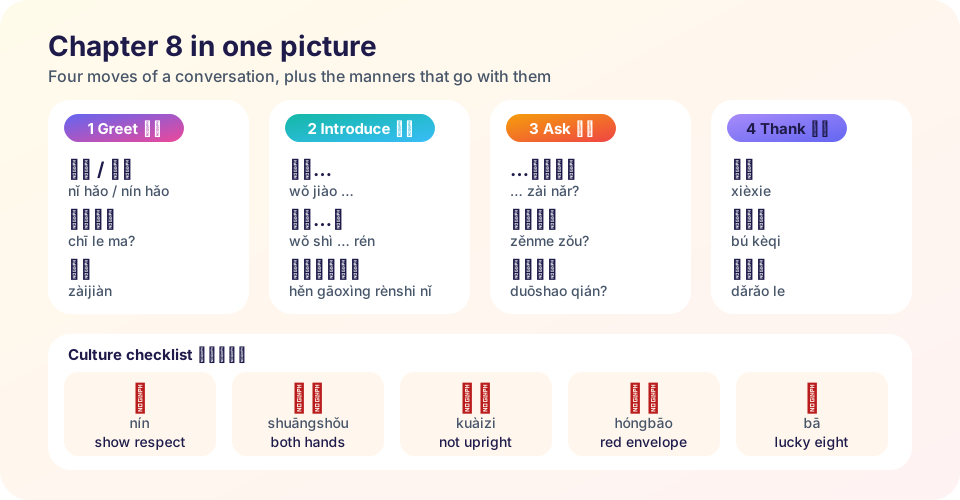
This chapter turned the language you have learned into conversations: introducing yourself, talking about family, finding your way, riding transport, and behaving politely at the table, with gifts and at festivals. The poster below shows the four moves of a conversation with the key phrases for each, and the culture checklist at the bottom is worth rereading before any meeting with Chinese friends or colleagues.
Recap table
| Topic | What to remember | Example | Lesson |
|---|---|---|---|
| Names | Family name first; 我叫… / 我姓… | 我叫小明。 | Introductions |
| Origin | 我是+country+人 | 我是美国人。 | Introductions |
| Jobs and age | 我是+job; 我今年…岁 | 我今年二十岁。 | Introductions |
| Family | Father's side vs mother's side; older vs younger | 爷爷, 外婆, 哥哥, 妹妹 | Introductions |
| Zodiac | 你属什么? 我属龙。 | 12 animals | Introductions |
| Asking the way | …在哪儿? 去…怎么走? | 请问,银行在哪儿? | Directions |
| Directions | 一直走, 左转, 右转, 红绿灯 | 到路口右转 | Directions |
| 在 vs 有 | X在Y旁边; Y旁边有X | 超市旁边有一家银行 | Directions |
| Distance | 离, 远, 近, 从…到…, 要 | 学校离这儿很近 | Directions |
| Transport | 坐, 骑, 开, 打车, 走路 | 坐地铁, 骑自行车 | Directions |
| Address | Surname + title; 您 | 王老师, 李经理 | Culture |
| Politeness | 谢谢, 不客气, 对不起, 辛苦了 | 哪里哪里 | Culture |
| Table and gifts | No upright chopsticks; both hands | 干杯, 红包 | Culture |
| Festivals | Lunar calendar, except National Day | 春节, 中秋节 | Culture |
Building real conversations
When you speak Chinese with real people, a few habits help more than perfect grammar. Speak slowly and clearly, because clear tones matter more than speed. Ask people to repeat: 请再说一遍。 (Qǐng zài shuō yí biàn.) and 请说慢一点儿。 (Qǐng shuō màn yìdiǎnr.) "Please speak a little slower." Use 我听不懂 (wǒ tīng bu dǒng) without shame. And be ready to use your hands and a translation app as backup. Remember that a course cannot replace conversation: the more you practice speaking with real people, the faster your Chinese grows.
Make a small script of five sentences you will always say: your name, where you are from, what you do, one thing you like, and 很高兴认识你. Rehearse it until it is automatic. Then every new meeting is a free practice session.
Worked example: a 60-second self-introduction
Here is a complete introduction that uses chapter 8, with pinyin and translation. Customize it with your own details, then practice saying it in under a minute.
你好!我叫大卫,我是美国人。我今年三十岁,是工程师。我家有四口人:爸爸、妈妈、一个妹妹和我。我现在住在北京,我喜欢看电影和游泳。我会说一点儿中文。很高兴认识你!
Nǐ hǎo! Wǒ jiào Dàwèi, wǒ shì Měiguó rén. Wǒ jīnnián sānshí suì, shì gōngchéngshī. Wǒ jiā yǒu sì kǒu rén: bàba, māma, yí ge mèimei hé wǒ. Wǒ xiànzài zhù zài Běijīng, wǒ xǐhuan kàn diànyǐng hé yóuyǒng. Wǒ huì shuō yìdiǎnr Zhōngwén. Hěn gāoxìng rènshi nǐ!
"Hello! My name is David and I am American. I am thirty years old and an engineer. There are four people in my family: my dad, my mom, a younger sister and me. I live in Beijing now, and I like watching movies and swimming. I can speak a little Chinese. Nice to meet you!"
Count the building blocks: a greeting, a name, nationality with 人, age with 岁, a job, a family with the measure word 口, a place with 住在, hobbies with 喜欢, a modest statement about ability, and the closing phrase. Each block can be swapped out without touching the others.
Three culture decisions
- You are invited to a family's home. Bring a small gift, such as fruit or tea, and give it with both hands. Do not worry if they put it aside without opening it.
- At dinner, the host keeps adding food to your bowl. Say
够了,谢谢(gòu le, xièxie) with a smile, and eat a little of what they offer. A refusal said kindly and warmly is part of the game. - You are speaking to your teacher. Use
您and王老师, not just你and a first name.
If you can justify each of these choices, you have understood the point of this chapter: grammar and manners work together.
Try it
Press Run (or Ctrl + Enter) to see the result here.
Program input · what you'd type while the program runs
Type the answers before you press Run, one per line. Each time the program reads a line (with input()), it gets the next line from this box.
Check your understanding
Quick check · 10 questions
of 10 answered You scored / 10 · perfect!
-
1. How do you say 'My name is David'?
我叫… introduces your name. -
2. Who is 外公?
外公 is the maternal grandfather; 爷爷 is the paternal one. -
3. Which pattern says 'The bank is next to the supermarket'?
X 在 Y 旁边 states where X is. -
4. Which verb do you use with a bicycle?
骑 is used for riding a bike; 坐 is for riding as a passenger and 开 is for driving. -
5. 'Turn right at the traffic light' is:
右转 is turn right; 红绿灯 is traffic light. -
6. How do you politely address a teacher named Li?
Surname + 老师 is respectful. -
7. What does 哪里哪里 mean as an answer to a compliment?
It is a modest reply, similar to 'You're too kind'. -
8. Which is NOT good table etiquette?
Upright chopsticks in rice resemble funeral incense. -
9. Why is 8 considered lucky?
八 (bā) sounds like 发 (fā), 'to get rich'. -
10. Which festival has a fixed Gregorian date?
National Day is October 1. Spring Festival and Mid-Autumn follow the lunar calendar.
Summary
- A conversation has four moves: greet, introduce, ask, thank.
- Use 我叫…, 我是…人, family terms, 在哪儿, 怎么走, 坐/骑/开, and polite phrases.
- Address people by surname + title; use 您 for respect; both hands for gifts; no upright chopsticks; 8 is lucky.
- Next chapter: practice dialogues, a study helper, a glossary, a cheat sheet and ideas for further study.
Track your progress
Create a free account to tick off lessons and pick up where you left off on any device.
of Mandarin Chinese for Beginners lessons completed