


















Lesson 34 of 44 · Reading Characters
Chapter 7 Review: Reading Characters
Review chapter 7: strokes and stroke order, radicals, phonetic-semantic compounds, and everyday signs, menus and app words, with a matching game and quiz.
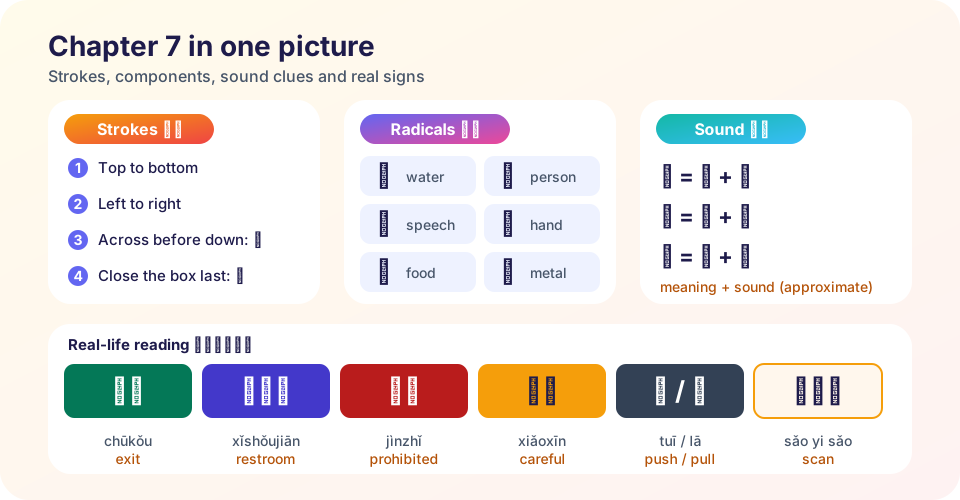
Chapter 7 turned characters from a mystery into a system: eight strokes, a few rules of order, a set of radicals that hint at meaning, sound parts that hint at pronunciation, and a vocabulary of everyday signs. The poster below pulls the main ideas together. Use the table to see what you remember, play the matching game, then take the ten-question quiz.
Recap table
| Topic | What to remember | Example | Lesson |
|---|---|---|---|
| Strokes | Eight basic strokes: 横 竖 撇 点 捺 提 钩 折 | 人 has 2, 日 has 4 | Radicals and strokes |
| Stroke order | Top to bottom, left to right, across before down, close the box last | 十, 口 | Radicals and strokes |
| Radicals | A component that hints at meaning category | 氵 in 河, 亻 in 你, 讠 in 说 | Radicals and strokes |
| Sound parts | Most characters = meaning part + sound part | 清 = 氵 + 青 | Phonetic compounds |
| Reliability | The sound clue gives the syllable; tones often differ | 请 qǐng vs 青 qīng | Phonetic compounds |
| Homophones | Same sound, written differently | 他, 她, 它 | Phonetic compounds |
| Signs | 出口, 入口, 厕所, 小心, 禁止, 请勿 | 请勿吸烟 | Signs, menus and apps |
| Menus | Cooking words 炒 烤 蒸 汤 | 炒饭 chǎofàn | Signs, menus and apps |
| Apps | 扫一扫, 登录, 设置, 确认, 取消 | 确认支付 | Signs, menus and apps |
| Typing | Pinyin without tones, choose the candidate | nihao → 你好 | Signs, menus and apps |
Three habits for lasting memory
First, review characters in context: a sign, a menu line, a message. A character met in real life sticks far better than one from a list. Second, group new characters by radical or by sound part, so each new character connects to others you know. Third, write a few characters by hand each day, saying the pinyin aloud as you write; the combination of movement, sound and image is powerful.
Keep a "street list" in your notes app: every unfamiliar character you see gets its pinyin and meaning. A week of this teaches you more useful characters than any generic word list.
Worked example: decoding new characters
Imagine you are at a restaurant and see the characters 洗手间 on a door. You do not know the first one. Here is how the tools of this chapter help.
- Find the radical.
洗starts with氵, the water radical. So the character is about water or washing. - Look for a sound part. The right side is
先(xiān). The whole character isxǐ, so the sound is close: same final, different initial and tone, a typical "similar" match. - Read the rest.
手(shǒu) is "hand", a pictograph you may already know.间(jiān) is "room" or "between": a gate门with something inside. - Put it together. "Wash-hand-room": the restroom,
洗手间(xǐshǒujiān). The context, a door in a restaurant, agrees.
A second example: 饭馆 (fànguǎn, restaurant). Both characters have the food radical 饣. 饭 adds 反 (fǎn), giving the sound fàn; 馆 adds 官 (guān), giving guǎn. Two food radicals and two sound hints: a place where food is served. You will often find that a word's characters repeat the same meaning part, which makes unknown words easier to guess.
A weekly reading routine
Pick a source of real characters, such as a menu, a shop sign or a chat app. Each week, collect five characters you did not know, find the radical and sound part for each, write them in your street list with their pinyin, and read them aloud. At the end of the week, test yourself with the self-check script below. In a month you will have twenty useful characters learned in context, and you will have used every idea from this chapter many times.
Try it
Press Run (or Ctrl + Enter) to see the result here.
Program input · what you'd type while the program runs
Type the answers before you press Run, one per line. Each time the program reads a line (with input()), it gets the next line from this box.
Check your understanding
Quick check · 10 questions
of 10 answered You scored / 10 · perfect!
-
1. How many basic strokes are usually named in teaching?
Eight basic strokes: 横, 竖, 撇, 点, 捺, 提, 钩, 折. -
2. In which order do you write 十?
Across before down: horizontal first. -
3. Which stroke is written first in 人?
In 人 the 撇 comes first, then the 捺. -
4. Which radical suggests 'speech' in 说 and 请?
讠 is the simplified speech radical. -
5. In 清, which part gives the sound?
青 (qīng) is the sound part; 氵 (water) is the meaning part. -
6. Which pair of characters is a homophone set (both tā)?
他 (he) and 她 (she) are both tā. 清 and 请 differ in tone, and 吗 and 妈 differ in tone. -
7. What does 请勿吸烟 mean?
请勿 + verb = please do not; 吸烟 = to smoke. -
8. On a menu, what does 炒饭 mean?
炒 is stir-fried and 饭 is rice or meal. -
9. How do you type 你好 on a pinyin keyboard?
Type the pinyin without tones, then choose the character from the candidates. -
10. Why are stories like '休 = a person resting by a tree' useful?
Memory stories are mnemonic aids; some do not match the real history.
Summary
- Eight basic strokes and a few order rules produce every character.
- Radicals hint at the category of meaning; sound parts hint at the syllable.
- Real-life vocabulary (signs, menus, apps) is the fastest way to build a useful set of characters.
- Next chapter: conversation and culture, putting everything together in real situations.
Track your progress
Create a free account to tick off lessons and pick up where you left off on any device.
of Mandarin Chinese for Beginners lessons completed