


















Lesson 31 of 44 · Reading Characters
Radicals, Strokes and Stroke Order
Learn the eight basic Chinese strokes, the stroke-order rules, how to count strokes, and 15 common radicals that give clues to meaning, with an animation tool.
Every Chinese character, no matter how complicated, is written with the same few kinds of strokes in a standard order. If you learn these basics early, characters stop looking like tangles of lines. You will also be able to count strokes (which you need for dictionaries), recognize the components that repeat in hundreds of characters, and guess the meaning of new characters from their radicals. This lesson gives you that foundation.
What you will learn
- The eight basic strokes and their names.
- The seven stroke-order rules and how to apply them.
- What a radical is and 15 radicals worth knowing.
- How to count strokes and use them to find a character in a dictionary.
Key terms
笔画 (bǐhuà): a stroke, one continuous line drawn without lifting the pen.
笔顺 (bǐshùn): stroke order.
部首 (bùshǒu): radical, the section header a character is filed under in a dictionary.
偏旁 (piānpáng): the side component of a character, such as 氵 on the left.
The eight basic strokes
Chinese teachers usually name eight basic strokes. Other, more complex strokes are combinations of these.
| Stroke | Name | Shape | Example characters |
|---|---|---|---|
| 一 | 横 héng | horizontal, left to right | 一, 二, 三 |
| 丨 | 竖 shù | vertical, top to bottom | 十, 中 |
| 丿 | 撇 piě | left-falling | 人, 八, 川 |
| 丶 | 点 diǎn | dot | 六, 小 |
| ㇏ | 捺 nà | right-falling | 人, 大 |
| ㇀ | 提 tí | rising, from lower left to upper right | 打, 地 |
| 亅 | 钩 gōu | hook, at the end of another stroke | 小 (the middle stroke) |
| ㇕ | 折 zhé | turn, a stroke with a corner | 口, 日, 山 |
Do not memorize the shapes as symbols; notice them as you write. Every time you meet a new character, name its strokes: "heng, shu, pie..."
Stroke-order rules
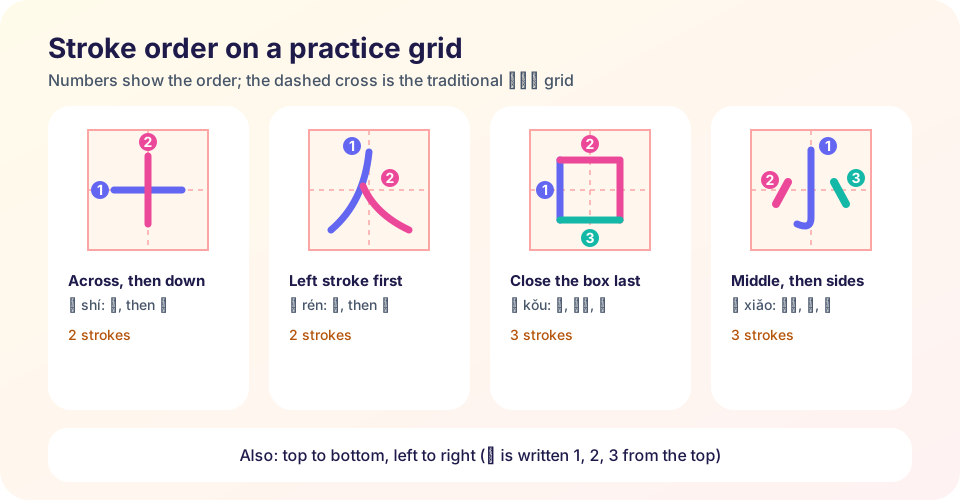
Writing in the standard order makes characters balanced and fast to write, and it is what handwriting apps and teachers expect. A handful of rules cover nearly every character.
- Top to bottom.
三is written 1, 2, 3 from the top. - Left to right.
川goes left, middle, right. - Horizontal before vertical when they cross: in
十, write 一 first, then 丨. - Left-falling before right-falling: in
人, the 撇 comes first, the 捺 second. - Outside before inside: in
月, draw the outer frame first, then the two inside strokes. - Middle before the sides for symmetrical characters: in
小, the middle hook comes first, then the two dots. - Close the box last: in
口and国, write the sides first and close the bottom last.
Two more are worth knowing. A vertical stroke that passes through the middle is written last: in 中, draw the box 口 first, then the line through it. And dots and small details come last: in 犬, write 大 first and the dot after.
Counting strokes
The stroke count of a character is the number of strokes in it, counting each continuous line once. A few reference points: 人 2, 大 3, 日 4, 好 6, 明 8, 国 8. Stroke counts matter because paper dictionaries file characters by radical and then by the number of remaining strokes after the radical. (Today you will usually look up a character by typing its pinyin or by drawing it on your phone, but the counting skill remains useful.)
Radicals: the clues inside characters
Many characters have a part that tells you the category of the meaning. That part is the radical. Traditional dictionaries list 214 of them; for a beginner, a small set covers a huge share of characters. Radicals often change shape when they sit on the side of a character: 水 (water) becomes 氵, and 人 (person) becomes 亻.
| Radical | Meaning | Example characters |
|---|---|---|
| 氵 | water | 河 hé (river), 海 hǎi (sea), 湖 hú (lake) |
| 亻 | person | 你 nǐ (you), 他 tā (he), 住 zhù (live), 休 xiū (rest) |
| 讠 | speech | 说 shuō (speak), 请 qǐng (please), 谢 xiè (thank), 话 huà (speech) |
| 扌 | hand | 打 dǎ (hit), 拿 ná (take), 找 zhǎo (look for), 推 tuī (push) |
| 木 | tree, wood | 树 shù (tree), 林 lín (woods), 桌 zhuō (table) |
| 口 | mouth | 吃 chī (eat), 喝 hē (drink), 叫 jiào (call), 吗 ma (question particle) |
| 心 / 忄 | heart, feelings | 想 xiǎng (think), 怕 pà (fear), 快 kuài (fast, happy), 忙 máng (busy) |
| 日 | sun, time | 明 míng (bright), 时 shí (time), 晚 wǎn (evening) |
| 女 | woman | 妈 mā (mom), 好 hǎo (good), 姐 jiě (older sister) |
| 艹 | grass, plants | 茶 chá (tea), 花 huā (flower), 菜 cài (vegetable, dish) |
| 辶 | movement | 这 zhè (this), 道 dào (road), 远 yuǎn (far), 进 jìn (enter) |
| 饣 | food | 饭 fàn (meal), 饿 è (hungry), 馆 guǎn (a place, as in 饭馆 restaurant) |
| 钅 | metal | 钱 qián (money), 铁 tiě (iron), 银 yín (silver) |
| 宀 | roof | 家 jiā (home), 字 zì (character), 室 shì (room) |
| 门 | gate, door | 问 wèn (ask), 间 jiān (between, room), 闻 wén (hear, smell) |
A word of caution: a radical tells you the category, not the exact meaning. 河 and 海 both have water, but neither is "water" itself. Meanings also drift over time; the connection can be obvious (氵 in 河) or faint (口 in 吗, a question particle). Treat radicals as hints that make characters easier to remember, not as a decoding system.
Components and memory stories
Many characters are built from two or more simpler characters, and the combinations can be used as memory aids. 明 combines 日 (sun) and 月 (moon) for brightness. 休 combines 亻 (person) and 木 (tree): a person resting by a tree. 好 combines 女 (woman) and 子 (child). 看 shows 手 (hand) above 目 (eye): looking with a hand shading the eyes. 林 is two trees, 森 (sēn) is three.
These stories are good for remembering, but some are folk etymology: they make sense to us, yet the historical origin may be different (for example, the real origin of 好 is debated by scholars). Use them as memory tools and do not treat them as history.
A five-minute writing routine
You do not need hours of calligraphy practice, only a short, regular routine. Pick three characters a day. For each one, say its pinyin and meaning aloud, name its radical, then write it five times on a practice grid or squared paper, naming each stroke softly as you draw it ("héng, shù, piě..."). On the sixth try, cover the model and write it from memory. Finally, write one word that contains the character, such as 大人 or 小心. Photograph the page and keep it in an album: after a few weeks you will see your handwriting steadily improve, and you will have a visual record of your characters. If your hand tires, switch to typing: type the pinyin, pick the character, and check the stroke order in an app.
Common misconceptions
"Characters are pictures of things." A few are (日, 月, 山), but most characters are built from components, often one for meaning and one for sound (the next lesson).
"A radical gives the exact meaning." It gives a hint about category.
"Stroke order does not matter if the result looks right." The order affects balance, speed and your ability to read other people's handwriting. Learn it from the start.
"I must write every character by hand." Handwriting helps memory, but nearly everyone types with pinyin. Learn to write the common characters, and rely on recognition for the rest.
Try it
Press Run (or Ctrl + Enter) to see the result here.
Program input · what you'd type while the program runs
Type the answers before you press Run, one per line. Each time the program reads a line (with input()), it gets the next line from this box.
Check your understanding
Quick check · 5 questions
of 5 answered You scored / 5 · perfect!
-
1. In 十, which stroke is written first?
Horizontal before vertical when they cross: 横 first, then 竖. -
2. How many strokes does 人 have?
人 has two strokes: a left-falling 撇 then a right-falling 捺. -
3. Which radical suggests the meaning 'water'?
氵 is the water radical, as in 河, 海 and 湖. -
4. In 口 and 国, when is the box closed?
Rule: close the box last, after the sides (and the inside in 国). -
5. What does a radical tell you?
A radical hints at a meaning category. Sound clues come from other components.
Summary
- Eight basic strokes (横, 竖, 撇, 点, 捺, 提, 钩, 折) combine into every character.
- Standard stroke order: top to bottom, left to right, horizontal before vertical, left-falling before right-falling, outside before inside, middle before sides, close the box last.
- Radicals are meaning hints and dictionary headings; learn about 15 common ones.
- Memory stories help, but some are folk etymology.
Track your progress
Create a free account to tick off lessons and pick up where you left off on any device.
of Mandarin Chinese for Beginners lessons completed