


















Lesson 26 of 44 · Time, Aspect and Complements
Dates, Days and Telling the Time
Say years, months, days and weekdays in Mandarin, tell the time with 点, 刻 and 半, and place time words correctly in a sentence, with a clock tool.
The Chinese calendar and clock are wonderfully regular. Months are just numbered (January is "one month"), weekdays are numbered too, and a date runs from the biggest unit to the smallest: year, month, day. Telling the time uses a few short words, and the time word then slots into the sentence in a fixed place. In this lesson you will learn to read and say any date and time, and to build sentences like "I get up at seven in the morning".
What you will learn
- How to say years, months, days and weekdays.
- Words for today, tomorrow, last year, next week and similar.
- How to tell the time using 点, 分, 刻, 半 and 差.
- Where time words go in a sentence.
Key terms
年 (nián), 月 (yuè), 日 / 号 (rì / hào): year, month, day. 号 is spoken, 日 is written.
星期 (xīngqī) / 周 (zhōu): week; used to name weekdays.
点 (diǎn): o'clock, the hour mark.
刻 (kè): a quarter of an hour (15 minutes).
半 (bàn): half, as in half past the hour.
Years, months and days
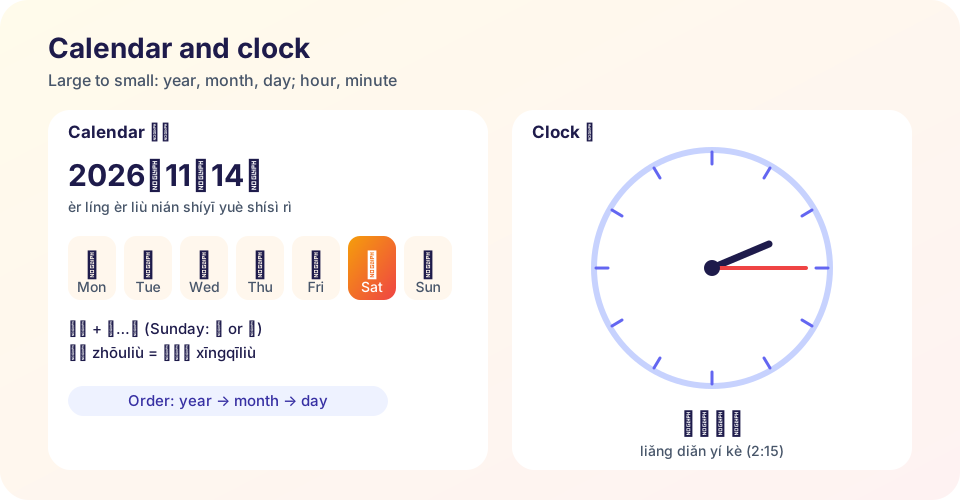
A year is read digit by digit and followed by 年: 2026 is 二零二六年 (èr líng èr liù nián). A month is the number plus 月 (yuè, which also means "moon"): 一月 (yī yuè) is January, 十二月 (shí'èr yuè) is December. A day is the number plus 号 in speech or 日 in writing: 十四号 (shísì hào) is the 14th.
The order is year, month, day, which is the same logic as an ISO date. For November 14, 2026:
| Part | Chinese | Pinyin |
|---|---|---|
| Year | 二零二六年 | èr líng èr liù nián |
| Month | 十一月 | shíyī yuè |
| Day | 十四号 (日) | shísì hào (rì) |
| Full date | 二零二六年十一月十四日 | èr líng èr liù nián shíyī yuè shísì rì |
The questions use 几 (jǐ), "how many" for a small number: 今天几月几号? (Jīntiān jǐ yuè jǐ hào?) "What is today's date?" 你的生日是几月几号? (Nǐ de shēngrì shì jǐ yuè jǐ hào?) "When is your birthday?"
The week
Weekdays are 星期 plus a number: 星期一 (xīngqī yī) is Monday, 星期二 Tuesday, up to 星期六 (xīngqī liù) Saturday. Sunday breaks the pattern: 星期日 (xīngqī rì), more often 星期天 (xīngqī tiān). A shorter form with 周 (zhōu) works the same: 周一, 周六. To ask which day: 今天星期几? (Jīntiān xīngqī jǐ?).
Relative time words
| Chinese | Pinyin | Meaning |
|---|---|---|
| 前天 / 昨天 | qiántiān / zuótiān | the day before yesterday / yesterday |
| 今天 | jīntiān | today |
| 明天 / 后天 | míngtiān / hòutiān | tomorrow / the day after tomorrow |
| 去年 / 今年 / 明年 | qùnián / jīnnián / míngnián | last year / this year / next year |
| 上个月 / 这个月 / 下个月 | shàng ge yuè / zhège yuè / xià ge yuè | last / this / next month |
| 上周 / 这周 / 下周 | shàng zhōu / zhè zhōu / xià zhōu | last / this / next week |
| 早上 / 上午 / 中午 | zǎoshang / shàngwǔ / zhōngwǔ | early morning / morning / noon |
| 下午 / 晚上 / 半夜 | xiàwǔ / wǎnshang / bànyè | afternoon / evening / midnight |
Notice 上 (shàng, "up, previous") and 下 (xià, "down, next"): last month is "up month", next month is "down month". The pattern 上 / 下 + (个) + unit works for weeks, months and even 上次 (last time) and 下次 (next time).
Telling the time
The hour is a number plus 点 (diǎn). For 2 o'clock, say 两点 (liǎng diǎn), with 两, not 二. Minutes add 分 (fēn).
| Time | Formal | Colloquial | Pinyin (colloquial) |
|---|---|---|---|
| 2:00 | 两点整 | 两点 | liǎng diǎn |
| 2:05 | 两点零五分 | 两点零五分 | liǎng diǎn líng wǔ fēn |
| 2:15 | 两点十五分 | 两点一刻 | liǎng diǎn yí kè |
| 2:30 | 两点三十分 | 两点半 | liǎng diǎn bàn |
| 2:45 | 两点四十五分 | 两点三刻 / 差一刻三点 | liǎng diǎn sān kè / chà yí kè sān diǎn |
| 2:55 | 两点五十五分 | 差五分三点 | chà wǔ fēn sān diǎn |
Key points:
刻counts fifteen-minute quarters: 一刻 is 15, 三刻 is 45. (二刻 is rarely used; say 半.)差(chà) means "short of":差五分三点is "five minutes short of three". It is the natural way to say 2:55.- For minutes from 1 to 9, say
零(líng) for the empty tens place: 2:05 is两点零五分. - Full words for parts of the day come first:
下午两点is 2 p.m.,晚上八点半is 8:30 in the evening. - 24-hour time (
十四点, 14:00) is common in timetables and official announcements. In conversation, people use the 12-hour clock with a part-of-day word.
Questions: 现在几点? (Xiànzài jǐ diǎn?) "What time is it?" and 几点…? for events: 你几点起床? "What time do you get up?"
Where time words go
Time words describe when, so they come before the verb. They sit either at the start of the sentence or right after the subject:
明天我去学校。(Míngtiān wǒ qù xuéxiào.) "Tomorrow I go to school."我明天去学校。(Wǒ míngtiān qù xuéxiào.) Same meaning, slightly less emphasis on tomorrow.
If you have several time words, go from big to small: 我明天下午三点去学校。 (Wǒ míngtiān xiàwǔ sān diǎn qù xuéxiào.) "I go to school tomorrow afternoon at three." The time must not be placed after the verb as in English ("I go to school tomorrow") - that is a very common learner error. Compare:
| English order (wrong) | Chinese order (right) |
|---|---|
| 我去学校明天。 | 我明天去学校。 |
| 我起床七点。 | 我七点起床。 |
Daily routine verbs: 起床 (qǐchuáng, get up), 吃早饭 (chī zǎofàn, have breakfast), 上班 (shàngbān, go to work), 上课 (shàngkè, attend class), 下班 (xiàbān, finish work), 睡觉 (shuìjiào, sleep). A sample day: 我早上七点起床,八点上班,晚上十一点睡觉。 (Wǒ zǎoshang qī diǎn qǐchuáng, bā diǎn shàngbān, wǎnshang shíyī diǎn shuìjiào.)
A day in Chinese: schedules and timetables
Put the pieces together by describing a typical day. Notice that each line uses a time word before the verb, and that the hour comes from the 12-hour clock with a part-of-day word.
| Time | Chinese | Pinyin | Meaning |
|---|---|---|---|
| 7:00 | 早上七点起床 | Zǎoshang qī diǎn qǐchuáng | get up at 7 a.m. |
| 8:30 | 八点半上班 | Bā diǎn bàn shàngbān | start work at 8:30 |
| 12:15 | 中午十二点一刻吃午饭 | Zhōngwǔ shí'èr diǎn yí kè chī wǔfàn | have lunch at 12:15 |
| 18:00 | 下午六点下班 | Xiàwǔ liù diǎn xiàbān | finish work at 6 p.m. |
| 23:00 | 晚上十一点睡觉 | Wǎnshang shíyī diǎn shuìjiào | go to sleep at 11 p.m. |
On a train or flight timetable you will often see the 24-hour clock written with a colon, such as 14:30. Read it as 十四点三十分 (shísì diǎn sānshí fēn) in formal announcements. In conversation, people convert it: 下午两点半. When you plan to meet someone, say both the day and the time, from big to small, and then repeat it back to confirm: 星期六下午三点,对吗? (Xīngqī liù xiàwǔ sān diǎn, duì ma?) "Saturday at three in the afternoon, right?" This habit prevents most misunderstandings, in any language.
Common misconceptions
"The time goes after the verb." In Chinese the time word comes before the verb: 我七点起床.
"Say 二点 for 2 o'clock." The correct form is 两点 (liǎng diǎn). 二 is for counting and for digits in numbers, not for the hour of two.
"Sunday is 星期七." Sunday is 星期日 or 星期天, never 星期七.
"There is one correct way to say 2:45." Three forms are all normal: 两点四十五分, 两点三刻 and 差一刻三点. Learn to recognize all of them and pick whichever feels natural.
Try it
Press Run (or Ctrl + Enter) to see the result here.
Program input · what you'd type while the program runs
Type the answers before you press Run, one per line. Each time the program reads a line (with input()), it gets the next line from this box.
Press Run (or Ctrl + Enter) to see the console output here.
No output.
Check your understanding
Quick check · 5 questions
of 5 answered You scored / 5 · perfect!
-
1. How do you say 2:00?
The hour two is 两点 (liǎng diǎn). -
2. What does 三点半 mean?
半 (bàn) means half, so 三点半 is half past three. -
3. Which sentence has the right word order?
Time words go before the verb: subject + time + verb. -
4. How do you say 'next month'?
下 means next: 下个月 (xià ge yuè). -
5. How is the date 3 May written in order?
Chinese runs from large to small: month, then day (五月三号).
Summary
- Dates run year → month → day; speak 号, write 日; weekdays are 星期 + number (Sunday is 日 or 天).
- Telling time: 点 for the hour (两点), 分 for minutes, 刻 for quarters, 半 for half, 差 for "short of".
- Time words come before the verb, either at the start of the sentence or after the subject, big unit first.
- 上 means last or previous; 下 means next.
Track your progress
Create a free account to tick off lessons and pick up where you left off on any device.
of Mandarin Chinese for Beginners lessons completed