


















Lesson 32 of 44 · Reading Characters
Phonetic-Semantic Compounds: Meaning plus Sound
Learn how most Chinese characters combine a meaning radical and a sound part, with the 青, 马, 包 and 方 families, how reliable sound clues are, and a decoder tool.
If someone told you that most Chinese characters contain a clue to how they sound, you might not believe it. Chinese is famous for not being phonetic. Yet the idea is true, with an important qualification: the clue is approximate. A large majority of characters, often estimated at around four fifths, are built from one part that hints at the meaning and another part that hints at the sound. These are called phonetic-semantic compounds (形声字, xíngshēngzì). Learning to spot the two parts is the biggest single shortcut for reading, and it makes new characters far less random.
What you will learn
- How a character is split into a meaning part and a sound part.
- Several families of characters that share a sound part.
- How reliable the sound clue is, and how to use it without overtrusting it.
- Why homophones such as 他, 她 and 它 are written differently.
Key terms
形声字 (xíngshēngzì): phonetic-semantic compound; "form + sound" character.
声旁 (shēngpáng): the sound component.
形旁 (xíngpáng): the meaning (form) component, usually the radical.
同音字 (tóngyīnzì): homophone, a character pronounced the same as another.
The 青 family
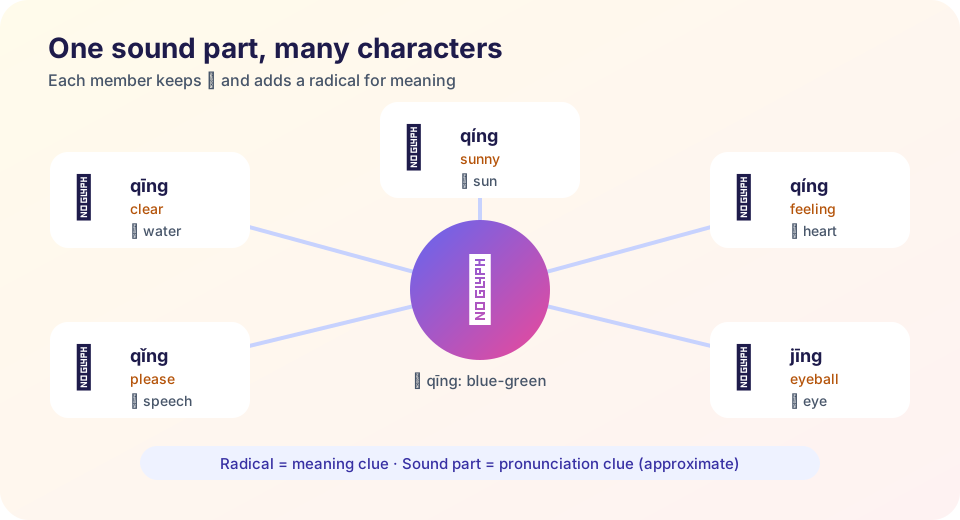
Look at the picture above. The character 青 (qīng) means blue-green. It reappears inside five other characters that all sound similar:
| Character | Pinyin | Meaning | Meaning part | Sound part |
|---|---|---|---|---|
| 清 | qīng | clear (water) | 氵 water | 青 |
| 请 | qǐng | please, to request | 讠 speech | 青 |
| 晴 | qíng | sunny | 日 sun | 青 |
| 情 | qíng | feeling, emotion | 忄 heart | 青 |
| 睛 | jīng | eyeball (as in 眼睛) | 目 eye | 青 |
Each character is built the same way: the left part tells you the category (water, speech, sun, heart, eye), and 青 gives you a sound close to qing. Once you recognize the pattern, you can look at a new character such as 清 and think: "water radical, sounds like 青: probably qīng, something to do with water". And that is the right answer.
Notice that the match is not exact. The tones differ (qīng, qǐng, qíng), and 睛 even changed its initial from q to j. That is normal. Spoken Chinese has changed over three thousand years, while the written form has stayed fairly stable, so the sound clue is a hint, not a guarantee.
The 马 family
马 (mǎ) means horse. The same pattern appears with a different set of radicals:
| Character | Pinyin | Meaning | Meaning part | Sound part |
|---|---|---|---|---|
| 妈 | mā | mom | 女 woman | 马 mǎ |
| 吗 | ma | question particle | 口 mouth | 马 mǎ |
| 骂 | mà | to scold | 口 mouth (two of them) | 马 mǎ |
| 码 | mǎ | code, number (as in 号码) | 石 stone | 马 mǎ |
Notice how these four sound alike: mā, ma, mà, mǎ. In each case 马 provides the syllable ma and the tone varies. This is the commonest kind of match: the syllable is shared, the tone often is not.
More families to recognize
| Sound part | Members |
|---|---|
| 包 bāo | 抱 bào (hug, 扌), 跑 pǎo (run, 足), 饱 bǎo (full, 饣), 泡 pào (soak, 氵) |
| 方 fāng | 房 fáng (house, 户), 访 fǎng (visit, 讠), 放 fàng (put, release, 攵), 防 fáng (guard, 阝) |
| 可 kě | 河 hé (river, 氵), 何 hé (what, 亻) |
| 门 mén | 们 men (plural marker for people, 亻): 我们, 你们, 他们 |
You will recognize many of these characters from earlier chapters: 们 in 我们, 河 in rivers on maps, 房 in 房间 (room) and 放 in 放心 ("don't worry").
How reliable is the sound clue?
Think of four levels of match:
- Same sound, same tone:
清and青(qīng),码and马(mǎ). - Same syllable, different tone:
请(qǐng) and青(qīng);妈(mā) and马(mǎ). - Similar: the finals match but the initials differ (
睛jīng with青qīng,跑pǎo with包bāo,河hé with可kě). - Different: the clue no longer helps (this happens in some older characters).
Level 2 is the most common. So the rule of thumb is: the sound part gives you the syllable, and you learn the tone from the word itself. Always check the pinyin of a new character in a dictionary or app. The sound clue is there to help you remember, not to replace checking.
Homophones: 他, 她, 它
Chinese has many characters that sound the same (homophones). They are distinguished in writing by their radical, so a reader can tell them apart even when spoken forms are identical. The classic example is 他, 她 and 它, all pronounced tā: 他 (亻, person) means "he", 她 (女, woman) means "she", and 它 (宀) means "it". Another common pair: 在 (zài, to be at) and 再 (zài, again). In speech, only context tells you which one is meant.
Three worked examples
Put the idea to work on characters you might meet for the first time.
饱 (bǎo, full). Split it into 饣 (food) and 包 (bāo). The radical says "to do with food or eating". The sound part says "something like bao". Together: "food" plus "bao" gives 饱, to be full from eating. The tone is bǎo, not bāo, so the tone is learned from the word 吃饱了 (chī bǎo le, "I'm full").
情 (qíng, feeling). Split into 忄 (heart) and 青 (qīng). Heart means feelings, emotions; the sound clue is qing. It appears in words such as 感情 (gǎnqíng, affection) and 事情 (shìqing, matter, thing). Notice that you could have guessed both the category and the pronunciation.
房 (fáng, house). Split into 户 (a door, an old word for household) and 方 (fāng). The radical hints at buildings or houses; 方 suggests fang. In 房间 (fángjiān, room) and 房子 (fángzi, house) you will use it again. Combined with 间 it means a room.
The same three steps apply each time: find the meaning part, find the sound part, and then check the exact tone in a dictionary. After a few weeks you will do the first two steps instantly.
Why do sound clues drift?
The sound parts were chosen thousands of years ago, when Chinese was pronounced differently from today's Mandarin. Over the centuries, the pronunciation of spoken Chinese changed, while the written characters stayed almost the same. As a result, a sound part that matched perfectly once can match only roughly today. That is why you see exact matches (清 and 青), tone differences (请 and 青) and similar matches (睛 and 青) in the same family. Other varieties of Chinese sometimes preserve a closer match than Mandarin does for a particular character. Do not expect to predict pronunciation perfectly; expect the clue to help you remember, and always check.
Common misconceptions
"Chinese characters tell you nothing about pronunciation." Most characters have a sound part, though the clue is approximate.
"If the sound part is 青, the character is always qīng." It is similar, and the tone often differs. Check each new character.
"The meaning part gives the whole meaning." It gives the category (water, speech, heart); the sound part carries no meaning at all in these compounds.
"I can ignore tones if I know the sound clue." The clue gives the syllable. The tone has to be learned with the word.
Try it
Press Run (or Ctrl + Enter) to see the result here.
Program input · what you'd type while the program runs
Type the answers before you press Run, one per line. Each time the program reads a line (with input()), it gets the next line from this box.
Check your understanding
Quick check · 5 questions
of 5 answered You scored / 5 · perfect!
-
1. In 清, which part gives the sound?
氵 (water) is the meaning part; 青 (qīng) is the sound part. -
2. Which of these characters has the water radical?
清 has 氵; 请 has 讠 (speech) and 晴 has 日 (sun). -
3. How reliable is the sound clue?
Sound parts usually give the syllable, but tones and initials often differ. -
4. Why are 他, 她 and 它 written differently?
All are tā, but 亻, 女 and 宀 make the meaning (he, she, it) clear in writing. -
5. In 妈 (mā), which part hints at 'mom'?
女 is the meaning part (woman); 马 gives the sound ma.
Summary
- Most characters are phonetic-semantic compounds: a meaning part (usually the radical) plus a sound part.
- Families such as 青 (清 请 晴 情 睛) and 马 (妈 吗 骂 码) share a sound part.
- The sound part usually gives the syllable; the tone and sometimes the initial can differ, so always check.
- Homophones like 他 / 她 / 它 and 在 / 再 are distinguished by their written form.
Next: Signs, menus and apps
Track your progress
Create a free account to tick off lessons and pick up where you left off on any device.
of Mandarin Chinese for Beginners lessons completed