


















Lesson 5 of 44 · Pinyin, Tones and Greetings
Chapter 2 overview: the sound system of Mandarin
A big-picture tour of Mandarin pronunciation: how a pinyin syllable is built from an initial, a final and a tone, and what this chapter covers.
Mandarin sounds are the gateway to everything else. If you can say a word correctly, you can remember it, hear it and use it in conversation. If you cannot, even simple words fail to land. The good news is that the Mandarin sound system is small and very regular. You will learn it in four lessons, and after that you can pronounce any word you can read in pinyin.
What you will learn
- how every Mandarin syllable is built: initial, final, tone
- why tones matter and how many sounds Mandarin really has
- what each lesson in this chapter covers
- how the sounds are described in this course (mouth position, respelling and IPA)
Key terms
Initial (声母, shēngmǔ) is the consonant that begins a syllable, such as b, zh or x. Some syllables have none.
Final (韵母, yùnmǔ) is the rest of the syllable: a vowel or vowel group, possibly followed by n or ng.
Tone (声调, shēngdiào) is the pitch pattern. There are four tones plus the neutral tone.
Syllable (音节, yīnjié) is one unit of sound, written in pinyin and usually matching one character.
A small, regular system
English has thousands of different syllables. Mandarin has far fewer: roughly 400 distinct syllables when you ignore tones, and about 1,300 when you count the tones. That sounds like a small inventory, and it is. The result is that many different words share the same sound, so context and tones do a lot of work.
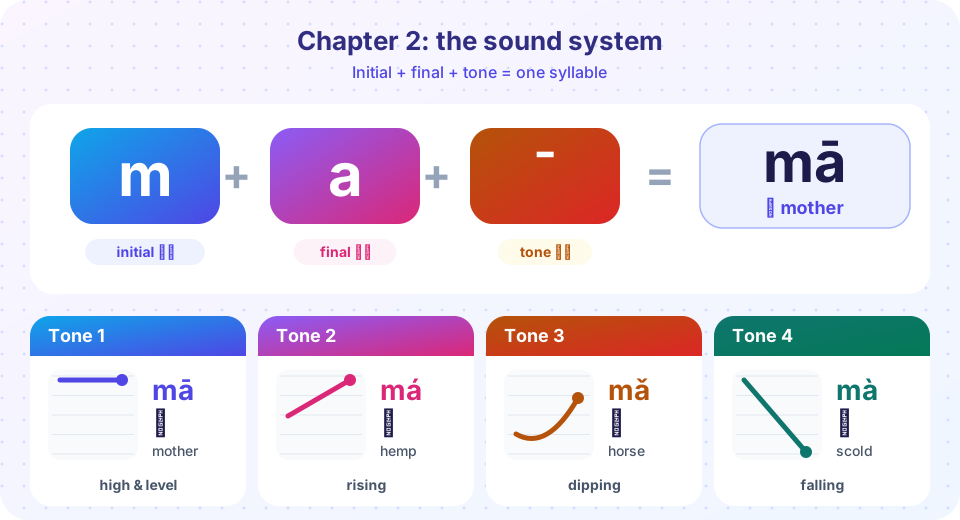
A syllable is built from up to three parts:
- an optional initial, a consonant such as m
- a final, which includes the vowel, such as a
- a tone, the pitch pattern, marked above the vowel: ā á ǎ à
Put them together and you get mā (妈, mother). Change only the tone and you get má (麻, hemp), mǎ (马, horse) or mà (骂, to scold). The tone is not decoration. It is part of the word, as real as the vowel.
Step 1: the initial
Some syllables start with a vowel.
Step 2: the final
Step 3: the tone
Step 4: use it
The last lesson gives you real phrases.
What this chapter covers
The chapter has five lessons, and each builds on the one before.
- This overview. The big picture of how a syllable works.
- The pinyin initials and finals. The 21 initials and the finals, with mouth positions, respelling, IPA and the spelling rules for y, w and ü.
- Tones and tone changes. The four tones, the neutral tone and the rules for how tones change in speech: the third tone before another third tone, 不 and 一.
- Greetings and politeness. Your first real conversation: hello, how are you, thanks, sorry, goodbye and introducing yourself.
- Chapter 2 review. One page that holds all the rules, and a quiz covering the whole chapter.
How sounds are written in this course
You cannot hear this page, so each sound is explained in up to three ways. A mouth description says where the tongue and lips go. A respelling uses English letters to approximate the sound, such as "xiè ≈ shyeh". The respelling is a rough guide and never exact. IPA (the International Phonetic Alphabet) appears in square brackets, such as [tɕʰ], for learners who know it and as a precise reference for everyone else. If IPA is new to you, ignore it at first. The names of the sounds and the examples are enough.
Whatever you read, say it aloud. If you can, record yourself and compare with a real Mandarin speaker or a reliable audio dictionary.
Common misconceptions
"Pinyin letters sound like English letters." Many do, but some are different traps. For example, q sounds like a "ch" (with a puff of air), x sounds like a soft "sh", z sounds like "ds" in "adds" and c like "ts" in "cats". The next lesson sorts them out.
"Tones are just emotion or emphasis." In English, a rising pitch signals a question. In Mandarin, the tone belongs to the word. Mā and mǎ are different words, whatever the speaker feels.
"I will pick up tones later." The earlier you learn tones along with each word, the easier it is. Learners who leave tones for later often have to relearn everything.
Try it
First, a syllable builder. Choose an initial, a final and a tone, and the tool writes the pinyin and, when it knows a common word for it, shows the character and meaning. Spend a minute switching only the tone and watch how the meaning changes.
Second, a Python table of syllables that differ only by tone. Read each row aloud: same letters, four different words.
Press Run (or Ctrl + Enter) to see the result here.
Program input · what you'd type while the program runs
Type the answers before you press Run, one per line. Each time the program reads a line (with input()), it gets the next line from this box.
Check your understanding
Quick check · 5 questions
of 5 answered You scored / 5 · perfect!
-
1. What are the three parts of a Mandarin syllable?
A syllable has an optional initial, a final (including the vowel) and a tone. -
2. What is the difference between mǎ and mà?
The tone is part of the word. Changing it changes the meaning. -
3. About how many different syllables does Mandarin have when tones are ignored?
Mandarin has roughly 400 base syllables, or about 1,300 with tones. That is why homophones are common. -
4. Which one is a final?
zh and b are initials; ang is a final (vowel plus ng). -
5. Why does this course give IPA in square brackets?
IPA gives a precise symbol for each sound. It is optional help beside mouth descriptions and English respellings.
Summary
- Every syllable is an optional initial, a final and a tone.
- Mandarin has about 400 syllables, about 1,300 with tones, so tones matter for meaning.
- The chapter teaches initials and finals, then tones and tone changes, then real greetings, then a review.
- Say everything aloud; respellings and IPA are guides, not substitutes for listening.
Track your progress
Create a free account to tick off lessons and pick up where you left off on any device.
of Mandarin Chinese for Beginners lessons completed