


















Lesson 46 of 46 · Projects and Practice
Further study: where to go after fluid dynamics
Plan your next steps after the fluid dynamics course: advanced topics, related tutorials on this site, project ideas and a self-assessment to find your weak spots.
You now have a working picture of fluid dynamics: the equations, ideal and viscous flow, turbulence, waves, instabilities and computation. This final lesson shows what lies beyond, how the course connects to the other tutorials on this site, and how to decide what to study next.
What you will learn
- Which advanced topics build on each chapter.
- Which tutorials on this site pair well with this one.
- How to choose a project that fits your goals.
- How to find the chapters you should revisit.
Key terms
- Specialization: a narrower field built on the core ideas, such as aerodynamics or combustion.
- Research literature: journals and conference papers where new results appear first.
- Capstone project: a larger project that combines several topics.
Topics that build on each chapter
| Chapter | What to study next |
|---|---|
| Viscous flow and boundary layers | Boundary layers with pressure gradients (Falkner-Skan), integral methods, transition and stability theory, heat transfer in boundary layers |
| Turbulence | Wall-bounded turbulence structures, large-eddy simulation, spectral methods, turbulent mixing, stratified turbulence |
| Waves and instabilities | Nonlinear waves and solitons, internal waves, wave-current interaction, hydrodynamic stability (Orr-Sommerfeld), pattern formation |
| Computational fluid dynamics | Finite-volume methods, pressure-velocity coupling, turbulence modeling in practice, high-order and spectral methods, mesh generation, parallel computing |
Several important areas are not covered by this course and are worth knowing about: compressible flow and shock waves, non-Newtonian fluids, multiphase flow, combustion and reacting flow, rarefied gases, and magnetohydrodynamics.
Related tutorials on this site
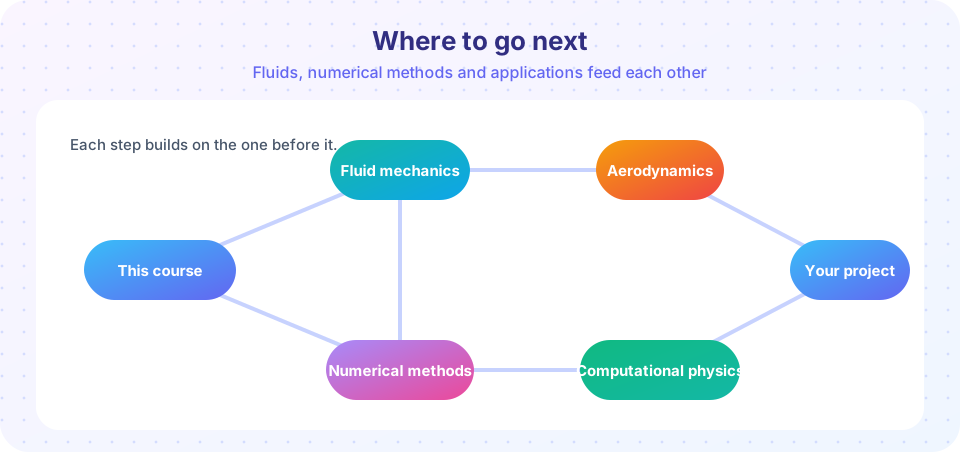
Fluid dynamics rests on mathematics and connects to many applications. These tracks fit naturally:
- Fluid mechanics: a more introductory treatment of statics, Bernoulli's equation and pipe flow, useful if any chapter here felt too fast.
- Aerodynamics: lift, drag, airfoils and compressible flow around aircraft.
- Numerical methods: the numerical techniques behind CFD, including root finding, linear systems and integration of ODEs.
- Differential equations: the mathematics of the model equations in this course.
- Computational physics: simulation methods for physical systems, including many that parallel CFD.
- Multivariable calculus: gradients, divergence and curl, the language of the conservation laws.
- Engineering thermodynamics: the energy side of flows with heat and compression.
Project ideas
- Vortex shedding. Extend the cavity solver to flow past a square or circular obstacle and measure the Strouhal number.
- Boundary-layer integral method. Implement the Thwaites method for a given outer velocity and predict separation.
- Shallow-water simulator. Solve the shallow-water equations in one dimension with an upwind scheme and watch a dam break.
- Turbulence statistics. Generate a synthetic velocity field with a
-5/3spectrum and compute structure functions. - Convection onset. Write a linear-stability code for Rayleigh-Bénard convection and recover
Ra_c = 1708.
Choose a project that is a little beyond comfortable: you should have to look something up, but not be lost.
Common misconceptions
- "I must finish all the theory before simulating." Simulation is a way to learn theory. Run small cases early and read more when something surprises you.
- "Software packages make theory unnecessary." Software returns numbers for any input. Knowing the theory is how you notice when the numbers are wrong.
Try it
Press Run (or Ctrl + Enter) to see the result here.
Program input · what you'd type while the program runs
Type the answers before you press Run, one per line. Each time the program reads a line (with input()), it gets the next line from this box.
Press Run (or Ctrl + Enter) to see the console output here.
No output.
Check your understanding
Quick check · 3 questions
of 3 answered You scored / 3 · perfect!
-
1. Which topic is NOT covered by this course?
Compressible flow and shocks are important topics that lie beyond the scope of this course. -
2. Which track on this site is the best next step for the numerical side of CFD?
Numerical methods covers root finding, linear systems and ODE integration, which are used in CFD solvers. -
3. Why simulate early when learning theory?
Small experiments with code connect equations to behavior and show where understanding is missing.
Summary
- Each chapter has natural continuations: boundary-layer theory, large-eddy simulation, hydrodynamic stability and finite-volume methods.
- Related tracks on this site cover mathematics, numerical methods and applications.
- Choose a project slightly beyond your comfort zone and check it against exact results.
Next: Back to the course page
Track your progress
Create a free account to tick off lessons and pick up where you left off on any device.
of Fluid Dynamics lessons completed