


















Lesson 32 of 46 · Turbulence
Chapter 6 review: turbulence
Review Reynolds averaging, the Kolmogorov cascade and the law of the wall with a summary picture, recap table, two practice tools and a ten-question quiz.
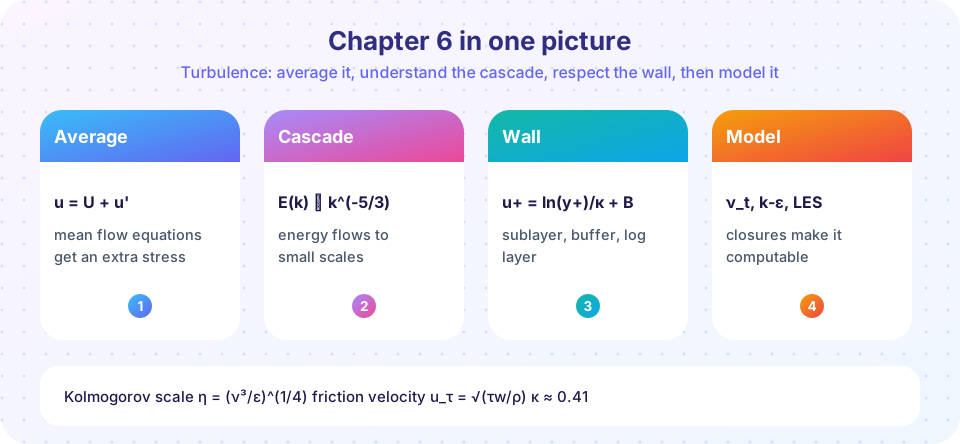
Turbulence resists exact solution, yet the chapter has given you a working toolkit: averaging to find the mean flow, the cascade to understand the scales, and wall units to understand friction. This review pulls the pieces into one picture.
Recap
| Lesson | Key results |
|---|---|
| Overview | Transition near Re ≈ 2,300 in pipes; turbulent friction exceeds laminar; mixing is fast |
| Reynolds averaging | u = U + u'; Reynolds stress -ρ<u'v'>; closure problem; `ν_t = l² |
| Energy cascade | η = (ν³/ε)^(1/4); ε ~ u'³/L; E(k) ∝ k^(-5/3); L/η ~ Re^(3/4); DNS cost ~ Re^(9/4) points |
| Law of the wall | u_τ = √(τw/ρ); u+ = y+ for y+ < 5; log law κ ≈ 0.41, B ≈ 5.2; Prandtl and Blasius friction |
How the ideas connect
The mean flow feeds energy to large eddies; the cascade hands it down; the dissipation rate ε appears in the k-ε model and sets the Kolmogorov scale. Near a wall, the same eddies are squeezed, which is why the wall layer needs its own scaling. A good turbulence model has to get all three right: the Reynolds stress in the core, the dissipation, and the wall layer.
Common misconceptions
- "If I average, I lose all the physics." The Reynolds stress retains the effect of the eddies on the mean flow, but you must model it.
- "More resolution always fixes a RANS simulation." A finer grid only converges to the model's own answer, which can still be wrong.
Try it
Press Run (or Ctrl + Enter) to see the result here.
Program input · what you'd type while the program runs
Type the answers before you press Run, one per line. Each time the program reads a line (with input()), it gets the next line from this box.
Press Run (or Ctrl + Enter) to see the console output here.
No output.
Check your understanding
Quick check · 9 questions
of 9 answered You scored / 9 · perfect!
-
1. What is the purpose of Reynolds averaging?
Averaging yields equations for mean quantities, at the price of an unknown Reynolds stress. -
2. Which statement about the Reynolds stress is correct?
The Reynolds stress is the mean momentum flux carried by the velocity fluctuations. -
3. Kolmogorov's length scale η is given by:
η = (ν³/ε)^(1/4), the only length built from ν and ε. -
4. The inertial-range spectrum has slope:
E(k) ∝ k^(-5/3). -
5. If Re_L rises by 10⁴ (a factor of ten thousand), by what factor does L/η rise?
L/η ~ Re^(3/4), and (10⁴)^(3/4) = 10³. -
6. Which range of y+ is the viscous sublayer?
For y+ below about 5 the mean profile is u+ = y+. -
7. Which quantity is the von Karman constant, approximately?
κ ≈ 0.41 appears in the log law. 0.09 is C_μ of k-ε and 1.5 is the Kolmogorov constant. -
8. For a smooth pipe at Re = 10⁵, which friction factor is closest to the correct value?
Both Blasius and Prandtl laws give f ≈ 0.018 at Re = 10⁵. -
9. Why do DNS costs grow so quickly with Re?
Resolving η in three dimensions requires about Re^(9/4) points, and more time steps are needed.
Summary
- Averaging gives mean equations plus a Reynolds stress that needs a closure model.
- The cascade passes energy to the Kolmogorov scale with an inertial
-5/3spectrum. - Wall units and the log law organize near-wall flow and give pipe friction.
- Chapter 7 turns to waves and the instabilities that start flows moving toward turbulence.
Track your progress
Create a free account to tick off lessons and pick up where you left off on any device.
of Fluid Dynamics lessons completed