


















Lesson 4 of 46 · Getting Started
Chapter 1 Review: Getting Started
Review chapter 1 of Fluid Dynamics: the six flow questions, the Reynolds number, dynamic similarity and other dimensionless numbers, with a nine-question quiz.
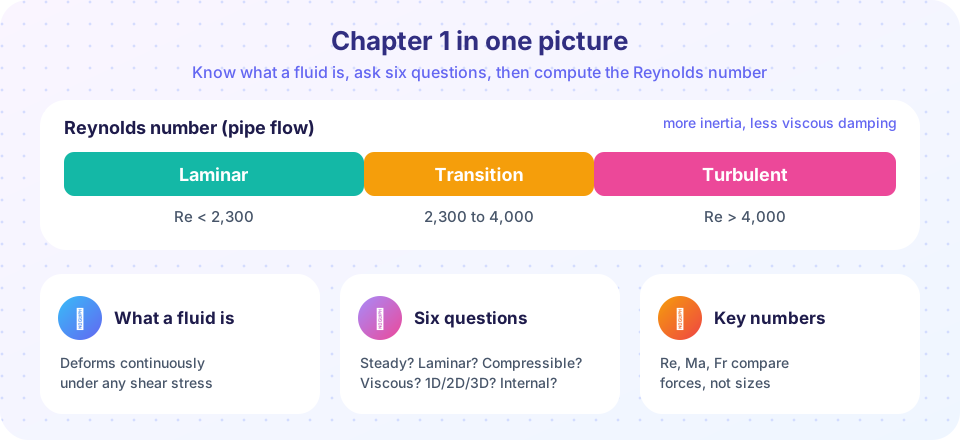
Chapter 1 gave you the vocabulary and the first tool of the subject. Before you move on to velocity fields and derivatives, make sure the picture below is clear in your mind. It shows the three ideas of the chapter: what a fluid is, the six questions, and the Reynolds number as a bar that runs from smooth to turbulent.
What you will learn
- A compact recap of the vocabulary of flow.
- How the Reynolds number ties the chapter together.
- Where to revisit if a quiz question surprises you.
Recap table
| Idea | Key statement | Where |
|---|---|---|
| Fluid | deforms continuously under any shear stress | Course map |
| Steady / unsteady | steady: nothing changes with time at a point | Flow around us |
| Laminar / turbulent | smooth layers versus eddies and mixing | Flow around us |
| Compressible | density changes matter when Mach is above about 0.3 | Flow around us |
| Reynolds number | Re = ρVL/μ, inertia over viscosity |
Reynolds number |
| Pipe thresholds | laminar below 2,300; turbulent above 4,000 | Reynolds number |
| Similarity | same dimensionless numbers give same flow pattern | Reynolds number |
| Other numbers | Mach V/a, Froude V/√(gL), Strouhal fL/V, Weber |
Reynolds number |
Key terms
Characteristic scales: the speed V and length L you pick to describe a flow. Every dimensionless number uses them.
Critical Reynolds number: the value at which laminar flow becomes unstable; for pipes about 2,300.
Kinematic viscosity ν = μ/ρ: the quantity that sets how quickly momentum spreads through a fluid.
Common misconceptions
"Water is thicker than air, so it must have a higher Reynolds number." At the same speed and size, water has a Reynolds number about 15 times larger than air because its kinematic viscosity is about 15 times smaller (1.0×10⁻⁶ against 1.5×10⁻⁵ m²/s).
"A flow is either laminar or turbulent." Real flows can be laminar in one part (the front of a wing) and turbulent in another (its rear), and transitional flows flicker between the two.
Try it
Compute the Reynolds numbers for the same flow in water and in air to confirm the factor of 15 in the misconception above.
Press Run (or Ctrl + Enter) to see the console output here.
No output.
A second plot shows how Re changes with speed for three fluids in a 1 cm pipe, with the laminar and turbulent zones shaded.
Press Run (or Ctrl + Enter) to see the result here.
Program input · what you'd type while the program runs
Type the answers before you press Run, one per line. Each time the program reads a line (with input()), it gets the next line from this box.
Check your understanding
Quick check · 9 questions
of 9 answered You scored / 9 · perfect!
-
1. Which of the following defines a fluid?
Continuous deformation under shear stress is the defining property; compressibility and viscosity are other properties. -
2. A flow is steady when
Steady refers to time independence at each point. Fluid particles can still accelerate, for example in a nozzle. -
3. Which Reynolds-number range corresponds to turbulent pipe flow?
Pipe flow is turbulent above about 4,000; 2,300 to 4,000 is the transition zone. -
4. Which pair of quantities does the Reynolds number compare?
Re is the ratio of inertial to viscous forces. -
5. Air at 20 degrees C has nu = 1.5e-5 m2/s. For D = 0.03 m, what speed gives Re = 2,300?
V = 2300 x 1.5e-5 / 0.03 = 1.15 m/s. -
6. Why is the Mach-number limit of 0.3 useful?
At Mach 0.3 the density change is about 5 percent, so below it the incompressible approximation is normally fine. -
7. The Froude number is most important for
Fr = V / sqrt(g L) compares inertia and gravity; it governs ships, rivers and waves. -
8. Which statement about dynamic similarity is true?
Geometric similarity plus matching dimensionless numbers gives the same dimensionless flow pattern at any scale. -
9. A cylinder of diameter 5 mm sheds vortices at 100 Hz. With St = 0.2, what is the flow speed?
V = f D / St = 100 x 0.005 / 0.2 = 2.5 m/s.
Summary
- Classify flows with six questions; most are answered by two numbers,
ReandMa. - Pipe flow: laminar below 2,300, turbulent above 4,000; always quote the length scale used.
- Dynamic similarity makes scale models informative, as long as every important dimensionless number is matched.
- Other numbers (Froude, Strouhal, Weber) measure other competitions between forces.
Track your progress
Create a free account to tick off lessons and pick up where you left off on any device.
of Fluid Dynamics lessons completed