


















Lesson 26 of 46 · Viscous Flow and Boundary Layers
Separation, drag and the Reynolds number
Understand why boundary layers separate in rising pressure, how friction and pressure drag add up, and how drag coefficients of spheres and cylinders change with Re.
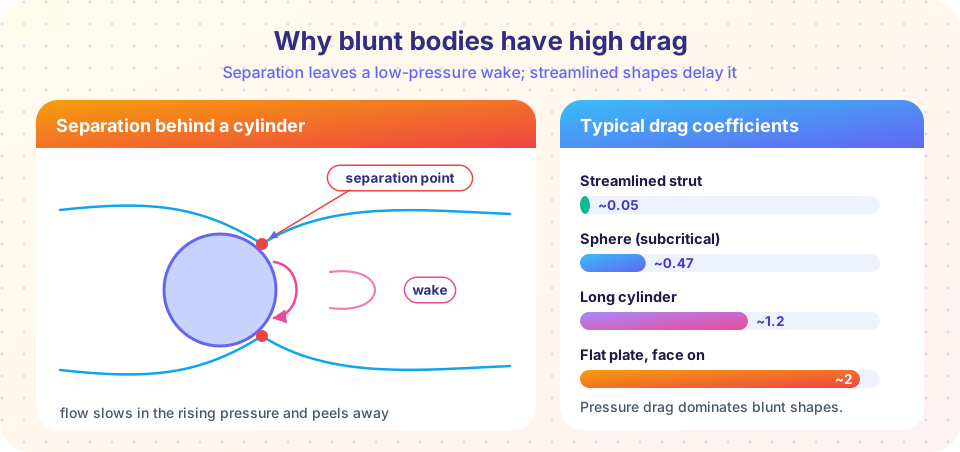
The flat plate is a clean test case, but real bodies are curved. On a curved body the outer flow speeds up and slows down, so the pressure is not constant along the surface. That changes the boundary layer completely. If the pressure rises in the flow direction, the slow fluid near the wall can be brought to rest and pushed backward. The layer then leaves the surface: it separates. Separation is the reason a parachute works, a stalled wing loses lift, and a blunt cylinder has so much more drag than a streamlined strut of the same width.
What you will learn
- Why a rising pressure along the wall (an adverse pressure gradient) leads to separation.
- The difference between friction drag and pressure (form) drag, and the drag coefficient.
- How the drag of spheres and cylinders depends on
Re, including the drag crisis. - How to estimate a terminal velocity from a drag law.
Key terms
- Adverse pressure gradient: pressure increasing in the flow direction,
dp/dx > 0. - Separation point: where the wall shear stress becomes zero,
∂u/∂y = 0aty = 0. - Pressure (form) drag: drag from the pressure difference between front and back of a body.
- Friction (skin) drag: drag from shear stress at the surface.
- Drag coefficient:
C_D = D / (½ ρ U² A), withAa reference area (usually the frontal area).
Why the layer separates
Just outside the boundary layer the flow is ideal, and Bernoulli's equation relates its speed U(x) to the pressure: dp/dx = -ρ U dU/dx. On the front half of a cylinder the outer flow speeds up (dU/dx > 0), so the pressure falls and pushes the layer along. On the rear half the outer flow slows down, so the pressure rises. The fluid near the wall has little momentum, and it cannot climb the pressure hill.
The momentum equation evaluated at the wall, where u = v = 0, gives a powerful hint:
μ ∂²u/∂y² |wall = dp/dx
With a favorable gradient (dp/dx < 0) the profile curves toward the stream and is full and stable. With an adverse gradient the curvature at the wall reverses sign, the near-wall velocity falls, and eventually ∂u/∂y = 0 at the wall. Beyond that point there is backflow. The streamline that was at the wall leaves the body as a free shear layer, and a wake of slow, recirculating fluid forms behind it.
Why the ideal solution gets drag wrong
For ideal flow around a cylinder the surface speed is 2U sin θ (angle θ from the front stagnation point), so the pressure is p = p∞ + ½ρU²(1 - 4 sin²θ). This pattern is perfectly symmetric front to back, so the pressure forces cancel: zero drag. This is d'Alembert's paradox, from 1752. A real separated flow has a nearly constant, low pressure in the wake, so the back of the body does not recover the pressure that the front lost. The net force is pressure drag.
A laminar boundary layer separates early, at about 80° from the front stagnation point, leaving a wide wake. A turbulent layer has more energy near the wall because of mixing, so it resists the pressure rise better, separates later (about 120°) and leaves a narrower wake. This is why, in a certain range of Re, making the boundary layer turbulent can reduce the total drag.
Drag coefficients
Drag is expressed through C_D = D / (½ ρ U² A). It depends on shape and on Re.
| Flow | Behavior |
|---|---|
Sphere, Re ≪ 1 (creeping flow) |
C_D = 24/Re, i.e. Stokes drag F = 3π μ d U |
Sphere, 10³ ≲ Re ≲ 2×10⁵ |
C_D ≈ 0.4 to 0.5, nearly constant |
Sphere, Re ≈ 3×10⁵ |
drag crisis: C_D falls by a factor of about three or more |
Long cylinder, 10³ ≲ Re ≲ 2×10⁵ |
C_D ≈ 1.0 to 1.2 |
| Streamlined body | friction drag dominates, C_D can be of order 0.05 or lower |
The drag crisis happens when the boundary layer on the front of the sphere becomes turbulent, moving the separation point back. Golf balls have dimples to trigger this transition at the speeds of a drive, so the drag is much smaller than for a smooth ball.
Behind a cylinder the wake becomes unsteady at about Re ≈ 47, and for a wide range of higher Reynolds numbers vortices are shed alternately from the two sides in a Karman vortex street with Strouhal number St = f D / U ≈ 0.2. That is the singing of power lines in the wind.
Terminal velocity
A particle falling at steady speed has weight (minus buoyancy) equal to drag. In the Stokes regime, (ρp - ρ) g (π d³ / 6) = 3π μ d U gives
U = (ρp - ρ) g d² / (18 μ)
A 0.1 mm water droplet in air (ρp = 1000, μ = 1.8 × 10⁻⁵) falls at about 0.30 m/s. Its Reynolds number is about 2, a little above the strict Stokes range, so the true value is slightly lower. A drag law that works at higher Re needs iteration, as the code below does.
Reducing separation
Engineers fight separation with streamlining (a long taper so that the pressure rises gently), vortex generators and vanes on wings that stir the layer and bring energy toward the wall, suction slots that remove the slow fluid, and roughness that triggers early transition.
Common misconceptions
- "Drag is just friction." For blunt bodies at high
Renearly all the drag is pressure drag. For a thin plate aligned with the stream nearly all of it is friction. - "A turbulent layer always means more drag." The skin friction is higher, but on a blunt body delayed separation can lower the total drag sharply.
- "Separation happens at the widest point." In ideal flow the pressure minimum is at the widest point, so separation happens downstream of it, in the region of rising pressure.
Try it
Press Run (or Ctrl + Enter) to see the result here.
Program input · what you'd type while the program runs
Type the answers before you press Run, one per line. Each time the program reads a line (with input()), it gets the next line from this box.
Press Run (or Ctrl + Enter) to see the result here.
Program input · what you'd type while the program runs
Type the answers before you press Run, one per line. Each time the program reads a line (with input()), it gets the next line from this box.
The slider uses the Pohlhausen one-parameter family, an approximate profile used in classical integral methods: separation occurs when Λ = -12.
Check your understanding
Quick check · 5 questions
of 5 answered You scored / 5 · perfect!
-
1. What condition defines the separation point?
Separation is where ∂u/∂y = 0 at the wall; beyond it the near-wall flow reverses. -
2. Why does a turbulent boundary layer separate later than a laminar one?
Turbulent mixing carries high-speed fluid toward the wall, which helps the layer resist the adverse pressure gradient. -
3. What does d'Alembert's paradox say?
In steady ideal flow the pressure pattern is symmetric front to back, so the net force vanishes. Separation and viscosity resolve the paradox. -
4. For a sphere at Re well below 1, what is the drag coefficient?
Stokes found F = 3πμdU, which corresponds to C_D = 24/Re. -
5. Why do golf balls have dimples?
Dimples trigger a turbulent layer at the speeds of a drive, which moves the separation point back and reduces pressure drag.
Summary
- An adverse pressure gradient slows the near-wall fluid; separation occurs where wall shear becomes zero.
- Separated flow leaves a low-pressure wake and creates pressure drag; ideal flow has none (d'Alembert).
C_D = D/(½ρU²A); spheres follow24/Reat lowReand plateau near 0.4 to 0.5 before the drag crisis.- Streamlining, vortex generators and surface texture manage separation.
Next: Chapter 5 review
Track your progress
Create a free account to tick off lessons and pick up where you left off on any device.
of Fluid Dynamics lessons completed