


















Lesson 9 of 46 · Continuum and Kinematics
Deformation, Strain Rate, Vorticity and Circulation
What a small fluid element can do: translate, stretch, shear and rotate. Learn strain rate, vorticity, circulation and irrotational flow with worked examples.
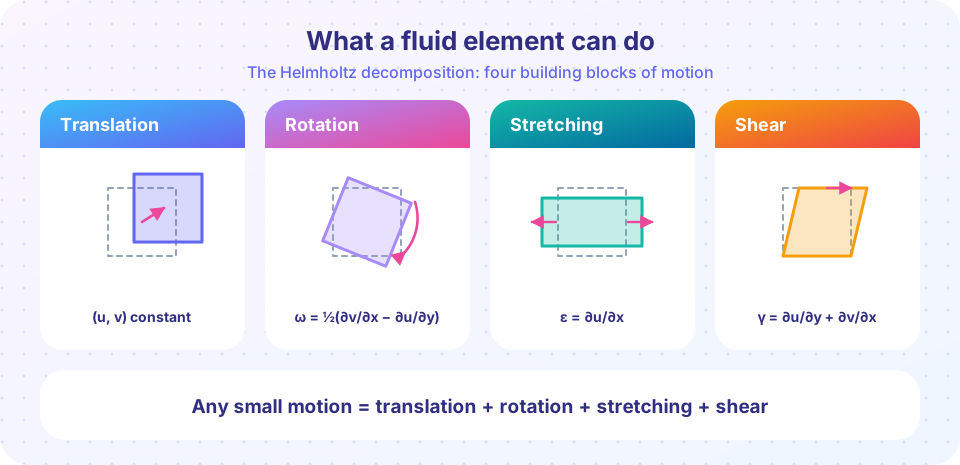
Imagine drawing a tiny square in a moving fluid with ink and watching what happens to it. It moves. It may turn. It may be stretched in one direction and squeezed in another, or sheared into a parallelogram. These four things are all that a small piece of fluid can do, and each one has a mathematical measure built from the derivatives of the velocity field. Two of them matter more than any others: the strain rate, because viscous stresses in a Newtonian fluid are proportional to it, and the vorticity, because it describes spinning motion and underlies lift, eddies and turbulence.
What you will learn
- How to split the velocity gradient into a strain-rate part and a rotation part.
- How to compute vorticity, divergence and shear rates from
u(x, y). - What circulation is and how it connects to vorticity.
- What irrotational and incompressible flows mean.
Key terms
Velocity gradient: the matrix of all first derivatives ∂u_i/∂x_j.
Strain rate: how fast an element stretches (normal) or shears (off-diagonal terms).
Vorticity ω = ∇ × u: twice the local angular velocity of a fluid element.
Circulation Γ = ∮ u · dl: the line integral of velocity around a closed loop.
Irrotational: ω = 0 everywhere (in the region of interest).
Velocity gradient: the source of everything
Near a point, the velocity at a neighbouring point (x + dx, y + dy) is, to first order,
u(x + dx, y + dy) = u + (∂u/∂x) dx + (∂u/∂y) dy
and similarly for v. The first term is a pure translation. The rest is controlled by the four derivatives ∂u/∂x, ∂u/∂y, ∂v/∂x, ∂v/∂y. A standard decomposition splits them into a symmetric part (strain) and an antisymmetric part (rotation):
- Normal strain rates:
ε_xx = ∂u/∂x,ε_yy = ∂v/∂y. They stretch or shorten the element along each axis. - Shear strain rate:
ε_xy = ½ (∂u/∂y + ∂v/∂x). It changes the angle between two lines in the element (the angular distortion rate is twice this). - Rotation rate of the element:
Ω_z = ½ (∂v/∂x − ∂u/∂y). - Volumetric dilatation rate:
ε_xx + ε_yy (+ ε_zz in 3D) = ∇ · u. It is the rate at which the volume of a fluid element grows per unit volume. For an incompressible flow it is zero.
Vorticity
The vorticity vector is the curl of velocity:
ω = ∇ × u = (∂w/∂y − ∂v/∂z, ∂u/∂z − ∂w/∂x, ∂v/∂x − ∂u/∂y).
In a 2D flow, only the z component is nonzero: ω_z = ∂v/∂x − ∂u/∂y, which is twice the rotation rate Ω_z. Positive ω_z means counter-clockwise spin when you look down the z axis. Vorticity says how fast a tiny element rotates about its own centre, whatever path the element follows.
Worked example 1: simple shear
Take u = γ̇ y, v = 0, with shear rate γ̇ = 2 s⁻¹: a layer at height y moves at speed 2y. Then ∂u/∂y = 2, so ω_z = 0 − 2 = −2 s⁻¹ and ε_xy = ½ (2 + 0) = 1 s⁻¹. Straight streamlines, yet the fluid has vorticity: a tiny paddle wheel placed in the flow would spin clockwise (the layer above moves faster to the right, pushing the top of the wheel forward). Straight does not mean irrotational.
Worked example 2: rigid rotation
Solid-body rotation at angular velocity Ω: u = −Ωy, v = Ωx. Then ∂v/∂x = Ω and ∂u/∂y = −Ω, so ω_z = 2Ω and all strain rates vanish. Rotating water in a stirred bucket, after it spins like a solid, behaves this way. Vorticity is twice the angular velocity.
Worked example 3: the free vortex
Around a point, u_θ = Γ / (2π r) and u_r = 0 (a "drain vortex", away from the centre). In polar coordinates ω_z = (1/r) d(r u_θ)/dr. Here r u_θ = Γ/(2π) is constant, so ω_z = 0 for every r > 0. Every fluid element circles the centre but does not spin about itself: it is irrotational. All the vorticity sits in an infinitely thin line at r = 0. A real vortex smooths this with a viscous core. The Rankine vortex model uses solid-body rotation inside radius a and the free-vortex form outside; it is a good first model of a tornado or a bathtub vortex.
Worked example 4: stagnation flow
u = εx, v = −εy: fluid approaches a wall, stretches along x, and is squeezed along y. ε_xx = ε, ε_yy = −ε, ∇·u = 0, ω_z = 0. Pure strain: no spin, no volume change.
Circulation
For a closed loop C in the flow, the circulation is
Γ = ∮_C u · dl.
By Stokes' theorem it equals the total vorticity passing through any surface A bounded by the loop: Γ = ∬ ω · n dA. For solid-body rotation and a circular loop of radius r: Γ = (Ωr)(2πr) = 2πΩr² = ω_z × (πr²) ✓. For a free vortex, any loop that encloses the centre gives Γ, any loop that does not gives zero.
Circulation is the central quantity in the theory of lift. A wing generates lift because the air circulates around it with net circulation Γ; the Kutta-Joukowski theorem you will meet in chapter 4 gives the lift per unit span as ρ U Γ.
Common misconceptions
"Curved streamlines mean vorticity, straight ones mean none." Neither is true. Simple shear has straight streamlines and vorticity; a free vortex has circular streamlines and none.
"Vorticity is the same as circulation." Vorticity is a local property (per unit area); circulation is the integral around a loop, a property of the whole loop.
"Strain and rotation are separate flows." A real flow generally has both; the decomposition just helps you see them. Simple shear contains equal parts of pure strain and rotation.
Try it
First, compute strain, rotation and vorticity for four flows from their velocity-gradient matrices, then see how a unit square deforms in three of them. The matrix A[i][j] is ∂u_i/∂x_j.
Press Run (or Ctrl + Enter) to see the result here.
Program input · what you'd type while the program runs
Type the answers before you press Run, one per line. Each time the program reads a line (with input()), it gets the next line from this box.
Second, check Stokes' theorem numerically: integrate the velocity around circles for the solid-body and free vortices. Solid-body rotation should give 2Ωπr²; the free vortex should give Γ for a loop around the centre and 0 for one that misses it.
Press Run (or Ctrl + Enter) to see the console output here.
No output.
Check your understanding
Quick check · 5 questions
of 5 answered You scored / 5 · perfect!
-
1. For the simple shear flow u = 3y, v = 0, the vorticity omega_z is
omega_z = dv/dx - du/dy = 0 - 3 = -3 per second (clockwise spin). -
2. For rigid rotation at angular velocity Omega, the vorticity is
u = -Omega y, v = Omega x gives omega_z = Omega - (-Omega) = 2 Omega. -
3. A flow has u = 2x, v = -2y. Its divergence is
div u = 2 + (-2) = 0: the flow can be incompressible. It is a pure strain flow. -
4. Which statement about the free vortex u_theta = Gamma / (2 pi r) is correct?
r u_theta is constant, so the vorticity is zero for r > 0, yet the circulation around the centre is Gamma. -
5. By Stokes' theorem, circulation around a closed loop equals
Gamma = closed integral of u dot dl = surface integral of omega dot n dA.
Summary
- A small fluid element translates, rotates, stretches and shears; the last three come from the velocity gradient.
- Strain rates (symmetric part) feed viscous stresses; vorticity
ω = ∇ × u(twice the rotation rate) measures spin. - Divergence
∇·uis the volumetric dilatation rate: zero for incompressible flow. - Circulation
Γ = ∮ u·dlequals the vorticity flux through the loop; the free vortex is irrotational except at its centre.
Next: Chapter 2 Review
Track your progress
Create a free account to tick off lessons and pick up where you left off on any device.
of Fluid Dynamics lessons completed