


















Lesson 31 of 46 · Turbulence
The law of the wall and turbulent pipe friction
Learn wall units, friction velocity, the viscous sublayer, buffer layer and logarithmic law of the wall, and use them to compute turbulent pipe friction.
Walls organize turbulent flow. Right at a wall the fluid is at rest, so eddies are squeezed out and viscosity rules. Farther out, eddies grow in proportion to the distance from the wall, and the mean velocity follows a universal logarithmic profile. This near-wall structure is so regular that it can be summarized with one velocity and one length, and it underlies how engineers compute friction in pipes, channels, rivers and on aircraft skins.
What you will learn
- The friction velocity
u_τand the wall unitsy+andu+. - The viscous sublayer, buffer layer and log layer, and where each ends.
- The log law
u+ = (1/κ) ln y+ + Band how mixing length explains it. - How to compute turbulent friction in a smooth pipe.
Key terms
- Friction velocity (u_τ):
u_τ = √(τw/ρ), a velocity scale built from the wall shear stress. - Viscous length:
ν / u_τ, the natural length scale at the wall. - Wall units:
y+ = y u_τ / νandu+ = U / u_τ. - Von Karman constant (κ): about 0.41, the slope constant of the log law.
- Friction Reynolds number (Re_τ):
u_τ h / ν, the ratio of the flow half-widthhto the viscous length.
Wall units
The wall shear stress τw is the main thing that the wall imposes on the flow. Together with ρ and ν it defines a velocity u_τ = √(τw/ρ) and a length ν/u_τ. These are the natural units near the wall, so we write
y+ = y u_τ / ν, u+ = U(y) / u_τ
Worked example
Water flows in a smooth pipe of diameter 50 mm at a mean speed of 2 m/s, so Re = 2 × 0.05 / 10⁻⁶ = 10⁵. The Blasius law gives f = 0.316 / 10⁵^(1/4) ≈ 0.0178. The wall shear is τw = (f/8) ρ Ubar² = (0.0178/8) × 1000 × 4 ≈ 8.9 Pa, so u_τ = √(8.9/1000) ≈ 0.094 m/s, about 5% of the mean speed. The viscous length is ν/u_τ = 10⁻⁶/0.094 ≈ 10.6 µm. A point 1 mm from the wall is at y+ ≈ 94, in the log layer; the viscous sublayer (y+ < 5) is only about 0.05 mm thick.
The three layers
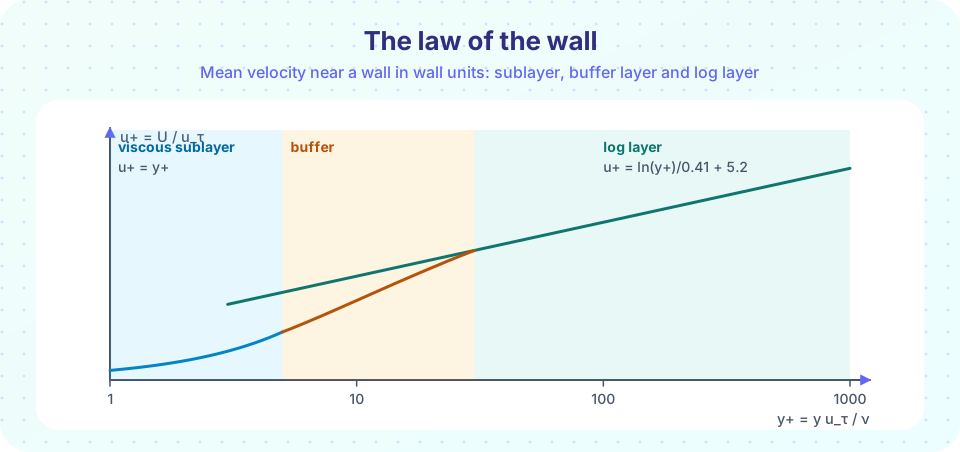
Experiments and simulations of many flows (pipes, channels, boundary layers) show that near the wall the mean velocity depends on y+ alone:
| Layer | Range | Mean velocity |
|---|---|---|
| Viscous sublayer | y+ < 5 |
u+ = y+ |
| Buffer layer | 5 < y+ < 30 |
a smooth blend, neither law fits |
| Log layer | y+ > 30 and y/h < 0.2 |
u+ = (1/κ) ln y+ + B |
with κ ≈ 0.41 and B ≈ 5.0 to 5.2 for smooth walls.
Sublayer. Here the turbulent stress is negligible and viscous stress is constant at the wall value: μ dU/dy = τw. Integrating gives U = τw y/μ, or u+ = y+.
Log layer. Far enough from the wall viscosity is unimportant, but the wall still sets the stress, τ ≈ τw. Prandtl assumed that eddies have size proportional to the distance from the wall, l = κ y. Then ν_t = l² dU/dy and τw/ρ = (κ y)² (dU/dy)², so dU/dy = u_τ / (κ y). Integrating gives the logarithm. The constant B comes from matching with the buffer layer, and is found from experiments.
Outer layer. Beyond the log layer the profile departs from the law and depends on the geometry (y/h). The velocity there deviates from the log law by a "wake" correction, but the difference from the centerline value is small.
Rough walls shift the log law downward by an amount that depends on the roughness height in wall units. In the fully rough regime viscosity no longer matters, which is why the pipe friction factor of a very rough pipe is independent of Re.
Turbulent pipe friction
Integrating the log law over the cross-section gives the Prandtl universal friction law for smooth pipes:
1/√f = 2.0 log₁₀(Re √f) - 0.8
It has to be solved by iteration. For 4,000 < Re < 10⁵ it is closely approximated by the Blasius law f = 0.316 Re^(-1/4). For rough pipes the Colebrook-White equation adds a term with the relative roughness ε/D; the Moody chart plots these curves. Note how weakly f depends on Re: it falls from about 0.03 at Re = 10⁴ to about 0.008 at Re = 10⁷.
The pressure drop in a pipe of length L is then the Darcy-Weisbach formula Δp = f (L/D) (ρ Ubar² / 2).
Common misconceptions
- "The log law holds across the whole pipe." It fails near the wall (sublayer and buffer layer) and near the centerline. It is valid only in a middle range.
- "The viscous sublayer is laminar and still." It is not stagnant: it is intermittently disturbed by streaks and bursts. Its mean profile is linear, but the layer is unsteady.
- "Wall units are just a convenience." They show that flows at different speeds and sizes share the same near-wall physics.
Try it
Press Run (or Ctrl + Enter) to see the result here.
Program input · what you'd type while the program runs
Type the answers before you press Run, one per line. Each time the program reads a line (with input()), it gets the next line from this box.
Press Run (or Ctrl + Enter) to see the result here.
Program input · what you'd type while the program runs
Type the answers before you press Run, one per line. Each time the program reads a line (with input()), it gets the next line from this box.
The first example is a model, not a measurement; it reproduces the log law and the lower edge of the buffer layer approximately. The second applies the formulas of the lesson.
Check your understanding
Quick check · 5 questions
of 5 answered You scored / 5 · perfect!
-
1. What is the friction velocity u_τ?
u_τ = √(τw/ρ). It is typically a few percent of the mean speed. -
2. In the viscous sublayer, what is the mean velocity profile?
Viscous stress is dominant and constant, so U increases linearly with y. -
3. What distance from the wall gives y+ = 100 when the viscous length is 10 µm?
y = y+ × (ν/u_τ) = 100 × 10 µm = 1 mm. -
4. What assumption yields the logarithmic law?
With l = κy and τ ≈ τw you get dU/dy = u_τ/(κ y), which integrates to a logarithm. -
5. How does the turbulent smooth-pipe friction factor vary with Re compared with the laminar law?
Blasius gives f ∝ Re^(-1/4), a weaker dependence than the laminar f ∝ Re^(-1). Only fully rough pipes are Re-independent.
Summary
- Wall units
y+ = y u_τ/νandu+ = U/u_τcollapse near-wall data of many flows. - Layers: viscous sublayer (
u+ = y+), buffer, and log layer (κ ≈ 0.41,B ≈ 5.2). - Prandtl's law and the Blasius fit give turbulent smooth-pipe friction,
Δp = f (L/D) ρ Ubar²/2. - Roughness shifts the log law and removes the Reynolds-number dependence at high
Re.
Next: Chapter 6 review
Track your progress
Create a free account to tick off lessons and pick up where you left off on any device.
of Fluid Dynamics lessons completed