


















Lesson 15 of 46 · Conservation Equations and Navier-Stokes
Exact Solutions: Couette, Poiseuille and Pipe Flow
Solve Navier-Stokes exactly for flow between plates and in a pipe: Couette, plane Poiseuille and Hagen-Poiseuille flow, with pressure drop and worked numbers.
The Navier-Stokes equations are nonlinear and hard. But if the geometry is simple and the flow is steady, straight and uniform along its length, the troublesome convective term vanishes identically and what remains can be solved on paper. These exact solutions are not just exercises: they describe the flow of blood in capillaries, oil in a lubricated bearing and water in a laboratory tube, and they are the test cases against which every simulation program is checked.
What you will learn
- How to reduce Navier-Stokes to a simple ODE for fully developed flow.
- The velocity profiles and wall shear stresses for Couette, plane Poiseuille and pipe flow.
- How to compute pressure drop and flow rate in a laminar pipe.
- Why
f = 64/Refor laminar pipe flow.
Key terms
Fully developed flow: the velocity profile does not change along the flow direction.
Couette flow: flow between parallel plates driven by the motion of one plate.
Poiseuille flow: flow driven by a pressure gradient in a channel or pipe.
Pressure gradient G = −dp/dx: the pressure drop per unit length that pushes the flow.
Entrance length: the distance needed for a pipe flow to become fully developed, about 0.06 Re D in laminar flow.
Setting up: why the nonlinear term disappears
Consider steady flow between two parallel plates a distance h apart, with the velocity in the x direction only: u = u(y), v = w = 0. Continuity: ∂u/∂x = 0 ✓. The convective term is u ∂u/∂x + v ∂u/∂y = 0 (u does not depend on x, and v is zero). The x-momentum equation with gravity ignored reduces to
0 = −dp/dx + μ d²u/dy², that is μ u'' = dp/dx.
(The y-momentum equation shows p depends only on x, so dp/dx is constant for a flow of uniform profile.) Now u'' = dp/dx / μ is a one-line ODE.
Couette flow
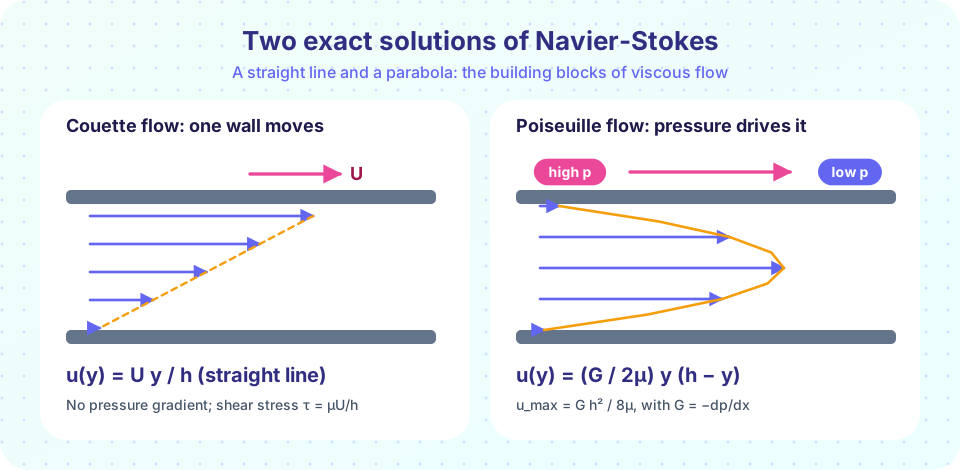
The bottom plate is fixed and the top plate moves at U. No pressure gradient: u'' = 0. With u(0) = 0 and u(h) = U:
u(y) = U y / h.
A straight-line profile. The shear stress is uniform, τ = μ U/h, which is the viscometer formula of the previous lesson. A journal bearing, with a thin oil film between a shaft and its housing, is almost a Couette flow.
Plane Poiseuille flow
Both plates are fixed; a pressure gradient G = −dp/dx > 0 pushes the fluid. Now u'' = −G/μ. Integrating twice: u = −(G/2μ) y² + C₁ y + C₂. No-slip at y = 0 and y = h gives C₂ = 0 and C₁ = G h/(2μ):
u(y) = (G / 2μ) y (h − y).
A parabola with maximum in the middle, u_max = G h² / (8μ). The mean speed is u_mean = G h²/(12 μ) = (2/3) u_max, the flow rate per unit width is Q' = G h³/(12 μ), and the wall shear stress is τ_w = μ u'(0) = G h/2. Notice Q ∝ h³: doubling the gap multiplies the flow by 8. This sensitivity is why a slightly clogged channel loses its flow quickly.
Superposing the two (the equation is linear here): u = U y/h + (G/2μ) y (h − y). If the pressure gradient opposes the wall motion strongly enough, G h²/(2μU) < −1, the profile develops backflow near the stationary wall.
Hagen-Poiseuille flow in a pipe
In a circular pipe of radius R, with u = u(r), the momentum equation in cylindrical coordinates is (μ/r) d/dr (r du/dr) = dp/dx = −G. Integrate: r du/dr = −G r²/(2μ) + C₁; regularity at the axis forces C₁ = 0; integrate again and apply u(R) = 0:
u(r) = G (R² − r²) / (4 μ).
- Maximum speed (on the axis):
u_max = G R²/(4μ). - Flow rate (integrate
uover the cross-section):Q = π R⁴ G / (8 μ). - Mean speed
V = Q/(π R²) = G R²/(8 μ) = u_max/2. - Wall shear:
τ_w = G R/2. - Pressure drop over a length
L:Δp = G L = 8 μ L Q/(π R⁴) = 32 μ L V/D².
The R⁴ dependence is striking: halving the radius cuts the flow by a factor of 16 at the same pressure gradient. In physiology, a small narrowing of an artery has a large effect on blood flow. Hagen (1839) and Poiseuille (1840, motivated by blood flow in capillaries) found the law experimentally; the derivation from Navier-Stokes came later.
In engineering form, the friction factor defined by Δp = f (L/D)(ρ V²/2) becomes f = 64/Re. Check: f = Δp D / (L ρ V²/2) = 32 μ V /D² × D × 2/(ρ V²) = 64 μ/(ρ V D) = 64/Re ✓.
Worked example: water in a thin tube
A laboratory tube has diameter 10 mm (R = 0.005 m) and carries Q = 1 mL/s = 10⁻⁶ m³/s of water at 20 °C (μ = 1.002×10⁻³ Pa·s).
- Mean speed:
V = Q/(π R²) = 10⁻⁶ / 7.85×10⁻⁵ = 0.0127 m/s. - Reynolds number:
Re = 998 × 0.0127 × 0.01 / 1.002×10⁻³ ≈ 127: laminar ✓. - Pressure gradient:
G = 8 μ Q / (π R⁴) = 8 × 1.002×10⁻³ × 10⁻⁶ / (π × 6.25×10⁻¹⁰) ≈ 4.08 Pa/m. - Over a 2 m tube:
Δp ≈ 8.2 Pa, about 0.8 mm of water column. - Centerline speed:
u_max = 2V ≈ 0.0255 m/s. - Wall shear:
τ_w = G R/2 = 4.08 × 0.005/2 ≈ 0.010 Pa. - Entrance length:
0.06 Re D ≈ 0.06 × 127 × 0.01 = 0.076 m, so the profile is fully developed after about 8 cm.
The formulas hold only while the flow is laminar and fully developed. Above Re ≈ 2,300 the flow becomes turbulent and the parabolic law fails: the pressure drop rises faster than linearly with Q.
Common misconceptions
"The parabola applies to any pipe flow." Only to laminar, fully developed flow. Turbulent profiles are much flatter in the core.
"Faster flow needs the same pressure drop." In laminar flow Δp ∝ V, but in turbulent flow Δp rises roughly as V^1.75, a much steeper increase.
"Exact solutions are useless because real flows are messy." They give the baseline for blood flow, lubrication, microfluidics and for checking numerical codes.
Try it
First, solve the combined Couette-Poiseuille problem symbolically and plot a family of profiles. Each curve has a different dimensionless pressure gradient P = G h²/(2μU). Backflow appears for P < −1.
Press Run (or Ctrl + Enter) to see the result here.
Program input · what you'd type while the program runs
Type the answers before you press Run, one per line. Each time the program reads a line (with input()), it gets the next line from this box.
Second, a pipe calculator that applies the Hagen-Poiseuille formulas and warns you when the laminar assumption fails.
Check your understanding
Quick check · 5 questions
of 5 answered You scored / 5 · perfect!
-
1. For plane Poiseuille flow between fixed plates a distance h apart, the maximum speed is
u = (G/2mu) y (h - y) has its maximum at y = h/2: (G/2mu)(h/2)(h/2) = G h^2/(8 mu). -
2. In Hagen-Poiseuille flow, the flow rate at a given pressure gradient scales with the radius as
Q = pi R^4 G / (8 mu). -
3. The mean speed in a laminar pipe flow is
u = u_max (1 - r^2/R^2), whose average over the cross-section is u_max / 2. -
4. The laminar friction factor in a pipe is
From Hagen-Poiseuille, Delta p = 32 mu L V / D^2, which gives the Darcy friction factor f = 64/Re. -
5. In Couette flow with no pressure gradient, the velocity profile between the plates is
u'' = 0 with u(0) = 0 and u(h) = U gives u = U y / h.
Summary
- Fully developed, steady, straight flows make the convective term vanish, leaving
μ u'' = dp/dx. - Couette:
u = U y/h; plane Poiseuille:u = (G/2μ) y(h−y); pipe:u = G(R²−r²)/(4μ). - Pipe:
Q = πR⁴G/(8μ),V = u_max/2,τ_w = GR/2,Δp = 32 μ L V/D²,f = 64/Re. - The results hold only for laminar flow,
Rebelow about 2,300.
Next: Chapter 3 Review
Track your progress
Create a free account to tick off lessons and pick up where you left off on any device.
of Fluid Dynamics lessons completed