


















Lesson 11 of 46 · Conservation Equations and Navier-Stokes
Chapter 3 Overview: From Conservation Laws to Navier-Stokes
Chapter 3 of Fluid Dynamics in one page: conservation of mass, a law for fluid stress, Newton's second law, the Navier-Stokes equations and a few exact solutions.
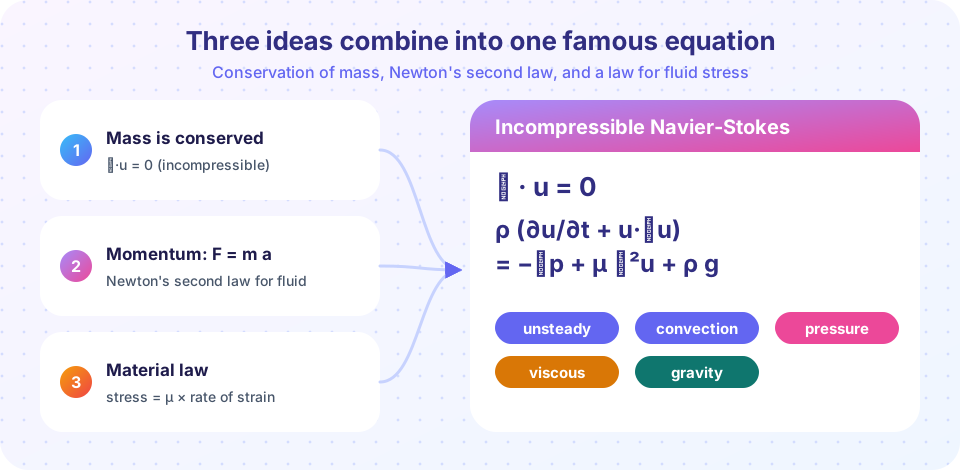
Chapter 2 described flows. This chapter explains which flows can actually happen. Three ideas are enough. Matter cannot be created or destroyed (conservation of mass). Fluids resist being sheared in a way that depends on how fast they are sheared (a material law for stress). And Newton's second law applies to every little piece of fluid. Put together, they give the Navier-Stokes equations, the most important equations in fluid dynamics, which describe water in a pipe, air over a wing, blood in an artery and the weather.
What you will learn
- The three ideas behind the governing equations.
- The shape of the incompressible Navier-Stokes equations and what each term means.
- The order of the lessons in this chapter.
- How to test whether a velocity field is physically possible for an incompressible flow.
Key terms
Continuity equation: the statement of mass conservation, ∇·u = 0 for incompressible flow.
Newtonian fluid: a fluid whose viscous stress is proportional to the strain rate.
Navier-Stokes equations: Newton's second law for a Newtonian fluid.
Boundary condition: a statement about the flow at the edge of the domain, such as no-slip at a wall.
The plan
Three ingredients
One equation
Exact solutions
What each lesson covers
- Continuity: the mass balance for a control volume, for a small box, and the incompressible form
∇·u = 0. - Stress and viscosity: pressure, shear stress, Newton's law of viscosity, temperature dependence and non-Newtonian fluids.
- The Navier-Stokes equations: Newton's second law for a fluid element, with each term interpreted and boundary conditions.
- Exact solutions: Couette, plane Poiseuille and Hagen-Poiseuille pipe flow, solved by hand.
- Chapter 3 review: a one-page summary and a quiz.
The equations at a glance
For an incompressible fluid of constant density ρ and viscosity μ, with body force ρg per unit volume:
∇ · u = 0
ρ (∂u/∂t + (u·∇)u) = −∇p + μ ∇²u + ρg
That is four scalar equations (one continuity, three momentum components) for four unknowns (u, v, w, p). Each term of the second equation has units of force per unit volume (N/m³). The left side is mass per volume times acceleration, which chapter 2 taught you to write using the material derivative. The right side lists the forces: pressure gradient, viscous diffusion and gravity.
A first use: is this field possible?
Not every velocity field can occur in an incompressible fluid. If ∇·u ≠ 0, matter would pile up or disappear somewhere. So one quick test of a proposed field is its divergence. For u = (x, −y, 0): ∂u/∂x + ∂v/∂y = 1 − 1 = 0 ✓. For u = (x, y, 0): 1 + 1 = 2 ≠ 0 ✗ (fluid would be created everywhere).
Common misconceptions
"Navier-Stokes is too complicated to be useful." It is complicated to solve in general, but simplified cases give exact answers, numerical methods give approximate ones, and dimensional analysis gives insights with no solution at all.
"The equations are only for liquids." They describe any Newtonian fluid; for gases at low Mach number the incompressible form is excellent, and the full compressible form covers the rest.
"Solving Navier-Stokes is a solved mathematical problem." In three dimensions, nobody has proved that smooth solutions always exist. This is one of the Clay Mathematics Institute's Millennium Prize problems (2000).
Try it
First, use sympy to test candidate velocity fields for incompressibility by computing their divergence.
Press Run (or Ctrl + Enter) to see the result here.
Program input · what you'd type while the program runs
Type the answers before you press Run, one per line. Each time the program reads a line (with input()), it gets the next line from this box.
Second, estimate numerically which terms of the momentum equation matter for a flow of water in a 1 cm pipe, using order-of-magnitude scales. The ratio of the convective term to the viscous term is the Reynolds number again.
Press Run (or Ctrl + Enter) to see the console output here.
No output.
Check your understanding
Quick check · 4 questions
of 4 answered You scored / 4 · perfect!
-
1. Which three ideas produce the Navier-Stokes equations?
Mass conservation gives continuity; the stress law relates stress to strain rate; Newton's law gives the momentum equation. -
2. The incompressible continuity equation is
div u = 0: no volume change for a fluid element. -
3. Is u = (2x, y, -3z) possible in an incompressible flow?
2 + 1 - 3 = 0, so the divergence vanishes and the field passes the incompressibility test. -
4. In rho (Du/Dt) = -grad p + mu laplacian(u) + rho g, what are the units of every term?
Each term is force per unit volume: rho times acceleration has units kg/m^3 x m/s^2 = N/m^3.
Summary
- Mass conservation, a stress law and Newton's second law give the governing equations.
- For constant
ρandμ:∇·u = 0andρ Du/Dt = −∇p + μ∇²u + ρg. - Four equations for four unknowns, together with boundary conditions, define the flow.
- The ratio of the inertial to the viscous term is the Reynolds number.
Track your progress
Create a free account to tick off lessons and pick up where you left off on any device.
of Fluid Dynamics lessons completed