


















Lesson 21 of 46 · Ideal and Potential Flow
Flow Past a Cylinder, Circulation and d'Alembert's Paradox
Build potential flow past a cylinder from a uniform stream and a doublet, find surface speed and pressure, meet d'Alembert's paradox and add circulation for lift.
The cylinder is the classic test case of fluid dynamics. It is simple enough to solve exactly, it appears everywhere (chimneys, wires, pipes in a stream, masts, bridge piers) and it teaches two deep lessons: what ideal-flow theory gets right, and the paradox that led Ludwig Prandtl to invent the boundary layer. We build the flow from the elementary flows of the previous lesson, compute the pressure all the way around, and then add circulation to see how a spinning cylinder makes lift.
What you will learn
- How a uniform stream plus a doublet gives flow around a circular cylinder.
- The surface speed and pressure coefficient
Cp = 1 − 4 sin²θ. - Why the net drag is zero in ideal flow (d'Alembert's paradox) and what breaks it in real flow.
- How circulation shifts the stagnation points and creates lift:
L' = ρ U Γ.
Key terms
Pressure coefficient Cp = (p − p∞) / (½ρU²): dimensionless pressure relative to the free stream.
d'Alembert's paradox: a steady ideal irrotational flow exerts no drag on a body.
Kutta-Joukowski theorem: lift per unit span is L' = ρ U Γ.
Magnus effect: the sideways force on a spinning body in a stream.
Uniform stream plus doublet
Take a uniform stream U in the +x direction and a doublet at the origin. The stream function is
ψ = U r sinθ − (κ / 2π) sinθ / r = U sinθ (r − a²/r), with a² = κ / (2πU).
For r = a, ψ = 0 for every θ: the circle r = a is a streamline, so no fluid crosses it. Replace it with a solid cylinder of radius a and the outside flow is unchanged. Also ψ = 0 on the x axis, so the dividing streamline splits at the front stagnation point and rejoins at the rear one.
Velocity components (angle θ measured from the +x axis, the downstream direction):
u_r = (1/r) ∂ψ/∂θ = U cosθ (1 − a²/r²), u_θ = −∂ψ/∂r = −U sinθ (1 + a²/r²).
On the surface r = a: u_r = 0 (no flow through) and u_θ = −2U sinθ. The speed is 2U |sinθ|: zero at the stagnation points θ = 0 and θ = π, and a maximum of 2U at the top and bottom (θ = ±90°), twice the free-stream speed.
Pressure around the cylinder
Bernoulli between the free stream (p∞, U) and a point on the surface (p, speed 2U sinθ) gives
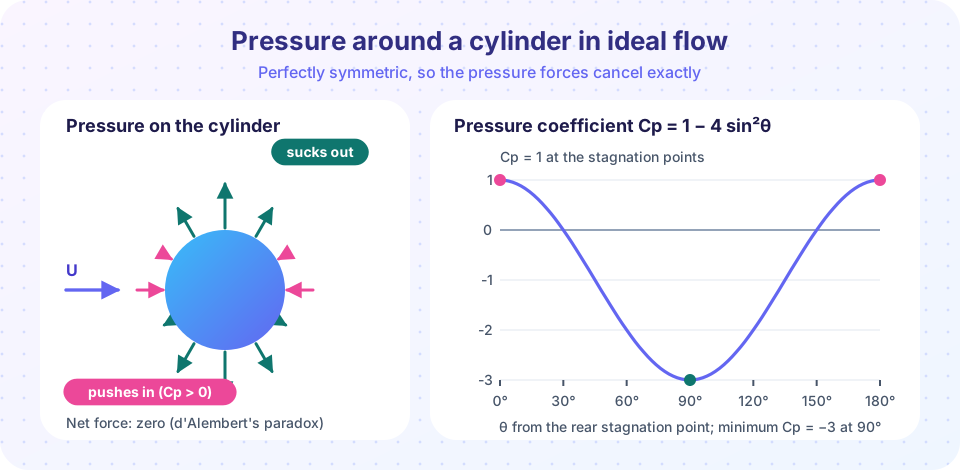
p = p∞ + ½ρU² (1 − 4 sin²θ), so Cp = 1 − 4 sin²θ.
- At the stagnation points
Cp = 1: the stagnation pressurep∞ + ½ρU². - At
θ = 30°(and 150°)Cp = 0: pressure equals the free-stream value. - At the top and bottom
Cp = −3: suction of1.5 ρU², strong enough that the cylinder is pulled outward there.
Worked example: wind on a chimney
Air (ρ = 1.2 kg/m³) at U = 20 m/s: dynamic pressure ½ρU² = 240 Pa. At the top of a cylindrical chimney, the ideal pressure is p∞ − 720 Pa, 3 × 240 below ambient; at the stagnation point it is p∞ + 240 Pa. The real values on the windward face match closely; the leeward side differs, as we see next.
d'Alembert's paradox
The force on the body is the integral of pressure over the surface. The pressure Cp = 1 − 4 sin²θ is symmetric front-to-back (same at θ and π − θ) and top-to-bottom, so the force components along and across the stream both vanish: zero drag and zero lift. The pressure gained on the front is regained on the rear. d'Alembert reached this surprising conclusion for ideal flow around any body in 1752, in clear conflict with reality.
The resolution, given by Prandtl in 1904, is that real fluids have viscosity. A boundary layer forms on the surface. On the rear half, the adverse pressure gradient (pressure rising along the flow) makes the boundary layer separate, leaving a wide, low-pressure wake. The pressure on the rear no longer recovers, and there is a net pressure drag. Typical drag coefficients for a smooth circular cylinder are C_D ≈ 1.2 for Reynolds numbers between about 10³ and 2×10⁵, falling to roughly 0.3 to 0.6 beyond the "drag crisis" where the boundary layer becomes turbulent and separates later. Chapter 5 treats this in detail.
Adding circulation
Add a vortex of clockwise circulation Γ at the origin. The stream function becomes
ψ = U sinθ (r − a²/r) + (Γ / 2π) ln(r / a).
The circle r = a is still a streamline (ψ = 0), so the body remains a cylinder, but now the surface speed is u_θ = −2U sinθ − Γ/(2πa). Write k = Γ / (2π U a). Then u_θ/U = −(2 sinθ + k), and the pressure coefficient is
Cp = 1 − (2 sinθ + k)².
The stagnation points (where u_θ = 0) are at sinθ_s = −k/2: they move to the lower half of the cylinder, and for k = 2 merge at the bottom (θ = −90°). For k > 2 the stagnation point leaves the surface into the flow.
The vortex adds speed on top (where the stream and the clockwise vortex move in the same direction) and subtracts it at the bottom. By Bernoulli, lower pressure on top and higher at the bottom: an upward force. Integrating −p sinθ around the surface gives
L' = ρ U Γ (Kutta-Joukowski theorem), with zero drag still.
Importantly, this holds for any closed body in a 2D ideal flow, not only for cylinders: lift per unit span equals fluid density times free-stream speed times circulation. Wings produce lift because they generate circulation (a topic for aerodynamics courses).
Worked example: a spinning cylinder
A cylinder of radius a = 0.1 m is in an airstream of U = 10 m/s, and spins at ω = 100 rad/s (clockwise). If the air next to the surface moved with the surface, its speed would be ωa = 10 m/s. The ideal vortex that gives this speed has Γ/(2πa) = ωa, so Γ = 2π a² ω = 2π × 0.01 × 100 = 6.28 m²/s. Then k = Γ/(2πUa) = 1.0, the stagnation points are at sinθ_s = −0.5, i.e. θ = −30° and −150° (210°), both on the lower half, and the lift per metre of length is L' = ρUΓ = 1.2 × 10 × 6.28 ≈ 75 N/m. This is the Magnus effect: it curves tennis balls and footballs, and is used by Flettner rotor ships. Real lift is lower than the ideal value because the boundary layer separates and spin-induced circulation is not perfect, but the direction and the trend are right.
Common misconceptions
"The paradox shows that potential flow is wrong." It shows that a model without viscosity cannot predict drag on bluff bodies. The pressure on the front and the lift from circulation are predicted well.
"A cylinder generates lift in any flow because the top speed is higher." The top and bottom speeds are equal in the circulation-free solution, so there is no lift. You need circulation.
"Lift comes from the vortex pushing the fluid." The vortex term only supplies a circulation; the lift is the integral of the resulting pressure difference, whose size is ρUΓ.
Try it
First compute the forces by integrating the pressure numerically for several spins. This reproduces C_D = 0 and C_L = 2πk (where C_L = L'/(½ρU² · 2a)).
Press Run (or Ctrl + Enter) to see the result here.
Program input · what you'd type while the program runs
Type the answers before you press Run, one per line. Each time the program reads a line (with input()), it gets the next line from this box.
Second, the streamlines for three spins. Watch the stagnation points slide down the cylinder as k grows and leave it when k > 2.
Press Run (or Ctrl + Enter) to see the result here.
Program input · what you'd type while the program runs
Type the answers before you press Run, one per line. Each time the program reads a line (with input()), it gets the next line from this box.
Third, a calculator for the spinning cylinder of the worked example. Change the radius, wind speed and spin and read the lift per metre.
Check your understanding
Quick check · 5 questions
of 5 answered You scored / 5 · perfect!
-
1. The maximum speed on the surface of a cylinder in ideal flow is
u_theta = -2 U sin(theta); the maximum magnitude, at the top and bottom, is 2U. -
2. The pressure coefficient on the cylinder surface (no circulation) is
Bernoulli with surface speed 2U sin(theta) gives Cp = 1 - (2 sin theta)^2. -
3. d'Alembert's paradox states that in steady ideal irrotational flow the drag on a body is
Symmetric pressure forces cancel, so the net drag is zero. -
4. A cylinder with circulation Gamma = 4 m^2/s in air (rho = 1.2) at U = 15 m/s has lift per unit span
L' = rho U Gamma = 1.2 x 15 x 4 = 72 N/m. -
5. What resolves d'Alembert's paradox in real flows?
Viscosity creates a boundary layer, which separates on the rear, so the rear pressure does not recover.
Summary
- Uniform stream plus doublet gives flow around a cylinder with surface speed
2U|sinθ|andCp = 1 − 4 sin²θ. - The pressure forces cancel: zero drag (d'Alembert's paradox); separation and the wake in real flow create drag.
- Adding circulation
Γshifts the stagnation points and gives liftL' = ρUΓ(Kutta-Joukowski), the basis of the Magnus effect and of wing theory. - Potential flow is excellent for pressure and lift, wrong for drag.
Next: Chapter 4 Review
Track your progress
Create a free account to tick off lessons and pick up where you left off on any device.
of Fluid Dynamics lessons completed