


















Lesson 13 of 46 · Conservation Equations and Navier-Stokes
Stress and Viscosity: Newton's Law of Viscosity
Learn normal and shear stress in fluids, Newton's law of viscosity tau = mu du/dy, typical viscosities, temperature effects and non-Newtonian fluids.
Stir honey and water with the same spoon and the difference is obvious: honey pushes back much harder. The property behind that push is viscosity, the fluid's resistance to being sheared. To write Newton's second law for a fluid we need a precise way to say how hard one piece of fluid pushes on its neighbor. That is the concept of stress, and the rule that connects stress to the flow is Newton's law of viscosity, the only material law needed for water, air and oil.
What you will learn
- The difference between normal stress (pressure) and shear stress.
- Newton's law of viscosity and the units of viscosity.
- Typical values for common fluids and how temperature changes them.
- What makes a fluid non-Newtonian.
Key terms
Stress: force per unit area acting on a surface; normal stress is perpendicular to the surface and shear stress is along it.
Dynamic viscosity μ: the proportionality between shear stress and velocity gradient; SI unit Pa·s.
Kinematic viscosity ν = μ/ρ: viscosity per unit density, in m²/s.
Newtonian fluid: shear stress is proportional to strain rate with a constant μ.
No-slip condition: fluid next to a solid wall moves with the wall.
Stress in a fluid
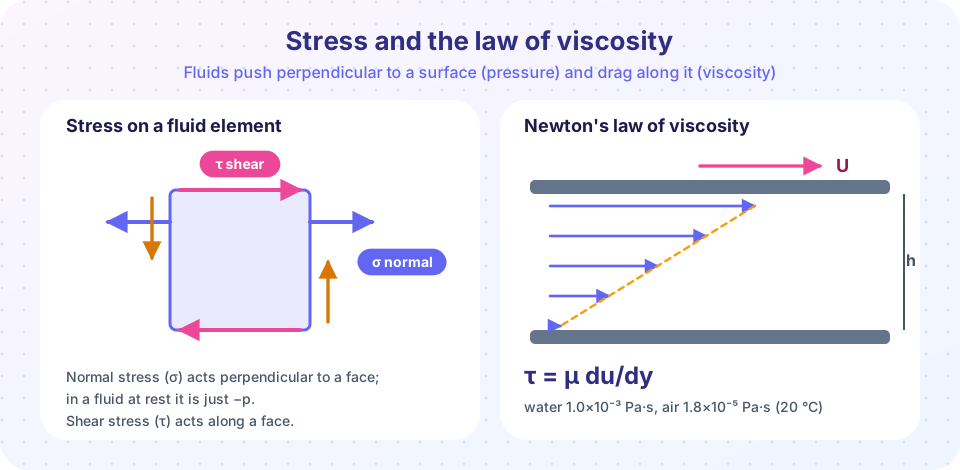
Pick a tiny plane inside a fluid. The fluid on one side pushes on the other with a force per unit area called the stress. The force can be split into two components:
- Normal stress acts perpendicular to the plane. In a fluid at rest it is the pressure: always compressive, the same in every direction (Pascal's law),
σ_xx = σ_yy = σ_zz = −p. - Shear stress acts parallel to the plane. A fluid at rest cannot sustain any shear stress; that is the definition of a fluid. Shear stress appears only when the fluid is deforming.
For a moving fluid we write σ_ij = −p δ_ij + τ_ij, where τ_ij are the viscous stresses. Moving fluid still pushes perpendicular to surfaces with pressure, and in addition it drags along them.
Newton's law of viscosity
Between two parallel plates a distance h apart, hold the bottom one still and drag the top one at speed U. Because of the no-slip condition, the fluid touching the top plate moves at U and the fluid touching the bottom moves at zero. In between, for a Newtonian fluid, the velocity changes linearly. The force per unit area needed to keep the top plate moving is
τ = μ du/dy.
The velocity gradient du/dy is the shear rate (units s⁻¹). Viscosity μ is a property of the fluid and temperature. Its SI unit is the pascal-second (Pa·s = N·s/m²). The older CGS unit is the poise: 1 Pa·s = 10 P, and 1 centipoise (cP) = 10⁻³ Pa·s, nearly the viscosity of water.
In three dimensions and for an incompressible Newtonian fluid, τ_ij = 2μ ε_ij, so for example τ_xy = μ (∂u/∂y + ∂v/∂x). The strain rates of chapter 2 appear directly.
Typical values (about 20 °C)
| Fluid | Dynamic viscosity μ (Pa·s) | Density ρ (kg/m³) | Kinematic ν (m²/s) |
|---|---|---|---|
| Air | 1.8×10⁻⁵ | 1.2 | 1.5×10⁻⁵ |
| Water | 1.0×10⁻³ | 998 | 1.0×10⁻⁶ |
| Mercury | 1.5×10⁻³ | 13,550 | 1.1×10⁻⁷ |
| Olive oil | about 0.08 | about 910 | about 9×10⁻⁵ |
| Glycerin | about 1.4 | 1,260 | about 1.1×10⁻³ |
| Honey | about 2 to 10 | about 1,420 | about 10⁻³ to 10⁻² |
Air is the least viscous in absolute terms, yet its kinematic viscosity is the largest of the first three rows because its density is so low. Which of the two, μ or ν, matters depends on the problem: μ sets forces, ν sets how quickly momentum diffuses.
Worked example: a lubricated plate
Two flat plates are 2 mm apart, with a fluid between them. The upper plate, of area 0.1 m², moves at U = 0.5 m/s. Shear stress τ = μ U/h:
- Olive oil:
τ = 0.08 × 0.5 / 0.002 = 20 Pa, forceF = τ A = 2.0 N. - Water:
τ = 1.002×10⁻³ × 0.5 / 0.002 = 0.25 Pa, force0.025 N. - Air:
τ = 1.81×10⁻⁵ × 0.5 / 0.002 = 4.5×10⁻³ Pa, force4.5×10⁻⁴ N.
The force to drag the plate drops by almost three orders of magnitude from oil to air. This is why oil lubricates: it separates surfaces with a film that carries load but resists shear moderately.
How temperature changes viscosity
Liquids and gases behave oppositely.
- Liquids: molecules are close and held together; heating gives them energy to hop past each other, so viscosity falls sharply with temperature. Water goes from 1.8×10⁻³ Pa·s at 0 °C to 0.28×10⁻³ at 100 °C. Motor oil is formulated to keep its viscosity within a range as an engine warms up.
- Gases: viscosity comes from molecules carrying momentum between layers; hotter molecules move faster and transport more, so viscosity rises with temperature, roughly as
√Tin kinetic theory. The empirical Sutherland formula isμ = μ₀ (T/T₀)^{3/2} (T₀ + S)/(T + S)withμ₀ = 1.716×10⁻⁵ Pa·s,T₀ = 273.15 K,S = 110.4 Kfor air.
A good simple fit for water is μ = A × 10^{B/(T − C)} with A = 2.414×10⁻⁵ Pa·s, B = 247.8 K and C = 140 K. It gives 1.0×10⁻³ at 20 °C.
Non-Newtonian fluids
Not every fluid has a constant μ. A fluid with τ = K (du/dy)ⁿ is a power-law fluid: n < 1 is shear-thinning (ketchup, paint, blood: they get runnier when stirred or pumped fast), n > 1 is shear-thickening (a cornstarch and water mixture: it stiffens under sudden force). Some materials, such as toothpaste and mayonnaise, have a yield stress and do not flow at all until τ exceeds a threshold. Newtonian behavior is an excellent model for water, air and light oils; the rest of this course assumes it.
Common misconceptions
"Pressure is a kind of viscous stress." Pressure acts even in a fluid at rest and is the same in all directions. Viscous stress appears only when the fluid deforms.
"Thicker means denser." Honey is more viscous and only slightly denser than water; mercury is 13 times denser than water but has only about 1.5 times its viscosity.
"Viscosity of a gas falls when heated, like a liquid." The reverse: gas viscosity increases with temperature.
Try it
Plot how viscosity changes with temperature for air (Sutherland) and water (the fit above). Air rises, water drops.
Press Run (or Ctrl + Enter) to see the result here.
Program input · what you'd type while the program runs
Type the answers before you press Run, one per line. Each time the program reads a line (with input()), it gets the next line from this box.
Now a rheometer in a box: choose a fluid, a gap and a plate speed, and read the shear stress and the force on the plate. The same law, applied to different fluids and a power-law fluid.
Check your understanding
Quick check · 5 questions
of 5 answered You scored / 5 · perfect!
-
1. In a fluid at rest, the stress on any surface is
A fluid at rest cannot sustain shear; only the normal compressive stress, pressure, remains. -
2. Newton's law of viscosity states that shear stress is
tau = mu du/dy for a Newtonian fluid. -
3. Two plates 4 mm apart contain water (mu = 1.0e-3 Pa s). The top plate moves at 0.2 m/s. The shear stress is
tau = mu U / h = 1.0e-3 x 0.2 / 0.004 = 0.05 Pa. -
4. When a gas is heated, its viscosity
For gases, hotter molecules transport more momentum between layers, so viscosity rises. -
5. Ketchup becomes runnier when shaken. This behaviour is called
A shear-thinning fluid has an apparent viscosity that decreases with shear rate (n < 1 in the power law).
Summary
- Fluid stress is
σ_ij = −p δ_ij + τ_ij: pressure plus viscous stress; shear stress needs deformation. - Newton's law:
τ = μ du/dy;μin Pa·s,ν = μ/ρin m²/s. - Liquid viscosity falls with temperature; gas viscosity rises.
- Non-Newtonian fluids (shear-thinning, shear-thickening, yield-stress) do not have a constant
μ.
Track your progress
Create a free account to tick off lessons and pick up where you left off on any device.
of Fluid Dynamics lessons completed