


















Lesson 28 of 46 · Turbulence
Chapter 6 overview: turbulence
Meet turbulence: Reynolds' pipe experiment, why the flow becomes chaotic, what the key ideas of averaging, cascade and wall layers are, and where to go next.
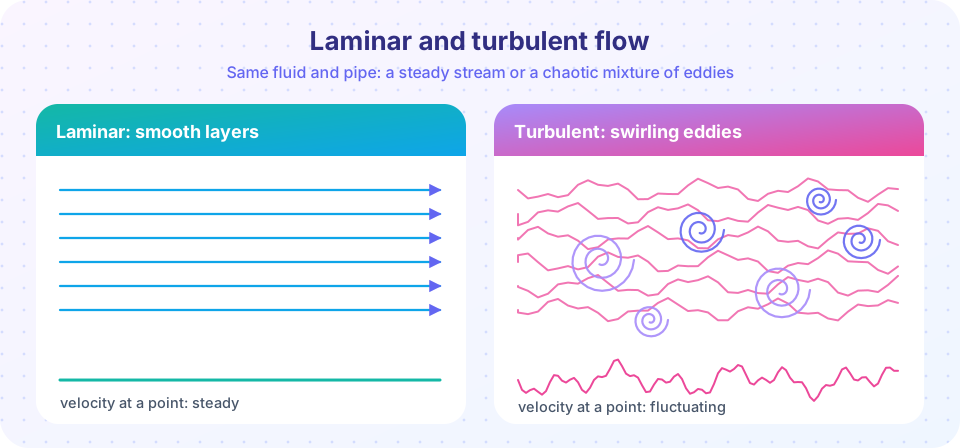
Most flows you meet outside a laboratory are turbulent: smoke from a chimney, a river below a waterfall, the air over an airplane wing, blood in the aorta during exercise, the wake of a truck. Turbulent flow is irregular, three-dimensional and rapidly mixing, and it carries many sizes of swirling eddies at once. Physicists often describe it as the most important unsolved problem of classical physics. We cannot predict each eddy for long, but we can still predict averages, energy flows and wall friction with good accuracy. That is the subject of this chapter.
What you will learn
- What makes a flow turbulent and how Osborne Reynolds' experiment showed it.
- The three big ideas of the chapter: averaging, the energy cascade and the law of the wall.
- Why turbulence increases mixing, drag and heat transfer.
- How turbulent pipe friction differs from the laminar
f = 64/Re.
Key terms
- Turbulence: irregular, chaotic, three-dimensional motion with a wide range of scales.
- Eddy: a swirling parcel of fluid, with a size that ranges from the flow width down to tiny scales.
- Transition: the change from laminar to turbulent flow.
- Intensity: root-mean-square fluctuation divided by the mean speed,
I = u'rms / U. - Mixing: transport of momentum, heat and dissolved matter by eddies, far faster than molecular diffusion.
Reynolds' experiment
In 1883 Osborne Reynolds injected a thin thread of dye into water flowing in a glass pipe. At low speed the dye stayed as a straight, sharp line: laminar flow. As the speed rose, the thread began to wobble and then suddenly burst into a cloud filling the pipe: turbulence. He found that the transition depends on the single combination Re = U D / ν, and that in a pipe it happens when Re is in the low thousands (about 2,300 is the traditional guide, though very quiet setups have kept the flow laminar to much higher values).
Why does the flow become unstable? Inertial terms in the Navier-Stokes equations amplify small disturbances, and viscosity damps them. When Re is large the amplification wins. Nonlinear interactions then spread the disturbances into a chaotic state.
The three big ideas
Why turbulence matters
Idea 1: averaging
Idea 2: cascade
Idea 3: the wall
- Reynolds averaging: split each variable into a mean and a fluctuation, derive the RANS equations and meet the closure problem.
- The energy cascade: Kolmogorov scales and the
-5/3spectrum. - The law of the wall: near-wall structure and turbulent pipe friction.
- Chapter review: one-picture summary and a ten-question quiz.
Turbulent versus laminar friction
Because eddies carry momentum toward the wall, a turbulent velocity profile is fuller, with a thin region of steep gradient at the wall. The wall shear stress is therefore larger than in a laminar flow at the same flow rate. In a pipe, the laminar friction factor f = 64/Re becomes (for smooth pipes, 4,000 < Re < 10⁵) the Blasius law f ≈ 0.316 / Re^(1/4). At Re = 10⁴, laminar flow would give f = 0.0064, while turbulence gives about 0.032, five times larger.
Common misconceptions
- "Turbulence is random, so nothing can be predicted." The equations are deterministic, but sensitive to tiny changes. Averages and statistics are reproducible, and engineers rely on them.
- "Turbulence is always bad." It increases drag but also gives efficient mixing in engines, chemical reactors, and the cooling of electronics. A turbulent layer also resists separation better.
- "A flow is either laminar or turbulent." Transition is gradual: intermittent patches called turbulent puffs and spots appear first.
Try it
Press Run (or Ctrl + Enter) to see the result here.
Program input · what you'd type while the program runs
Type the answers before you press Run, one per line. Each time the program reads a line (with input()), it gets the next line from this box.
Check your understanding
Quick check · 4 questions
of 4 answered You scored / 4 · perfect!
-
1. What dimensionless number controls transition in pipe flow?
Reynolds showed that U D / ν decides whether the flow in a pipe is laminar or turbulent. -
2. Roughly where does the traditional pipe transition occur?
The traditional guide is about 2,300, with fully turbulent flow established beyond about 4,000. -
3. How does the friction factor in a smooth turbulent pipe compare with laminar flow at the same Re near 10⁴?
At Re = 10⁴ the laminar formula gives 0.0064 and the Blasius turbulent law gives about 0.032. -
4. What does turbulent mixing do to heat transfer?
Eddies carry heat much faster than molecular conduction, so heat transfer coefficients are larger.
Summary
- Turbulence is chaotic, three-dimensional, multi-scale and mixes quickly.
- Reynolds found transition in pipes at
Reof a few thousand. - Three tools organize the theory: averaging, the energy cascade and wall scaling.
- Turbulent flows have more wall friction and mixing than laminar ones.
Track your progress
Create a free account to tick off lessons and pick up where you left off on any device.
of Fluid Dynamics lessons completed