


















Lesson 24 of 46 · Viscous Flow and Boundary Layers
Couette and Poiseuille flow: exact viscous solutions
Solve the Navier-Stokes equations exactly for flow between plates and in a pipe, find velocity profiles, wall shear and flow rate, and check them numerically.
The Navier-Stokes equations are nonlinear and mostly impossible to solve by hand. A few special flows are the exception: when the flow runs in straight lines, the nonlinear term vanishes and what is left is a simple balance between pressure and viscous stress. These exact solutions are worth knowing for three reasons. They show what viscous stress really does, they describe real devices (lubricated bearings, microchannels, blood vessels), and they are the standard test cases for any numerical code.
What you will learn
- How to reduce the Navier-Stokes equations to one ordinary differential equation for straight, steady flow.
- The velocity profile, wall shear stress and flow rate of plane Couette and Poiseuille flow.
- The Hagen-Poiseuille law for a circular pipe and the friction factor
f = 64/Re. - How to test a numerical solution against an exact one.
Key terms
- Fully developed flow: the velocity profile no longer changes along the flow direction.
- Pressure gradient (G): we write
G = -dp/dx, a positive number when pressure falls along the flow. - Wall shear stress (τw): the friction force per unit wall area,
τw = μ du/dyevaluated at the wall. - Volume flow rate (Q): the volume of fluid passing a cross-section per second, in m³/s.
- Darcy friction factor (f):
f = 8 τw / (ρ Ubar²), a dimensionless wall friction.
Reducing the equations
Take a steady, incompressible flow between two infinite parallel plates a distance h apart, with the lower wall at y = 0 and the upper wall at y = h. Suppose the fluid moves only in the x direction: velocity (u(y), 0, 0). The continuity equation ∂u/∂x = 0 is satisfied automatically. The x-momentum equation has no acceleration term, because u ∂u/∂x = 0, and what remains is
0 = -dp/dx + μ d²u/dy²
The y-momentum equation gives dp/dy = 0 (neglecting gravity, or absorbing it into p), so p depends only on x. Since the first term cannot depend on y and the second cannot depend on x, both must be constants: dp/dx = -G. Integrate twice:
u(y) = -G y² / (2μ) + A y + B
and fit the constants to the walls.
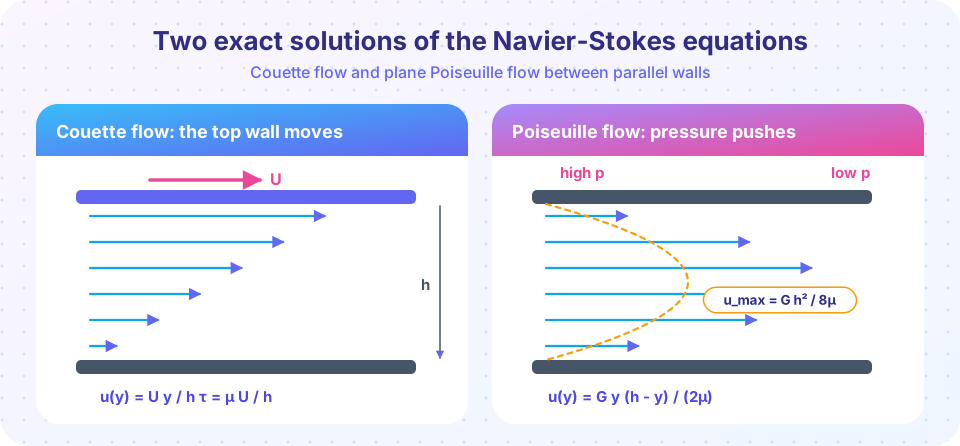
Plane Couette flow
Let the lower wall be fixed (u = 0) and the upper wall move at speed U, with G = 0. The solution is a straight line:
u(y) = U y / h
The velocity gradient is U/h everywhere, so the shear stress τ = μ U / h is uniform. Check the physics: to keep the upper plate moving you must push with force per unit area μ U/h. A bearing with oil film h = 0.1 mm, oil viscosity μ = 0.05 Pa s and plate speed U = 2 m/s needs τ = 0.05 × 2 / 0.0001 = 1,000 Pa.
Plane Poiseuille flow
Now hold both walls fixed (u = 0 at y = 0 and y = h) and apply a pressure gradient. The solution is a parabola:
u(y) = G y (h - y) / (2μ)
From it we read off all the useful quantities.
| Quantity | Formula |
|---|---|
Maximum velocity (at y = h/2) |
u_max = G h² / (8μ) |
| Mean velocity | Ubar = G h² / (12μ) = (2/3) u_max |
| Flow rate per unit width | Q = G h³ / (12μ) |
| Wall shear stress | τw = G h / 2 |
The flow rate scales with h³. Halving the gap reduces the flow by a factor of eight at the same pressure gradient. This cubic law is why a slightly narrowed artery or a clogged microchannel has such a large effect.
Combining both effects gives a general solution, because the equation is linear: u = U y/h + G y (h - y)/(2μ). If the pressure gradient opposes the wall motion strongly enough (G h² / (2μ U) < -1), the profile has backflow near the lower wall. A similar reverse flow appears in boundary layers on the way to separation.
Hagen-Poiseuille flow in a pipe
For a circular pipe of radius R, use cylindrical coordinates: u(r) with G = -dp/dx. The momentum equation becomes 0 = G + μ (1/r) d/dr (r du/dr). Using symmetry on the axis and no slip at r = R:
u(r) = G (R² - r²) / (4μ)
| Quantity | Formula |
|---|---|
| Centerline velocity | u_max = G R² / (4μ) |
| Mean velocity | Ubar = G R² / (8μ) = u_max / 2 |
| Flow rate | Q = π G R⁴ / (8μ) |
| Wall shear stress | τw = G R / 2 |
Q scales with R⁴. Doubling the radius gives sixteen times the flow. This is the Hagen-Poiseuille law, found experimentally by Gotthilf Hagen and Jean Poiseuille in the 1830s and 1840s.
Write the wall friction in dimensionless form with Re = Ubar D / ν and D = 2R:
f = 8 τw / (ρ Ubar²) = 64 / Re
This is the laminar friction factor, valid only while the flow stays laminar (up to about Re ≈ 2,300 in practice, though a carefully quiet pipe can stay laminar longer).
Worked example
Water (μ = 1.0 × 10⁻³ Pa s, ρ = 1000 kg/m³) flows through a tube of diameter 2 mm and length 0.5 m under a pressure drop of 2 kPa. Then G = 2000 / 0.5 = 4000 Pa/m, R = 1 mm, and
Ubar = G R² / (8μ) = 4000 × 10⁻⁶ / (8 × 10⁻³) = 0.5 m/sQ = π R² Ubar = π × 10⁻⁶ × 0.5 ≈ 1.57 × 10⁻⁶ m³/s(about 1.6 mL/s)Re = Ubar D / ν = 0.5 × 0.002 / 10⁻⁶ = 1,000, so laminar flow is consistent.
Always check Re after the fact. If it came out near 10⁴, the laminar formula would not apply.
Using exact solutions to test a code
When you write a flow solver, run it on a case that has an exact answer. For Poiseuille flow, discretize μ u'' = -G on a grid with u = 0 at both walls. The finite-difference formula u[i-1] - 2u[i] + u[i+1] = -G dy²/μ gives a tridiagonal system. For a quadratic solution, the central difference is exact, so the error should be at rounding level. That is a sharp test: any larger error reveals a bug.
Common misconceptions
- "The velocity is highest where the shear is highest." In Poiseuille flow the shear stress is zero at the center, where the velocity is highest, and maximum at the walls, where the velocity is zero.
- "More pressure always gives proportionally more flow." Only for laminar flow. In turbulent pipe flow,
Qgrows roughly as the square root of the pressure drop, not linearly. - "Pipe flow is laminar if
Reis below 2,300, always." The number is a guideline; very smooth pipes can stay laminar to higherRe, and disturbances can trigger turbulence at lowerReonly rarely.
Try it
Press Run (or Ctrl + Enter) to see the result here.
Program input · what you'd type while the program runs
Type the answers before you press Run, one per line. Each time the program reads a line (with input()), it gets the next line from this box.
Press Run (or Ctrl + Enter) to see the result here.
Program input · what you'd type while the program runs
Type the answers before you press Run, one per line. Each time the program reads a line (with input()), it gets the next line from this box.
Check your understanding
Quick check · 5 questions
of 5 answered You scored / 5 · perfect!
-
1. In plane Poiseuille flow, where is the shear stress zero?
The stress is τ = μ du/dy, and the parabola has zero slope at its maximum, in the middle of the gap. -
2. A pipe's radius is doubled at the same pressure gradient. How does the laminar flow rate change?
Q = πGR⁴/(8μ) scales with the fourth power of the radius, and 2⁴ = 16. -
3. What is the ratio of mean to maximum velocity in Hagen-Poiseuille pipe flow?
u_max = GR²/(4μ) and Ubar = GR²/(8μ), so the ratio is one half. For plane Poiseuille flow it is 2/3. -
4. What does the laminar friction factor equal in a circular pipe?
From τw = GR/2 and Ubar = GR²/(8μ) you get f = 8τw/(ρ Ubar²) = 64/Re. -
5. Why is the finite-difference solution of Poiseuille flow essentially exact?
The three-point formula for the second derivative reproduces the second derivative of any quadratic exactly, up to rounding.
Summary
- Straight, steady flow reduces Navier-Stokes to
μ u'' = dp/dx. - Couette flow is a straight line with uniform shear
μU/h; plane Poiseuille flow is a parabola withUbar = (2/3) u_max. - Pipe flow gives
u = G(R² - r²)/(4μ),Q = πGR⁴/(8μ)andf = 64/Re. - Exact solutions are the first test for any numerical solver.
Track your progress
Create a free account to tick off lessons and pick up where you left off on any device.
of Fluid Dynamics lessons completed