


















Lesson 12 of 46 · Conservation Equations and Navier-Stokes
Continuity: Conservation of Mass in a Flow
Derive the continuity equation for a control volume and a small box, see why A1 v1 equals A2 v2 for incompressible flow and test whether a velocity field conserves mass.
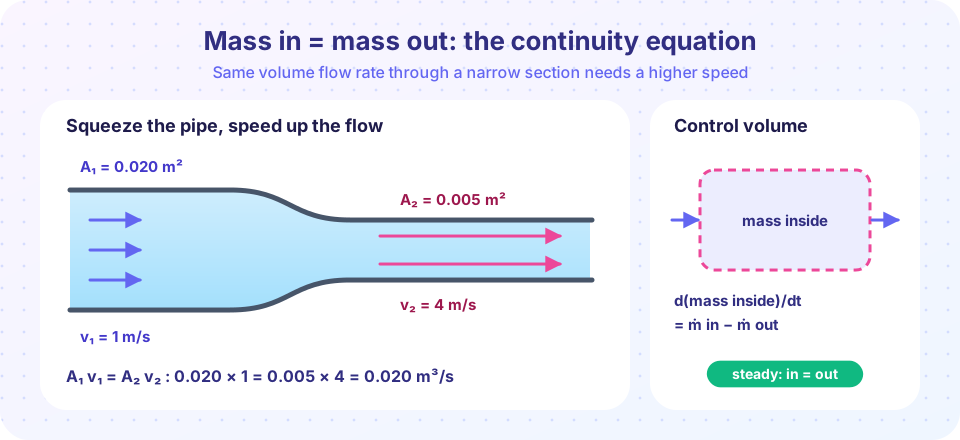
Squeeze the end of a garden hose and the water leaves faster. You did not add water; you made the opening smaller, so the same water has to leave at a higher speed. That everyday observation is conservation of mass at work. Because mass can be neither created nor destroyed, whatever flows into a region must either flow out or accumulate inside. Written as an equation, this bookkeeping is the continuity equation, the first of the governing equations of fluid dynamics.
What you will learn
- How to write the mass balance for a control volume.
- The incompressible result
A₁v₁ = A₂v₂and its use for pipes and junctions. - The differential form
∂ρ/∂t + ∇·(ρu) = 0and its incompressible version∇·u = 0. - How to find a missing velocity component from continuity.
Key terms
Control volume: a fixed region of space through whose boundary fluid can flow.
Mass flow rate ṁ = ρ A v: kilograms per second crossing an area A at normal speed v.
Volume flow rate Q = A v: cubic metres per second.
Divergence ∇·u: the net outflow of volume per unit volume per unit time.
Mass balance for a control volume
Draw a closed surface in space. The mass inside it is M. Mass can change only because fluid crosses the surface:
dM/dt = ṁ_in − ṁ_out.
For a steady flow through a duct with one inlet (area A₁, speed v₁, density ρ₁) and one outlet (A₂, v₂, ρ₂), nothing accumulates, so ṁ_in = ṁ_out:
ρ₁ A₁ v₁ = ρ₂ A₂ v₂.
If the density is constant (liquids; gases at low Mach number), ρ cancels:
A₁ v₁ = A₂ v₂ = Q.
The speed is inversely proportional to the cross-section area. Two corollaries: streamlines crowd together where the flow is fast; and at a junction, the incoming flow rates equal the sum of the outgoing: Q₁ = Q₂ + Q₃.
Worked example 1: a pipe contraction
Water enters a pipe of diameter D₁ = 0.10 m at v₁ = 2 m/s. It narrows to D₂ = 0.05 m. Areas: A₁ = π (0.05)² = 7.85×10⁻³ m², A₂ = π (0.025)² = 1.96×10⁻³ m². Flow rate: Q = A₁v₁ = 1.57×10⁻² m³/s (15.7 L/s). Exit speed: v₂ = Q/A₂ = 8 m/s. Halving the diameter quadruples the area ratio, so the speed increases by 4 × 2 = 8 m/s. Note: the factor is the square of the diameter ratio.
Worked example 2: a branching pipe
A main pipe carries Q = 30 L/s. It splits into two branches. Branch B takes 12 L/s. Branch C then carries 30 − 12 = 18 L/s. If branch C has diameter 0.08 m (A = 5.03×10⁻³ m²), its speed is 0.018 / 5.03×10⁻³ = 3.58 m/s.
Worked example 3: a filling tank
A tank of horizontal area A_t = 1 m² receives 0.5 L/s and loses 0.3 L/s. The mass balance (constant ρ) gives A_t dh/dt = Q_in − Q_out = 0.2 L/s = 2×10⁻⁴ m³/s, so dh/dt = 2×10⁻⁴ m/s: 0.72 m per hour.
Continuity at a point
Shrink the control volume to a tiny box with sides dx, dy, dz. Net mass outflow per unit time through its faces, divided by the box volume, is ∇·(ρu). The rate of change of mass per unit volume is ∂ρ/∂t. The local mass balance is therefore
∂ρ/∂t + ∇·(ρu) = 0 (continuity equation, any fluid).
Expanding the divergence of a product gives Dρ/Dt + ρ ∇·u = 0. A fluid particle's density changes only if the flow diverges or converges. For an incompressible flow, Dρ/Dt = 0 and so
∇ · u = ∂u/∂x + ∂v/∂y + ∂w/∂z = 0.
This is exactly the divergence test of the previous lesson: it says each fluid particle keeps its volume. It does not say that the density is uniform in space (layers of salt water of different density can coexist), only that it does not change following a particle.
Worked example 4: finding a missing component
In a 2D incompressible flow, u = 2x (fluid is stretched in x). What is v? From ∂u/∂x + ∂v/∂y = 0: 2 + ∂v/∂y = 0, so v = −2y + f(x), where f(x) is an unknown function (it does not change ∂v/∂y). If v = 0 at the wall y = 0, then f(x) = 0 and v = −2y. This is the stagnation flow seen earlier.
Common misconceptions
"Incompressible means constant density everywhere." It means constant density following each particle. A stratified ocean is incompressible but has density varying with depth.
"Continuity says the speed is the same everywhere." The opposite: continuity says the speed changes wherever the cross-section changes.
"Continuity is the same as Bernoulli." Continuity is conservation of mass and involves no forces. Bernoulli (chapter 4) comes from energy or momentum and links speed to pressure.
Try it
First, a duct whose radius dips to half its value at a throat. We apply v = Q/A along the duct and plot both the shape and the speed. At the throat the area has fallen to a quarter, so the speed is four times higher.
Press Run (or Ctrl + Enter) to see the result here.
Program input · what you'd type while the program runs
Type the answers before you press Run, one per line. Each time the program reads a line (with input()), it gets the next line from this box.
Second, an interactive pipe. Move the sliders to change the two diameters and the inlet speed; the numbers and the arrow lengths follow continuity.
Check your understanding
Quick check · 5 questions
of 5 answered You scored / 5 · perfect!
-
1. Water flows at 1.5 m/s in a pipe of cross-section 0.02 m2. It enters a section of 0.005 m2. The new speed is
v2 = A1 v1 / A2 = 0.02 x 1.5 / 0.005 = 6 m/s. -
2. If a pipe's diameter is halved, the speed of an incompressible flow in it
Area scales with diameter squared, so halving the diameter reduces the area to a quarter and quadruples the speed. -
3. The incompressible continuity equation says
div u = 0: each fluid particle keeps its volume. -
4. For a 2D incompressible flow with u = 3x, which v satisfies continuity and v = 0 at y = 0?
du/dx = 3 requires dv/dy = -3, so v = -3y (+ f(x), zero by the boundary condition). -
5. A main flow of 40 L/s splits into two branches. One carries 15 L/s. The other carries
Q_in = Q_1 + Q_2, so Q_2 = 40 - 15 = 25 L/s.
Summary
- Mass balance for a control volume:
dM/dt = ṁ_in − ṁ_out. - Incompressible steady flow in a duct:
A₁v₁ = A₂v₂; junctions: flow in = flow out. - Differential form:
∂ρ/∂t + ∇·(ρu) = 0; incompressible:∇·u = 0. - Continuity determines a missing velocity component, but it says nothing about forces or pressure.
Next: Stress and Viscosity
Track your progress
Create a free account to tick off lessons and pick up where you left off on any device.
of Fluid Dynamics lessons completed