


















Lesson 17 of 46 · Ideal and Potential Flow
Chapter 4 Overview: Ideal and Potential Flow
Why ignoring viscosity gives useful answers: ideal fluids, irrotational flow and potential flow, plus a preview of Bernoulli, stream functions and the cylinder.
The Navier-Stokes equations are hard. But in many flows, viscosity matters only in thin layers next to walls, and almost everywhere else the fluid behaves as if it had no friction at all. Remove the viscous term and you get the Euler equations. Add the observation that flow starting from rest is irrotational and you get potential flow, where the whole problem collapses to Laplace's equation, one of the best-studied equations in mathematics. This chapter shows what this idealization gets right (pressure, lift, speed), what it gets wrong (drag), and why it is still the foundation of aerodynamics.
What you will learn
- When it is reasonable to ignore viscosity.
- What irrotational flow is and why flows starting from rest are usually irrotational.
- The structure of the chapter: Bernoulli, stream function and potential, elementary flows, the cylinder.
- The famous failure of ideal theory: d'Alembert's paradox.
Key terms
Ideal (inviscid) fluid: a fluid with zero viscosity; no shear stress, only pressure.
Irrotational flow: vorticity is zero everywhere, ∇×u = 0.
Velocity potential φ: a scalar whose gradient is the velocity, u = ∇φ.
Stagnation point: a point where the fluid speed is zero.
When can viscosity be ignored?
At a high Reynolds number, the viscous term of Navier-Stokes is small compared with inertia in most of the flow. Flow around an airplane wing at cruise has Re of the order of tens of millions. Yet viscosity cannot be dropped everywhere: the no-slip condition still holds at the surface, and within a thin boundary layer the viscous term is as big as the inertial one. The strategy of the first half of the twentieth century, due largely to Ludwig Prandtl (1904), is to split the flow into two regions: an outer region, where the ideal-flow equations work, and the thin boundary layer, which chapter 5 treats separately. Chapter 4 is the outer region.
Irrotational flow
Take the Euler equations (Navier-Stokes without viscosity). Kelvin's circulation theorem (1869) says that in an ideal, barotropic flow with conservative body forces, the circulation around any closed loop moving with the fluid does not change in time. A flow that begins at rest, or with uniform velocity far upstream, has zero circulation to begin with, so it stays irrotational: ω = ∇ × u = 0.
For an irrotational flow, the velocity is the gradient of a scalar function: u = ∇φ. If it is also incompressible, ∇·u = 0 becomes Laplace's equation:
∇²φ = 0.
It is a linear equation: if φ₁ and φ₂ are solutions, so is any combination. This superposition principle is a huge simplification, and it lets us build complicated flows from simple building blocks.
The plan for the chapter
Chapter 4 in four steps
Building and testing
The catch
The lessons
- Euler equation and Bernoulli's equation: the energy balance along a streamline, with Venturi tubes, Torricelli's law and Pitot tubes.
- Stream function and velocity potential: two scalar fields and the grids they form.
- Elementary flows and superposition: uniform stream, source, vortex and doublet.
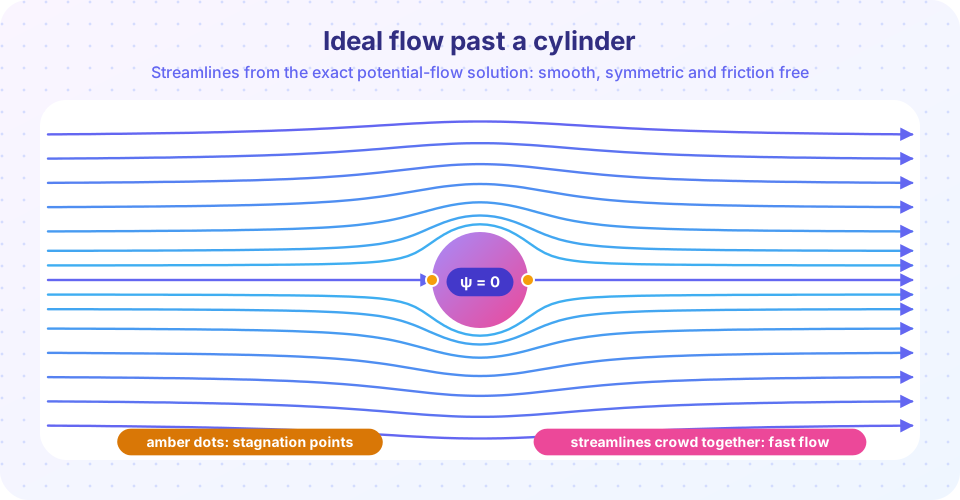
- Flow past a cylinder: pressure distribution, d'Alembert's paradox, lift with circulation.
- Chapter 4 review.
The paradox to come
When you compute the pressure distribution on a cylinder in potential flow and add up the forces, the answer for the drag is exactly zero. In 1752 Jean le Rond d'Alembert noticed this and could not reconcile it with the obvious fact that real bodies feel drag. The paradox is resolved by the boundary layer and flow separation of chapter 5. It does not make potential flow useless: the pressure on the front of a body, and the lift on a wing at small angles of attack, are predicted well.
Common misconceptions
"Ideal fluid means the fluid is perfect or frictionless in reality." It is a model that drops the viscous term. It is excellent far from walls and wrong inside boundary layers.
"Irrotational means the streamlines are straight." A free vortex has circular streamlines and is irrotational (except at its centre).
"Potential flow applies to every fluid motion." It requires ω = 0, which holds only where viscosity and boundary layers have not generated vorticity.
Try it
Compute the potential flow past a circular cylinder of radius a in a stream U: the streamlines come from the stream function ψ = U sinθ (r − a²/r), and the surface speed is 2U |sinθ|. The code draws both. Notice how the streamlines crowd above and below the cylinder.
Press Run (or Ctrl + Enter) to see the result here.
Program input · what you'd type while the program runs
Type the answers before you press Run, one per line. Each time the program reads a line (with input()), it gets the next line from this box.
Second, the ideal-flow assumption is only as good as the Reynolds number is large. This console example prints the Reynolds number of a few flows to see where ideal flow is a sensible outer model.
Press Run (or Ctrl + Enter) to see the console output here.
No output.
Check your understanding
Quick check · 5 questions
of 5 answered You scored / 5 · perfect!
-
1. Potential flow assumes the flow is
Potential flow has zero vorticity so that u = grad(phi); with incompressibility, phi satisfies Laplace's equation. -
2. Laplace's equation for the potential is
div u = 0 with u = grad phi gives the Laplacian of phi equal to zero. -
3. Which important property of Laplace's equation makes potential flow easy to use?
Superposition: sums of solutions are solutions. -
4. Where must potential flow fail to describe a real flow?
Viscosity matters inside the boundary layer, where vorticity is generated. -
5. d'Alembert's paradox is that ideal flow around a body predicts
The net force opposing the motion is zero in steady, ideal, irrotational flow.
Summary
- At high Reynolds numbers, viscosity matters only in thin layers; elsewhere, the Euler equations apply.
- Flow starting from rest stays irrotational (Kelvin), so
u = ∇φand∇²φ = 0. - Linearity lets us add elementary flows; the cylinder is a uniform stream plus a doublet.
- Ideal flow predicts pressure and lift well and drag not at all (d'Alembert's paradox).
Track your progress
Create a free account to tick off lessons and pick up where you left off on any device.
of Fluid Dynamics lessons completed