


















Lesson 3 of 46 · Getting Started
The Reynolds Number and Dynamic Similarity
Understand the Reynolds number as inertia over viscosity, see Reynolds' dye experiment, compute critical speeds and meet Mach, Froude and Strouhal numbers.
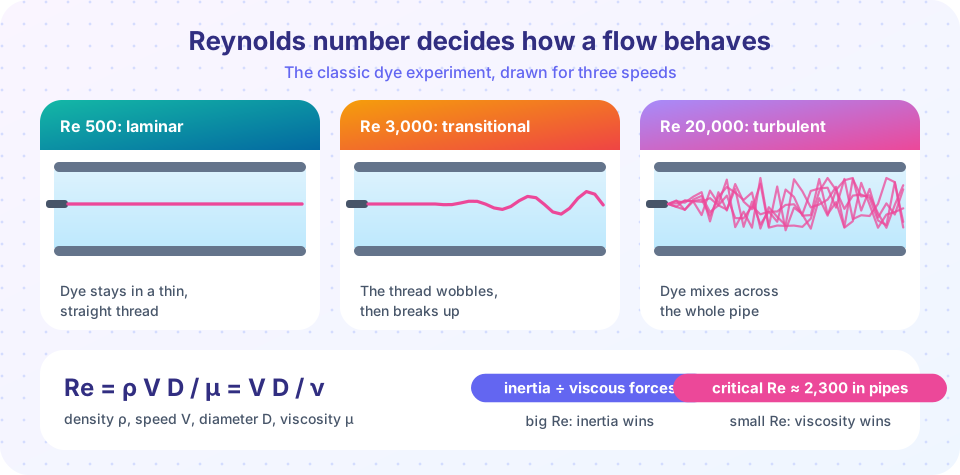
In 1883 the Manchester engineer Osborne Reynolds filled a glass tank with water, ran a glass tube out of it, and injected a thin thread of colored dye into the tube's entrance. At low flow rates the dye stayed as a straight thread along the tube. Raise the flow and the thread started to wobble, then burst into a cloud that filled the whole tube. Reynolds repeated the experiment with different tube diameters, water temperatures and speeds and found that the switch always happened at about the same value of one combination of quantities. We now call that combination the Reynolds number.
What you will learn
- What the Reynolds number is and why it is a ratio of inertial to viscous effects.
- How to compute
Reand the critical speed for a pipe. - What dynamic similarity means and why a small model can predict a big flow.
- The meaning of the Mach, Froude and Strouhal numbers.
Key terms
Reynolds number: Re = ρ V L / μ = V L / ν, with density ρ, speed V, length scale L and dynamic viscosity μ.
Kinematic viscosity ν = μ / ρ: momentum diffusivity, in m²/s. Water at 20 °C: about 1.0×10⁻⁶ m²/s; air: about 1.5×10⁻⁵ m²/s.
Characteristic length L: the size that matters, such as pipe diameter, chord of a wing or body length.
Dynamic similarity: two flows with the same dimensionless numbers behave the same way, whatever their sizes.
Why this combination?
Imagine a blob of fluid of size L moving at speed V. Two kinds of forces act on it. Inertia wants to keep the blob going in a straight line: its size is about density times velocity squared per unit of length, ρV²/L (force per unit volume). Viscosity drags the blob toward its neighbors: its size is about μV/L². The ratio of the two is
inertia / viscous = (ρV²/L) / (μV/L²) = ρ V L / μ = Re.
When Re is small, viscosity wins: disturbances are smoothed out and the flow is smooth. When Re is large, inertia wins: small disturbances grow, and the flow becomes turbulent. That is the whole idea. The details are the thresholds.
For flow in a circular pipe, using diameter D and the mean speed V:
Re < 2,300: laminar. A disturbance dies out.2,300 < Re < 4,000: transitional, intermittent bursts of turbulence ("puffs").Re > 4,000: turbulent.
Careful laboratory work has kept pipe flow laminar up to Re of 100,000 by removing every disturbance, and in ordinary pipes it becomes turbulent near 2,000 to 2,500. So 2,300 is a practical, not a universal, number.
Worked example 1: water in a 25 mm pipe
Water at 20 °C: ρ = 998 kg/m³, μ = 1.002×10⁻³ Pa·s, ν = 1.004×10⁻⁶ m²/s. Pipe diameter D = 0.025 m.
At V = 0.05 m/s: Re = 998 × 0.05 × 0.025 / 1.002×10⁻³ ≈ 1,245. Laminar.
At V = 1.0 m/s: Re = 998 × 1.0 × 0.025 / 1.002×10⁻³ ≈ 24,900. Strongly turbulent.
The critical speed for Re = 2,300 follows from solving for V: V_crit = Re ν / D = 2,300 × 1.004×10⁻⁶ / 0.025 ≈ 0.092 m/s. A garden-hose flow of about 1 m/s is therefore more than ten times the critical speed.
Worked example 2: the same pipe with air
Air at 20 °C has ν ≈ 1.5×10⁻⁵ m²/s. In the same 25 mm pipe, V_crit = 2,300 × 1.5×10⁻⁵ / 0.025 ≈ 1.4 m/s. Air is much "thicker" in the kinematic sense (higher ν), so it stays laminar up to a higher speed than water. Note that this is not because air is more viscous in absolute terms: its dynamic viscosity μ is about 55 times smaller than that of water. It is because air's density is about 830 times smaller, so its inertia is tiny.
Dynamic similarity and models
If two geometrically similar flows have the same Reynolds number, the flow patterns scale exactly (provided no other dimensionless number matters). This is why aircraft designers test small models in wind tunnels, and ship designers pull small hulls through towing tanks.
Suppose you test a 1:10 scale model of a car that drives at 30 m/s. To match Re in the same air, the model needs ten times the speed: 300 m/s, a Mach number of about 0.87. Compressibility effects now appear that the real car never sees, so matching Re this way fails. Engineers solve this by pressurizing or cooling the tunnel gas (raising ρ/μ), or by using a different fluid such as water. This is exactly the sort of reasoning dimensionless numbers make possible.
Other numbers you will meet
| Number | Formula | Compares | Matters when |
|---|---|---|---|
Mach Ma |
V / a |
speed to speed of sound | gas flow near or above 0.3 |
Froude Fr |
V / √(g L) |
inertia to gravity | free surfaces: ships, rivers, waves |
Strouhal St |
f L / V |
oscillation period to flow time | vortex shedding, flutter |
Weber We |
ρ V² L / σ |
inertia to surface tension | droplets, sprays |
For example, a cylinder in a flow sheds vortices alternately from each side. For a wide range of Reynolds numbers (roughly 300 up to a few hundred thousand), the Strouhal number St = f D / V is about 0.2. A 10 mm wire in a 20 m/s wind therefore sings at about f = 0.2 × 20 / 0.01 = 400 Hz, which is why wires and antennas whistle in the wind.
Common misconceptions
"Re = 2,300 is a law of nature." It is an empirical value for ordinary pipes. Smooth entrances, steady supplies or rough walls shift it. On a flat plate the transition is around Re of several hundred thousand based on distance from the leading edge.
"A bigger Reynolds number means a faster flow." Re also grows with size and falls with viscosity. A blue whale swimming slowly can have a larger Re than a mosquito flying fast.
"Any length will do." The length in Re must be the one that matters for the question: pipe diameter for pipe flow, chord for a wing, distance from the leading edge for a boundary layer. Quote the length whenever you quote a Reynolds number.
Try it
A live explorer: choose a fluid, a speed and a length, and see the Reynolds number, the Mach number and the pipe-flow regime. The sliders are logarithmic, so you can reach from a crawl to a jet.
Now plot the critical speed for water as a function of pipe diameter. Anything above the line is turbulent. Notice how quickly the threshold shrinks for big pipes.
Press Run (or Ctrl + Enter) to see the result here.
Program input · what you'd type while the program runs
Type the answers before you press Run, one per line. Each time the program reads a line (with input()), it gets the next line from this box.
Check your understanding
Quick check · 5 questions
of 5 answered You scored / 5 · perfect!
-
1. The Reynolds number is a ratio of
Re = rho V L / mu compares the tendency of fluid to keep moving (inertia) with viscous damping. -
2. Water (nu = 1.0e-6 m2/s) flows in a 0.05 m pipe. What speed gives Re = 2,300?
V = Re nu / D = 2300 x 1.0e-6 / 0.05 = 0.046 m/s. -
3. Why can a 1:10 model car not simply be tested at the real car's Reynolds number in the same air at the same pressure?
Matching Re at one tenth the length requires ten times the speed, about Mach 0.87 here, where air compressibility changes the flow. -
4. Which dimensionless number compares inertia with gravity at a free surface?
Fr = V / sqrt(g L) compares inertia to gravity and governs waves, ships and open channels. -
5. A wire in a 20 m/s wind has diameter 10 mm. With St = 0.2, what is the approximate shedding frequency?
f = St V / D = 0.2 x 20 / 0.01 = 400 Hz.
Summary
Re = ρVL/μcompares inertial and viscous forces; smallReis smooth, largeReis turbulent.- In pipes, laminar below about 2,300, turbulent above about 4,000, with a transition band between.
- Dynamic similarity lets models predict full-scale flows if all the relevant dimensionless numbers match.
- Mach, Froude, Strouhal and Weber numbers measure other competitions: compressibility, gravity, oscillation and surface tension.
Next: Chapter 1 Review
Track your progress
Create a free account to tick off lessons and pick up where you left off on any device.
of Fluid Dynamics lessons completed