


















Lesson 27 of 46 · Viscous Flow and Boundary Layers
Chapter 5 review: viscous flow and boundary layers
Review exact viscous solutions, Blasius boundary layers, separation and drag with a one-page picture, a recap table, a calculator and a ten-question quiz.
This chapter followed one idea from several angles: viscosity is weak but never absent, and it acts where velocity gradients are large. Use this review to see the whole chapter at a glance, test yourself, and try a combined calculator.
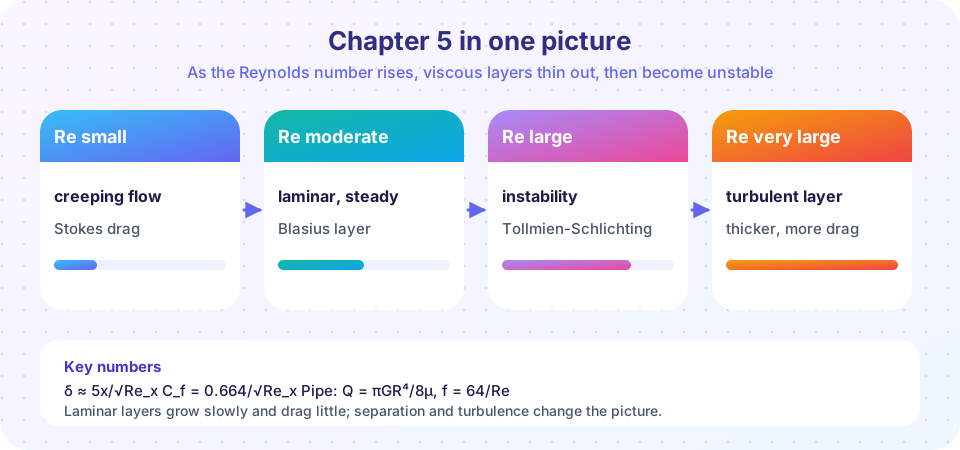
Recap
| Lesson | Key results |
|---|---|
| Couette and Poiseuille | Straight line u = Uy/h; parabola u = Gy(h-y)/2μ; pipe Q = πGR⁴/8μ, f = 64/Re |
| Blasius layer | δ = 4.91 x/√Re_x, Cf = 0.664/√Re_x, C_D = 1.328/√Re_L; transition around Re_x of 10⁵ to 3×10⁶ |
| Separation and drag | Adverse dp/dx causes ∂u/∂y = 0 at the wall; pressure drag; Stokes C_D = 24/Re; drag crisis |
How experts reason
An experienced engineer looks at a new flow and asks three questions in order. What is the Reynolds number? If it is large, where are the thin layers (walls, wakes, jets)? In each layer, is the pressure gradient favorable or adverse? Those three answers usually predict whether the flow is attached, whether the drag is mostly friction or pressure, and whether the layer might separate.
Common misconceptions
- "Exact solutions are only toys." They calibrate numerical codes and describe microfluidics, lubrication and blood flow in small vessels.
- "Boundary-layer thickness is where velocity equals U." It only approaches U asymptotically, so the 99% convention is used.
Try it
Press Run (or Ctrl + Enter) to see the result here.
Program input · what you'd type while the program runs
Type the answers before you press Run, one per line. Each time the program reads a line (with input()), it gets the next line from this box.
Press Run (or Ctrl + Enter) to see the console output here.
No output.
Check your understanding
Quick check · 10 questions
of 10 answered You scored / 10 · perfect!
-
1. In Couette flow between a fixed and a moving plate (no pressure gradient), what is the velocity profile?
With G = 0, μ u'' = 0, so u is linear in y. -
2. In plane Poiseuille flow, by what factor does the flow rate change if the gap h is halved at fixed G?
Q = G h³/(12 μ), so halving h divides Q by 8. -
3. A laminar flat-plate boundary layer at x = 1 m has δ = 5 mm. What is δ at x = 4 m (same U and ν)?
δ ∝ √x, and √4 = 2, so δ doubles. -
4. Which quantity measures the momentum lost in the boundary layer and relates to drag?
The momentum thickness θ is proportional to the drag per unit width on a flat plate. -
5. What happens to the wall shear stress at a separation point?
Separation is defined by ∂u/∂y = 0 at the wall. -
6. Which pipe formula is correct for laminar flow?
f = 64/Re is the laminar Darcy friction factor; the 0.316 Re^(-1/4) law is the Blasius turbulent correlation. -
7. Why is pressure drag large on a flat plate facing the flow?
Separation at the plate edges leaves a low-pressure wake, while the stagnation region on the front has high pressure. -
8. What does a drag crisis on a sphere correspond to?
A turbulent layer resists the adverse gradient better, so the wake narrows and C_D drops. -
9. At which Reynolds number does linear theory predict the first growth of Tollmien-Schlichting waves on a flat plate (in terms of Re_x)?
The critical value from linear stability is Re_x ≈ 9 × 10⁴, corresponding to Re_δ* ≈ 520. -
10. A bacterium has Re ≈ 10⁻⁴. Which statement is true?
At tiny Re the viscous term wins: motion stops almost at once when the propulsion stops.
Summary
- Exact solutions (Couette, Poiseuille) show what viscous stress does and test numerical codes.
- Laminar flat-plate layers:
δ ∝ √x,Cf = 0.664/√Re_x. - Adverse pressure gradients cause separation and pressure drag.
- Next, turbulence changes both layer growth and friction.
Track your progress
Create a free account to tick off lessons and pick up where you left off on any device.
of Fluid Dynamics lessons completed