


















Lesson 22 of 46 · Ideal and Potential Flow
Chapter 4 Review: Ideal and Potential Flow
Review chapter 4 of Fluid Dynamics: Euler and Bernoulli, stream function and potential, elementary flows and the cylinder, with a recap table and quiz.
Chapter 4 showed how much you can learn about a flow by throwing away viscosity. Pressure, speed, stagnation points and even lift come out of a few lines of algebra. It also showed the limit of the idea: the zero drag of d'Alembert's paradox, which only the boundary layers of chapter 5 can fix. Use the picture and the table below to check that the chapter's ideas hang together.
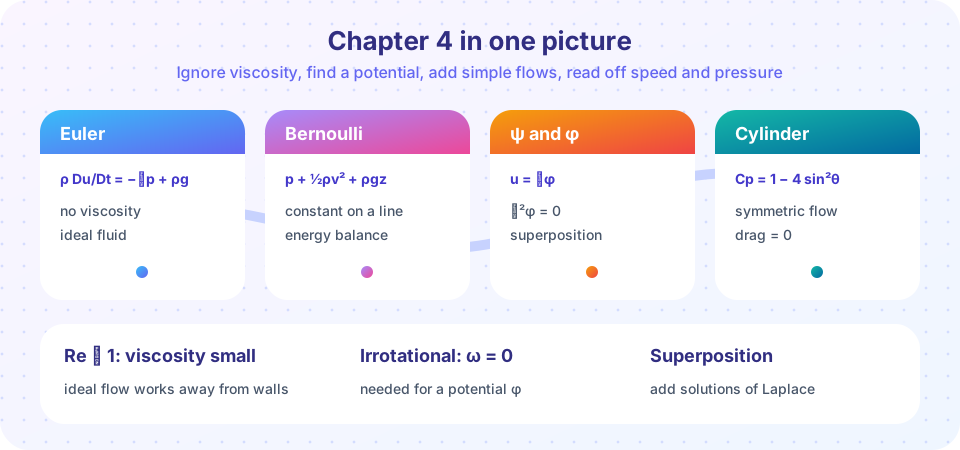
What you will learn
- A recap of the formulas of the chapter in one table.
- Which tool to use for which kind of question.
- A ten-question self-test.
Recap table
| Topic | Key formula | Remember |
|---|---|---|
| Bernoulli | p + ½ρv² + ρgz = const |
along a streamline; steady, incompressible, inviscid |
| Torricelli | v = √(2gh) |
same as free fall |
| Pitot | v = √(2(p₀ − p)/ρ) |
stagnation minus static |
| Stream function | u = ψ_y, v = −ψ_x |
ψ differences are flow rates |
| Potential | u = ∇φ, ∇²φ = 0 |
needs ω = 0 |
| Source | u_r = m/(2πr) |
strength m in m²/s |
| Vortex | u_θ = Γ/(2πr) |
irrotational except at the centre |
| Cylinder | Cp = 1 − 4 sin²θ |
surface speed `2U |
| Lift | L' = ρUΓ |
Kutta-Joukowski; drag still 0 |
Key terms
Superposition: adding solutions of Laplace's equation to build new flows.
Stagnation point: speed zero, pressure equal to p∞ + ½ρU² in a uniform stream.
Dividing streamline: the streamline that splits at a stagnation point and outlines a body.
Circulation Γ: the line integral of velocity around a loop; the source of lift.
Which tool for which question?
- "How does pressure change when the speed changes along a streamline?" Bernoulli.
- "What is the flow rate between two curves?" The difference of
ψ. - "Can I model a body as a stream plus simple sources?" Superposition; find the dividing streamline
ψ = const. - "How much lift does a spinning or lifting body generate?" Kutta-Joukowski:
ρUΓ. - "Why does a real cylinder have drag?" Separation of the boundary layer: the subject of chapter 5.
Common misconceptions
"Bernoulli's equation explains lift by itself." It relates pressure and speed; circulation explains why the speeds differ.
"Streamlines of a potential flow around a cylinder are the same in real air." Only in front and near the surface for attached flow; the rear is replaced by a separated wake.
"Superposition works for pressure." Add velocities (or ψ, φ), then compute the pressure from the total velocity.
Try it
Combine the lesson's formulas in one calculator: for a cylinder in a stream with spin, print the surface speed at several angles, the pressure and the stagnation points.
Press Run (or Ctrl + Enter) to see the console output here.
No output.
Second, a plot that unites the chapter: pressure coefficient around the cylinder against the speed on the surface, with the Bernoulli relation Cp = 1 − (v/U)² made visible.
Press Run (or Ctrl + Enter) to see the result here.
Program input · what you'd type while the program runs
Type the answers before you press Run, one per line. Each time the program reads a line (with input()), it gets the next line from this box.
Check your understanding
Quick check · 10 questions
of 10 answered You scored / 10 · perfect!
-
1. Bernoulli's equation can be applied between two points on the same streamline if the flow is
Those are the standard conditions for p + 1/2 rho v^2 + rho g z = constant. -
2. A tank of water drains through a hole 3 m below the surface. The exit speed is about
v = sqrt(2 x 9.81 x 3) = 7.67 m/s. -
3. For psi = 5xy, the velocity components are
u = dpsi/dy = 5x; v = -dpsi/dx = -5y. -
4. A source of strength 12.6 m^2/s gives a radial speed at r = 1 m of about
u_r = m / (2 pi r) = 12.6 / 6.283 = 2.0 m/s. -
5. The stagnation pressure in a stream of air (1.2 kg/m^3) at 30 m/s is p_inf plus
(1/2) rho U^2 = 0.5 x 1.2 x 900 = 540 Pa. -
6. The lift per metre on a cylinder with circulation 5 m^2/s in water (998 kg/m^3) at 2 m/s is
L' = rho U Gamma = 998 x 2 x 5 = 9,980 N/m. -
7. Which statement about the circulation-free cylinder is correct?
The pressure distribution is symmetric, so both force components vanish. -
8. The cylinder's stagnation points with k = 1 (Gamma/(2 pi U a)) are at sin(theta) equal to
sin(theta_s) = -k/2 = -0.5 (lower half for clockwise spin). -
9. Where does ideal-flow theory fail most seriously?
Viscous effects in the boundary layer and wake are absent from the ideal model. -
10. Superposition of potential flows is allowed because
The sum of solutions of a linear equation is a solution.
Summary
- Ideal-flow tools: Bernoulli along streamlines,
ψandφ, elementary flows and superposition. - The cylinder gives
Cp = 1 − 4 sin²θ, zero drag and, with circulation, liftρUΓ. - The paradox of zero drag leads to the boundary layer, which chapter 5 develops.
- You can now describe, derive and compute many flows; the next chapters add the physics the ideal model leaves out.
Track your progress
Create a free account to tick off lessons and pick up where you left off on any device.
of Fluid Dynamics lessons completed