


















Lesson 8 of 46 · Continuum and Kinematics
Streamlines, Pathlines and Streaklines
Learn the three curves used to picture a flow, how to compute each one, why they differ in unsteady flow and why they coincide when the flow is steady.
A velocity field is a lot of arrows. To understand a flow at a glance, we draw curves. The curves experimenters draw in the lab and the ones theorists draw on paper are not always the same, and mixing them up is a classic source of confusion. There are three: streamlines, pathlines and streaklines. Each answers a different question, and each is easy to compute once you see which question it is.
What you will learn
- The definition of each curve and the differential equation it solves.
- How the three curves differ in an unsteady flow.
- Why they coincide in a steady flow.
- How to compute a streamline by hand for a simple field.
Key terms
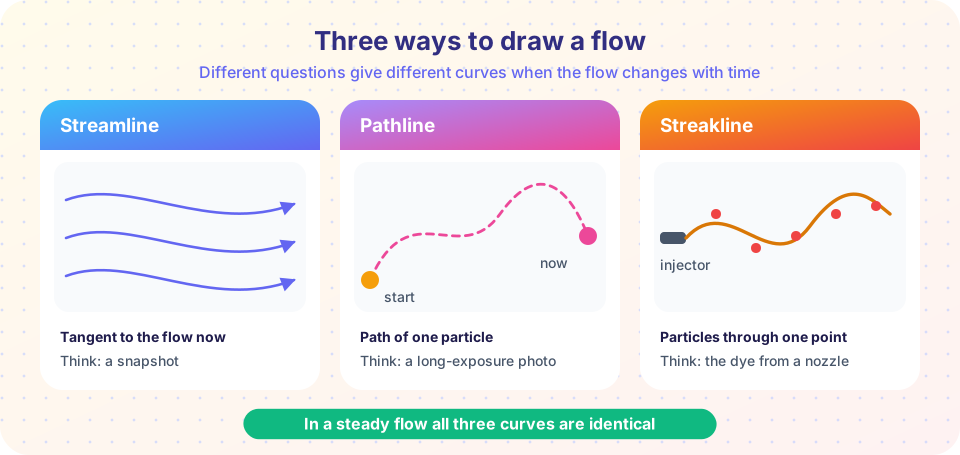
Streamline: a curve that is everywhere tangent to the velocity vector at one instant.
Pathline: the trajectory of one fluid particle over time.
Streakline: the curve formed, at one instant, by all particles that have passed through one fixed point.
Stream tube: a bundle of streamlines through a closed curve; no fluid crosses its side walls.
Streamlines: the snapshot
Freeze time at t = t₁. A streamline is any curve whose tangent at each point points along the local velocity. If a short element of the curve is (dx, dy), tangency means it is parallel to (u, v):
dx / u = dy / v (evaluated at the frozen time).
In a 2D flow this gives a single ordinary differential equation, dy/dx = v/u, which you integrate with t held constant. Streamlines never cross (except at points where the velocity is zero), because a point cannot have two velocities. Where streamlines crowd together, the flow is fast (for an incompressible flow).
Pathlines: the particle track
A pathline answers: where does this particle go? You solve the particle's equations of motion dx/dt = u(x, y, t), dy/dt = v(x, y, t) from a starting point, with t now varying. It is what a long-exposure photograph shows if a single bright bead is carried by the flow. Different particles started at different times from the same place trace different pathlines in an unsteady flow.
Streaklines: the dye line
Release dye continuously from a fixed nozzle. At time T, every dye particle that left the nozzle at any earlier time t₀ is somewhere along the curve. Connecting the current positions of all those particles gives the streakline. Smoke from a chimney and ink from a pipette make streaklines. Experiments with smoke in wind tunnels almost always show streaklines, not streamlines.
When they coincide
In a steady flow, the velocity field does not change, so the tangent direction at every point is fixed for all time. A particle that passes a point follows the same curve as the one before it: the pathline is a streamline, and every particle that passed the nozzle lies on that same streamline, so the streakline is the same curve. All three curves are identical. This is why a streamline picture is so useful for steady flows, and why the distinction matters only for unsteady ones.
Worked example: a wavy flow
Take the field u = 1, v = a sin(kx − ωt) with a = 0.5, k = 1.5 m⁻¹ and ω = 3 s⁻¹. The pattern is a wave traveling at speed ω/k = 2 m/s while the fluid itself moves at 1 m/s, so particles and wave move at different speeds. That mismatch is exactly what makes the three curves differ.
Streamline through the origin at time T. With u = 1, dy/dx = a sin(kx − ωT). Integrating from x = 0 gives y = −(a/k)[cos(kx − ωT) − cos(ωT)]. Check: at x = 0 this gives y = 0 ✓.
Pathline of a particle released at the origin at t = 0. Since dx/dt = 1, we have x = t, and dy/dt = a sin(kt − ωt) = −a sin(1.5 t). Integrating from y(0) = 0 gives y = (a / 1.5)(cos(1.5 t) − 1), which is never positive: the particle only ever drifts to negative y. The wave crosses the particle faster than the particle moves, so the streamline (which sees the whole wave at one instant) and the pathline (which sees the wave pass by) have different shapes.
Streakline. Computed numerically below: integrate every particle released from the origin at times t₀ from 0 to T, and record where each one is at time T.
Common misconceptions
"Streamlines show where fluid particles go." Only in steady flows. In unsteady flows, particles follow pathlines, which can cross a streamline many times.
"Streamlines can cross." They cannot (except at stagnation points), because that would give one point two velocities. Pathlines of different times can cross, because the field changes between them.
"A smoke photo shows streamlines." Smoke shows streaklines. They match streamlines only if the flow is steady.
Try it
This plot computes all three curves for the wavy flow of the worked example at T = 4 s. Look how the dashed streamline, the particle's path and the streak differ.
Press Run (or Ctrl + Enter) to see the result here.
Program input · what you'd type while the program runs
Type the answers before you press Run, one per line. Each time the program reads a line (with input()), it gets the next line from this box.
Now run the experiment yourself. The blue curve is the streamline through the origin at the current time, the pink dots are dye particles (their line is the streakline) and the orange trail is the pathline of the first particle. Tick the box to freeze the wave (steady flow): all three curves should snap onto each other.
Check your understanding
Quick check · 5 questions
of 5 answered You scored / 5 · perfect!
-
1. A streamline is a curve that is
Streamlines are tangent to the instantaneous velocity field; pathlines and streaklines involve time evolution. -
2. Smoke released continuously from a chimney draws a
A continuous source shows all particles that have passed through one point: a streakline. -
3. When do streamlines, pathlines and streaklines coincide?
In steady flow the field is time independent, so every particle through a point follows the same curve. -
4. For the 2D field (u, v) the differential equation of a streamline is
Tangency to (u, v) means dy/dx = v/u, with time held fixed. -
5. Where streamlines of an incompressible flow are close together, the speed is
The same volume flow passes between neighbouring streamlines, so a narrower gap means a higher speed.
Summary
- Streamlines: tangent to velocity at one instant,
dy/dx = v/uwith time fixed. - Pathlines: tracks of single particles,
dx/dt = u. - Streaklines: the line of all particles that passed one point, what dye and smoke show.
- All three are identical in steady flow and differ in unsteady flow.
Track your progress
Create a free account to tick off lessons and pick up where you left off on any device.
of Fluid Dynamics lessons completed