


















Lesson 5 of 46 · Continuum and Kinematics
Chapter 2 Overview: Describing Motion Without Forces
Chapter 2 of Fluid Dynamics: how to describe flow with velocity fields, the material derivative, streamlines and vorticity before asking what causes the motion.
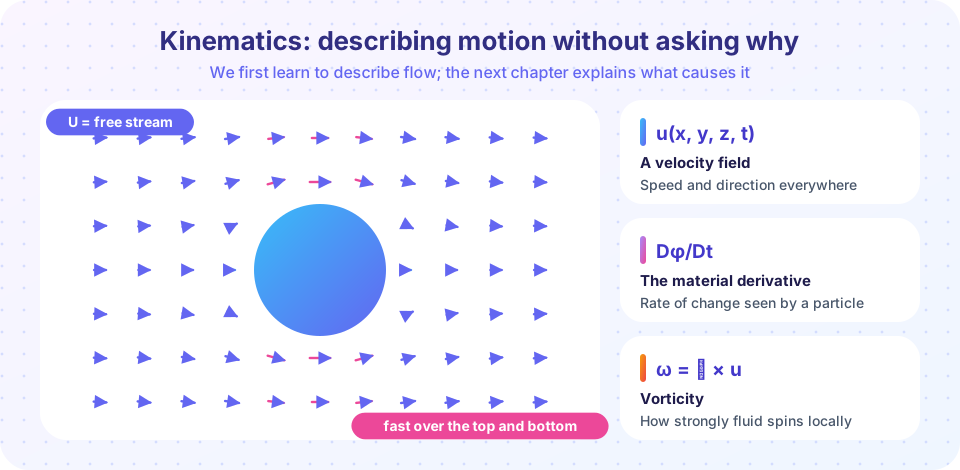
Kinematics is the part of mechanics that describes motion without asking what causes it. For a single ball this means position, velocity and acceleration. For a fluid, which has no fixed number of pieces, we need a new language: the field. Instead of naming the particles and following each one, we ask for the velocity at every point of space at every instant. This chapter builds that language, and chapter 3 will then ask which fields nature allows.
What you will learn
- Why fluids are described by fields instead of by lists of particles.
- The five topics of this chapter and what each one gives you.
- How to read a velocity-field plot.
Key terms
Velocity field u(x, y, z, t): the fluid velocity as a vector at every position and time.
Eulerian description: describe the flow at fixed points of space. Lagrangian description: follow individual fluid particles.
Material derivative D/Dt: the rate of change of a quantity as seen by a particle moving with the fluid.
Vorticity ω = ∇ × u: twice the local angular velocity of the fluid.
The picture of the chapter
Chapter 2 in five steps
Following the flow
Why it matters
What each lesson covers
- The continuum hypothesis: why a collection of molecules can be treated as smooth fields, and where that fails (the Knudsen number).
- Eulerian and Lagrangian views: two ways of watching, and the material derivative that connects them.
- Streamlines, pathlines and streaklines: three curves that coincide only in steady flow.
- Deformation, strain rate and vorticity: what a small fluid element can do, and how to measure it.
- Chapter 2 review: a one-page picture and a ten-question quiz.
Reading a velocity field
A velocity field has a vector at every point. In two dimensions, we write u = (u, v) where u is the x component and v the y component. A plot draws an arrow at a grid of points: the arrow's direction is the flow direction and its length is the speed. Where arrows are long, the flow is fast; where they are short or absent, the fluid is nearly still. A field is called uniform when the arrow is the same everywhere, steady when the arrows do not change with time, and irrotational when the fluid does not spin locally (we make that precise in lesson 5).
Common misconceptions
"A field arrow shows where one particle goes." The arrow shows the velocity of whatever fluid is at that point at that instant. The particle that is there now will be somewhere else a moment later, with a different arrow.
"Kinematics ignores physics." Kinematics ignores the forces, but it still contains a lot of physics: mass conservation, for example, is a kinematic constraint on which fields are possible.
Try it
The first example plots two simple fields with arrows and with streamlines: a stagnation-point flow (fluid hits a wall and spreads out) and a rigid rotation. You do not need to understand the formulas yet; look at how the pictures differ.
Press Run (or Ctrl + Enter) to see the result here.
Program input · what you'd type while the program runs
Type the answers before you press Run, one per line. Each time the program reads a line (with input()), it gets the next line from this box.
The second example is interactive. Move the pointer over the square to read the velocity of four classic fields at that point. Notice how the arrow changes size and direction with position.
Check your understanding
Quick check · 4 questions
of 4 answered You scored / 4 · perfect!
-
1. What does a velocity field give you?
A velocity field assigns a vector to every position (and time), so it describes the whole flow at once. -
2. In the Eulerian description you
Eulerian means fixed points of space; Lagrangian means moving with the particles. -
3. A flow field that does not change with time is called
Steady means all field values at each point are independent of time. -
4. Vorticity measures
Vorticity is the curl of the velocity and equals twice the local angular velocity of fluid elements.
Summary
- Fluids are described by fields: velocity (and pressure and density) at every point and time.
- Eulerian descriptions watch fixed points; Lagrangian descriptions follow particles; the material derivative links them.
- Streamlines, pathlines and streaklines are different curves, equal only for steady flow.
- Deformation and vorticity measure how a small fluid element stretches, shears and spins.
Next: The Continuum Hypothesis
Track your progress
Create a free account to tick off lessons and pick up where you left off on any device.
of Fluid Dynamics lessons completed