


















Lesson 23 of 46 · Viscous Flow and Boundary Layers
Chapter 5 overview: viscous flow and boundary layers
See the big picture of viscous flow: exact solutions, thin boundary layers, separation and drag, and why the Reynolds number decides which picture applies.
Ideal flow, the topic of the previous chapter, is a beautiful theory with one famous flaw: it predicts that a body moving steadily through a fluid feels no drag at all. Real bodies do feel drag, and the reason is viscosity. This chapter puts viscosity back into the picture and shows where it matters, where it does not, and how the two regions fit together.
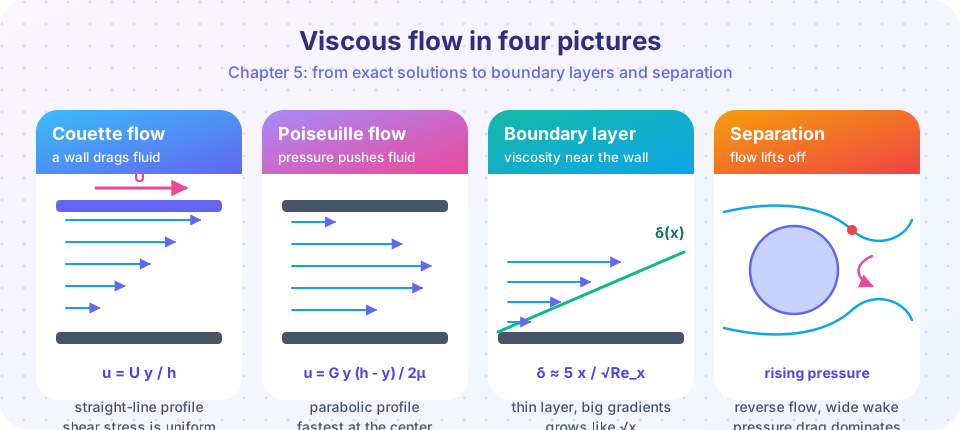
What you will learn
- Why viscosity is important close to walls even when the fluid is "thin" like air or water.
- How exact solutions (Couette and Poiseuille flow) show what viscous stress does.
- What a boundary layer is, how thick it gets, and how much drag it causes.
- Why flow separates from blunt bodies and how this creates pressure drag.
Key terms
- Viscosity (μ): the property that turns velocity differences into shear stress,
τ = μ du/dy. - Kinematic viscosity (ν):
ν = μ / ρ, the diffusivity of momentum, in m²/s. - Reynolds number (Re):
Re = U L / ν, the ratio of inertial to viscous effects. - No-slip condition: fluid touching a solid wall moves with the wall.
- Boundary layer: the thin region next to a wall where viscosity changes the velocity from zero to the free-stream value.
The big picture
Think of a flow as a crowd of layers sliding past each other. Viscosity is the friction between neighboring layers. At a wall the no-slip condition forces the fluid to stop, so somewhere between the wall and the open stream the speed must change. That change happens across a layer, and inside it viscous stress is important.
For water or air the viscosity is small, so for ordinary sizes and speeds the Reynolds number is large. A large Reynolds number does not mean that viscosity can be ignored everywhere. It means that viscosity is confined to thin regions: boundary layers on walls and wakes behind bodies. Outside them, the flow behaves almost like the ideal flow of chapter 4. This is the great insight of Ludwig Prandtl in 1904, and it is the reason we can calculate the flow around an airplane wing without solving the full equations over the whole space.
Viscosity at work
Exact solutions
Boundary layers
Separation
How the lessons fit together
- Couette and Poiseuille flow solves the Navier-Stokes equations exactly for flow between parallel plates and in a pipe, and builds a numerical check.
- The laminar boundary layer derives how thick the layer is and how much wall friction it produces on a flat plate.
- Separation, drag and the Reynolds number explains why blunt bodies create wakes and how drag coefficients change with Re.
- Chapter review ties everything into one picture and tests you with ten questions.
Where flows live on the Reynolds scale
A bacterium swims at a Reynolds number far below 1: its motion is completely dominated by viscosity, and it stops the moment it stops pushing. A human swimmer has a Reynolds number of order a million, where inertia dominates and boundary layers are thin. The same equations describe both. Only the balance of terms differs.
Common misconceptions
"Air and water are nearly inviscid, so viscosity never matters." Viscosity is small, but without it there would be no drag, no lift on a real wing and no wake. A tiny viscosity acting in a thin layer has large consequences.
"Large Re means turbulent everywhere." Large Re means thin viscous layers. Whether those layers are laminar or turbulent depends on disturbances, roughness and pressure gradients.
Try it
Press Run (or Ctrl + Enter) to see the result here.
Program input · what you'd type while the program runs
Type the answers before you press Run, one per line. Each time the program reads a line (with input()), it gets the next line from this box.
The widget is a demonstration of the dimensionless ratio, not a flow solver. Rough regime names are guides, because real transitions depend on geometry.
Check your understanding
Quick check · 4 questions
of 4 answered You scored / 4 · perfect!
-
1. What does the no-slip condition say?
Fluid in contact with a solid surface has the same velocity as the surface, so a fixed wall has zero fluid velocity. -
2. For water flowing in a river, the Reynolds number is large. What does that tell you about viscosity?
Large Re means inertia dominates in most of the flow, while viscosity acts in thin layers next to walls and in wakes. -
3. Which unit does kinematic viscosity have?
Kinematic viscosity ν = μ/ρ has units of area per time, like a diffusion coefficient for momentum. -
4. Who introduced the boundary-layer idea in 1904?
Prandtl showed that viscous effects at large Reynolds number are confined to a thin layer near the body.
Summary
- Viscosity converts velocity differences into shear stress and explains drag.
- The no-slip condition makes the wall speed equal to the fluid speed there.
- At large Reynolds number viscosity is confined to boundary layers and wakes.
- The chapter covers exact solutions, laminar boundary layers and separation.
Track your progress
Create a free account to tick off lessons and pick up where you left off on any device.
of Fluid Dynamics lessons completed