


















Lesson 2 of 46 · Getting Started
Flow Around Us: The Six Questions
Learn the six questions that classify any flow: steady or unsteady, laminar or turbulent, compressible or not, viscous or inviscid, 1D to 3D, internal or external.
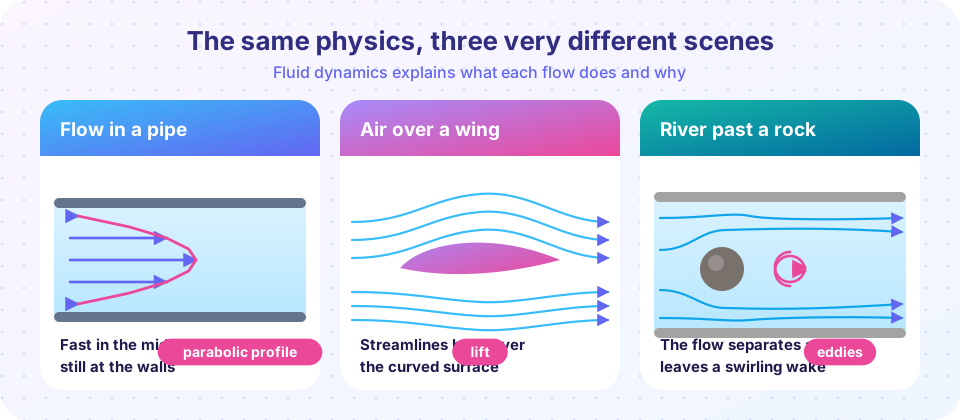
Look at a stream of water leaving a tap. At low flow it is a smooth, glassy rod. Open the tap wider and it breaks into a rough, churning jet. Same water, same tap, very different behavior. To reason about flows like this, fluid dynamicists ask a small set of questions about every flow before they write a single equation. The answers tell them which equations apply and which simplifications are safe.
What you will learn
- The six questions used to classify a flow.
- What laminar, turbulent, steady, compressible, viscous and inviscid mean in practice.
- How to tell internal flow (in a duct) from external flow (around a body).
- Why the Reynolds and Mach numbers decide most of the answers.
Key terms
Steady flow: at every point, velocity and pressure do not change with time.
Laminar flow: smooth flow in orderly layers; turbulent flow is irregular, swirling and mixes strongly.
Compressible flow: density changes appreciably. For gases this happens at high speed (Mach number above about 0.3).
Viscosity: the internal friction of a fluid, its resistance to shear. Inviscid means we ignore it.
Internal / external flow: flow bounded by walls (pipes) or flow around an immersed body (a car).
The six questions
1. Steady or unsteady?
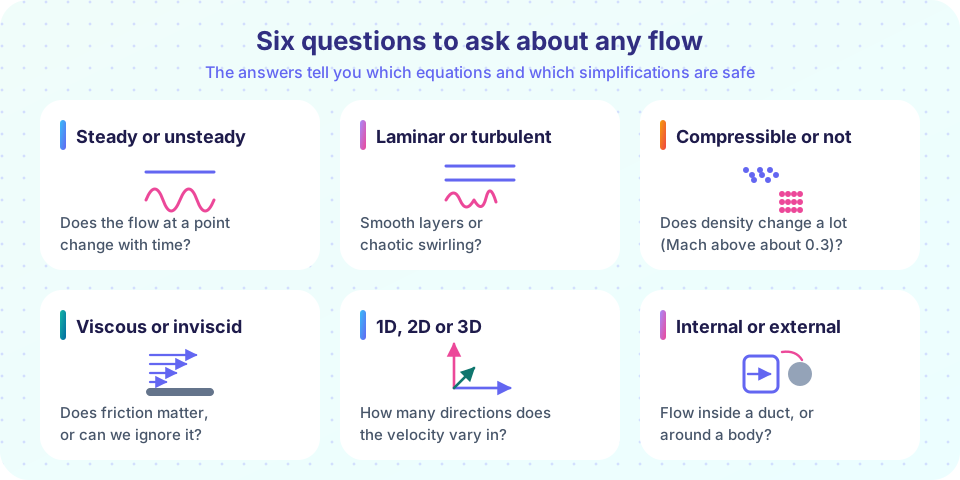
A flow is steady if what you see at one location never changes. Water leaving a tap at a constant rate is steady: the speed at a point just below the nozzle is always the same, even though different water molecules pass through it. A flow is unsteady if it changes with time, such as the air around a car while a gust arrives, or blood in an artery during a heartbeat. Steady problems are much easier because the derivative with respect to time drops out of the equations.
2. Laminar or turbulent?
In laminar flow, neighboring layers of fluid slide past each other in smooth lines. Dye injected into a laminar flow stays as a thin thread. In turbulent flow, the velocity at any point fluctuates randomly, eddies of many sizes appear, and the dye mixes quickly. Turbulence increases friction and also mixing and heat transfer, which is why it is useful in a coffee cup and harmful in a pipeline. The next lesson shows that one number, the Reynolds number, decides between them.
3. Compressible or incompressible?
Every fluid is compressible to some degree. Water is so stiff that its density hardly changes even under enormous pressures, so we treat it as incompressible. Air is easy to compress, but when it moves slowly its density barely changes, because pressure changes are small. The usual rule of thumb: treat gas flow as incompressible when the Mach number Ma = V / a (speed divided by the speed of sound) is below about 0.3. At Ma = 0.3 the density change in a steady flow is about 5 percent. A car at 100 km/h has Ma of about 0.08, so for aerodynamics we can treat the air as incompressible. A jet at cruise has Ma of about 0.8 and cannot.
4. Viscous or inviscid?
All real fluids have viscosity. But in many flows, viscous forces are tiny compared with inertia everywhere except in a thin layer next to surfaces. Ignoring viscosity gives the inviscid (ideal) flow of chapter 4: simple mathematics, surprisingly good answers for lift and pressure, but no drag. Chapter 5 shows how to patch the theory near surfaces.
5. One, two or three dimensions?
How many coordinates does the velocity depend on? Flow in a long straight pipe far from the ends depends only on the distance from the axis: a 1D flow in a useful sense. Flow past a very long cylinder is mostly 2D (the same in every cross-section). Flow around a real airplane is fully 3D. Fewer dimensions mean easier equations, so engineers reduce dimensions whenever they can.
6. Internal or external?
Internal flows are confined by walls: pipes, ducts, channels, blood vessels. The key results are pressure drop and flow rate. External flows surround a body: wings, cars, buildings, ships. The key results are lift and drag. Boundary layers on the outside of a wing and in a pipe obey the same physics, but the design questions differ.
Worked example: classify three flows
Smoke rising from an extinguished candle. It starts as a thin straight thread (laminar), then wobbles and breaks into curls higher up (transition to turbulent). It is unsteady in the turbulent part, 3D, essentially incompressible, external.
Air through a bicycle pump hose when you push slowly. Steady (while you push at a constant rate), laminar, incompressible (speed far below Ma = 0.3), internal, 1D in a first approximation.
The tip of a fast propeller. Tip speeds can approach the speed of sound, so the flow is compressible, unsteady in the lab frame, turbulent and 3D. This is the hardest category.
Common misconceptions
"Steady means the fluid is not moving." Steady means the pattern does not change. The fluid in a steady river flows continuously.
"Water is incompressible, so no liquid flow is ever compressible." Pressure waves (sound) travel through water, and water hammer in a pipe is a compressible effect. "Incompressible" is a modeling choice that is usually safe for liquids, not a property of nature.
"Laminar is good and turbulent is bad." Turbulence mixes fuel and air in an engine, delays separation on a golf ball and cools a computer chip. Which is better depends on the goal.
Try it
This table-maker computes the Reynolds number and the Mach number for six real situations, then draws the Reynolds numbers on a logarithmic axis. The values of density, viscosity and speed are typical and rounded.
Press Run (or Ctrl + Enter) to see the result here.
Program input · what you'd type while the program runs
Type the answers before you press Run, one per line. Each time the program reads a line (with input()), it gets the next line from this box.
Next, a small decision helper in the console: it takes a flow's Reynolds and Mach numbers and prints the answers to questions 2 and 3. This is a model of how engineers screen a problem, not a replacement for judgment.
Press Run (or Ctrl + Enter) to see the console output here.
No output.
(The Reynolds-number thresholds of 2,300 and 4,000 are for pipe flow. Flow over a flat plate or a wing has different thresholds; you will meet them in chapter 5.)
Check your understanding
Quick check · 5 questions
of 5 answered You scored / 5 · perfect!
-
1. Water flows steadily from a tap at a constant rate. Which description is correct?
Steady refers to time independence of the flow field at each point, not to the absence of motion. -
2. Up to roughly what Mach number can a gas flow normally be treated as incompressible?
At Mach 0.3 the density change is about 5 percent. Below that, the incompressible assumption is usually good. -
3. Which flow is an example of external flow?
External flows surround an immersed body such as a building, a car or a wing. The others are bounded by walls. -
4. What does ignoring viscosity (an inviscid model) lose?
An inviscid model keeps pressure and mass conservation but cannot describe friction at surfaces or the drag it causes. -
5. A flow is a function only of the distance from the axis of a long pipe. How many spatial dimensions is it in a useful sense?
The velocity varies with one coordinate (the radius), so the flow is effectively one-dimensional.
Summary
- Classify any flow with six questions: steady or unsteady, laminar or turbulent, compressible or not, viscous or inviscid, 1D/2D/3D, internal or external.
- Gas flow is usually incompressible below Mach 0.3; liquids almost always are.
- Viscosity matters near surfaces even in flows that are nearly ideal elsewhere.
- Turbulence is neither good nor bad; it is a regime with different physics.
Next: The Reynolds Number
Track your progress
Create a free account to tick off lessons and pick up where you left off on any device.
of Fluid Dynamics lessons completed