


















Lesson 34 of 46 · Waves and Instabilities
Surface gravity waves, dispersion and tsunamis
Derive wave speed from the dispersion relation, compare deep and shallow water, understand group velocity and ripples, and compute tsunami speed and shoaling.
A swell that left a storm 3,000 km away reaches the beach as long, regular waves. A tsunami crosses the ocean faster than a jet airliner but is barely noticeable at sea. Ripples from a falling raindrop spread out faster than larger waves, and the whole pattern changes shape as it travels. All of these follow from one relation between frequency and wavenumber, the dispersion relation of water waves.
What you will learn
- The linear dispersion relation
ω² = g k tanh(k h)and what it means. - The deep-water and shallow-water limits, and the wave speed in each.
- The difference between phase velocity and group velocity.
- How capillary waves, tsunami speed and shoaling follow from the same ideas.
Key terms
- Dispersion relation: the formula connecting frequency
ωand wavenumberk. - Dispersive waves: waves whose speed depends on wavelength.
- Deep water:
h > λ/2, where the bottom is not felt. - Shallow water:
h < λ/20, where waves are long compared with the depth. - Shoaling: the growth in height of a wave as it enters shallower water.
The dispersion relation
Consider a small-amplitude wave on water of depth h. Assume the flow is irrotational and inviscid, so a potential φ satisfies Laplace's equation. Apply the kinematic condition (the surface moves with the fluid), the dynamic condition (Bernoulli at the surface, with g as the restoring force), and no flow through the bottom. A solution η = a cos(kx - ωt) exists only if
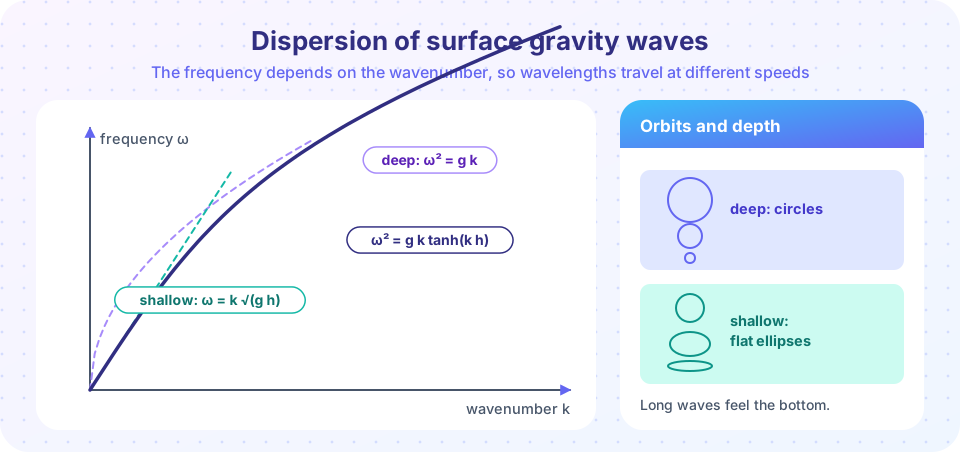
ω² = g k tanh(k h)
This gives the phase speed
c = ω/k = √( (g/k) tanh(k h) )
Deep water (h > λ/2)
Then tanh(kh) ≈ 1, so ω² = g k and
c = √(g λ / 2π) ≈ 1.25 √λ (in m/s, with λ in m)
Longer waves travel faster. A 100 m swell moves at 12.5 m/s, with a period T = λ/c = 8 s. A 1 m ripple moves at 1.25 m/s. The orbits of water particles are circles whose radius decays with depth as e^(-kz): at a depth of half a wavelength, the motion has shrunk to 4% of its surface value. That is why submarines can avoid a storm by diving.
Shallow water (h < λ/20)
Then tanh(kh) ≈ kh, so ω = k √(g h) and
c = √(g h)
All wavelengths travel at the same speed, which depends only on the depth. The orbits become flat ellipses and the water slides back and forth nearly horizontally.
Group velocity
A real wave packet contains many wavelengths. Its envelope, and the energy, travels at the group velocity c_g = dω/dk. In deep water ω = √(g k), so c_g = ½ √(g/k) = c/2: individual crests overtake the packet, appear at its rear, and die out at its front. In shallow water c_g = c, because there is no dispersion. The energy per unit surface area of a wave of amplitude a is E = ½ ρ g a², and the energy flux is E c_g.
Ripples: surface tension
Surface tension σ (about 0.0728 N/m for clean water at 20 °C) adds a restoring force for short waves. The full relation is
ω² = (g k + σ k³/ρ) tanh(k h)
In deep water, c² = g/k + σ k/ρ. The speed has a minimum at k = √(ρ g/σ), which gives a wavelength of 1.7 cm and a minimum speed of about 0.23 m/s. Waves much longer than that are gravity waves, much shorter are capillary waves. This is why a fishing line moving through water creates ripples ahead of it and gravity waves behind it.
Tsunamis and shoaling
An earthquake displaces the sea floor and makes a wave with wavelength of order 100 km and period of about 15 minutes. Compared with an ocean depth of 4,000 m, that is very much shallow-water, so c = √(g h) = √(9.81 × 4000) ≈ 198 m/s ≈ 710 km/h. The wave height in the open ocean is typically below a meter, with a slope so gentle that ships do not notice it.
As the wave approaches the coast, h falls and c falls with it. The period stays fixed, so the wavelength shortens, λ = c T. Energy flux E c_g is conserved (neglecting reflection and friction), and since c_g = √(g h) falls, E ~ a² must rise. This gives Green's law:
a ∝ h^(-1/4)
From 4,000 m to 10 m depth, the wave speed falls to √(9.81 × 10) ≈ 9.9 m/s (36 km/h), and the amplitude of a 0.5 m deep-ocean wave grows by a factor of (400)^(1/4) ≈ 4.5 in linear theory. In reality, nonlinear steepening, breaking, bay shape and run-up on land make the final effect much larger and very site-dependent.
Common misconceptions
- "Big waves always travel faster." In deep water yes, but in shallow water all wavelengths travel at the same speed
√(gh). - "A tsunami is a very tall wave in the open ocean." It is long and low at sea; the danger comes from the huge volume of water and energy as it shoals.
- "The wave crest speed is the speed of the energy." In deep water the energy moves at half the crest speed.
Try it
Press Run (or Ctrl + Enter) to see the result here.
Program input · what you'd type while the program runs
Type the answers before you press Run, one per line. Each time the program reads a line (with input()), it gets the next line from this box.
Press Run (or Ctrl + Enter) to see the result here.
Program input · what you'd type while the program runs
Type the answers before you press Run, one per line. Each time the program reads a line (with input()), it gets the next line from this box.
The animation is a visual illustration of group and phase motion with the ratio one half, not a measurement.
Check your understanding
Quick check · 5 questions
of 5 answered You scored / 5 · perfect!
-
1. In deep water, how does the wave speed depend on wavelength?
c = √(gλ/2π), so longer waves are faster. -
2. What is the speed of a tsunami in 4,000 m of water, approximately?
c = √(9.81 × 4000) ≈ 198 m/s, about 710 km/h. -
3. What is the ratio of group velocity to phase velocity in deep water?
ω = √(gk) gives c_g = dω/dk = ½ √(g/k) = c/2. -
4. Why does a tsunami grow in height as it approaches the shore?
With energy flux E c_g constant and c_g decreasing, the energy density, and hence the amplitude, rises (Green's law, a ∝ h^(-1/4)). -
5. What wavelength has the minimum phase speed for water waves?
The minimum occurs at k = √(ρg/σ), which gives λ ≈ 1.7 cm and c ≈ 0.23 m/s.
Summary
ω² = g k tanh(k h)governs linear gravity waves; capillarity addsσk³/ρ.- Deep water:
c = √(gλ/2π),c_g = c/2; shallow water:c = c_g = √(gh). - Tsunamis are shallow-water waves: about 710 km/h in a 4 km ocean, growing as
h^(-1/4)when shoaling. - Particle orbits are circles in deep water, flat ellipses in shallow water.
Next: Instabilities of fluids
Track your progress
Create a free account to tick off lessons and pick up where you left off on any device.
of Fluid Dynamics lessons completed