


















Lesson 33 of 46 · Waves and Instabilities
Chapter 7 overview: waves and instabilities
See how waves carry energy through fluids and how instabilities decide when smooth flow breaks up, with a map of the chapter and a live wave demonstration.
Drop a pebble in a pond and rings spread outward. Heat a pan of oil and hexagonal cells appear. Pour cream into coffee and fingers of cream sink. Wind over water makes ripples, then waves. All of these are fluid phenomena in which a small disturbance either travels as a wave or grows into something bigger. This chapter introduces both: waves, which carry energy without carrying fluid with them, and instabilities, which explain how a smooth flow gives birth to waves, vortices and eventually turbulence.
What you will learn
- What a wave is in a fluid and which restoring forces create them (gravity, surface tension, compressibility, buoyancy).
- Why waves in water are dispersive: long waves and short waves travel at different speeds.
- What an instability is, and four classic examples.
- How waves and instabilities connect back to transition and turbulence.
Key terms
- Wavelength (λ) and wavenumber (k = 2π/λ): the length of one cycle and its inverse measure.
- Frequency (ω) and period (T = 2π/ω).
- Phase speed (c = ω/k): how fast a crest moves.
- Group velocity (c_g = dω/dk): how fast wave energy moves.
- Instability: a state where a small disturbance grows instead of decaying.
Waves in a fluid
A wave is a disturbance that travels because the fluid has a restoring force. Push water up and gravity pulls it back, overshooting and creating an oscillation: a gravity wave. Surface tension restores tiny ripples. Compression and expansion give sound waves. Stable density layering lets internal waves travel inside the ocean and atmosphere, where buoyancy plays the role of gravity.
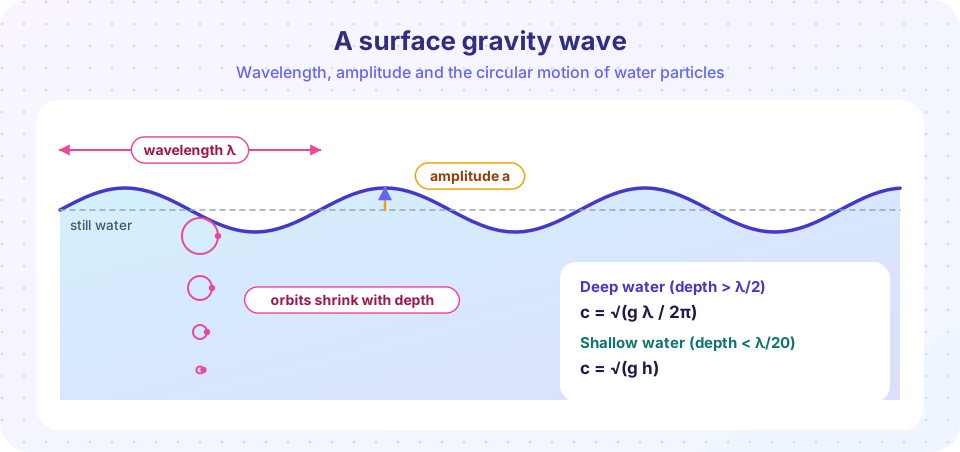
All of these share a pattern: the disturbance moves, but the fluid itself only oscillates about its place. A cork on a passing swell rises and falls and moves slightly forward and back, but it does not travel with the wave crest.
Instability
An instability is a different story. The base flow is an exact solution, but it is delicate. A small disturbance feeds on some source of energy: the kinetic energy of shear, the potential energy of a heavy fluid sitting above a light one, the heat added from below, or surface energy of a jet. The disturbance grows exponentially at first, e^(σt), then nonlinear effects take over. The study of instability (linear stability theory) asks: for which parameters is σ > 0?
Waves
Dispersion
Instabilities
The lessons
- Surface gravity waves and dispersion: the dispersion relation, deep and shallow limits, group velocity, tsunamis and shoaling.
- Instabilities of fluids: shear, density, heating and surface tension, with the criteria that decide when they occur.
- Chapter review: a summary picture and ten questions.
Common misconceptions
- "Water travels with the wave." Particles move in closed orbits; only the energy and pattern advance (apart from a small drift).
- "Instability means the flow is turbulent." Instability is the first step. It can lead to a new organized pattern (convection rolls, vortex streets) long before turbulence.
- "All waves in water travel at the same speed." Gravity waves are dispersive: speed depends on wavelength and depth.
Try it
Press Run (or Ctrl + Enter) to see the result here.
Program input · what you'd type while the program runs
Type the answers before you press Run, one per line. Each time the program reads a line (with input()), it gets the next line from this box.
The first is a calculator for the linear-theory formulas, and the second a visualization of the same formulas, not a flow simulation.
Check your understanding
Quick check · 4 questions
of 4 answered You scored / 4 · perfect!
-
1. What does a surface gravity wave carry from place to place?
Water particles move in closed orbits; the wave transports energy and momentum, with only a small net drift. -
2. Which pair is correctly matched?
Sound waves are restored by compressibility, capillary ripples by surface tension, and internal waves by buoyancy. -
3. What does phase speed c = ω/k measure?
Phase speed is the speed of a crest; group velocity dω/dk is that of the energy. -
4. What does it mean if the growth rate σ of a disturbance is positive?
A disturbance proportional to e^(σt) grows when σ > 0.
Summary
- Waves transport energy through restoring forces (gravity, tension, compressibility, buoyancy).
- Phase speed
ω/kand group velocitydω/dkdiffer in dispersive media. - Instabilities occur when small disturbances grow, drawing energy from the base flow.
- Convection, shear layers and jets are classic cases, the starting points of turbulence.
Track your progress
Create a free account to tick off lessons and pick up where you left off on any device.
of Fluid Dynamics lessons completed