


















Lesson 39 of 46 · Computational Fluid Dynamics
An incompressible flow solver: the lid-driven cavity
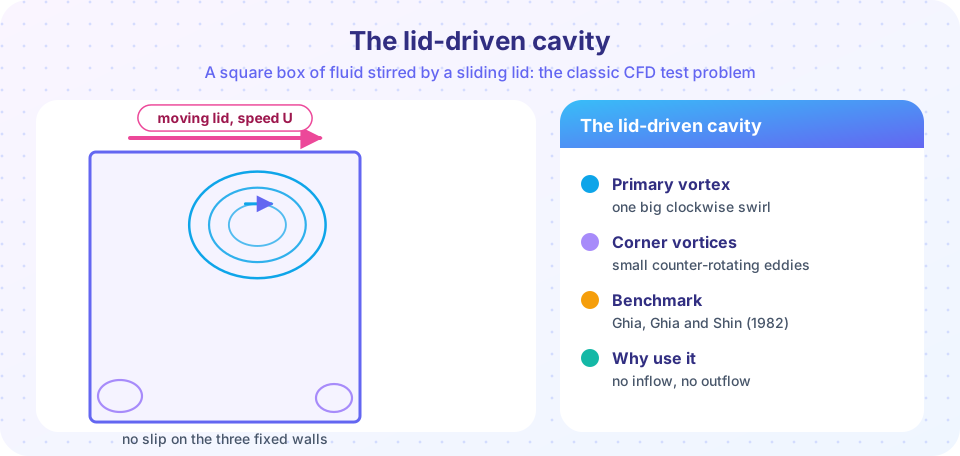
Build a 2D incompressible Navier-Stokes solver with the streamfunction-vorticity method, run the lid-driven cavity at Re = 100 and check it with grid refinement.
The previous lesson used a model equation. Real flows add two difficulties: the nonlinear advection term, and the incompressibility constraint ∇·u = 0, which is not an evolution equation for any variable. Pressure is whatever it needs to be to keep the velocity divergence-free. Finding it is the central difficulty of incompressible CFD. This lesson shows the cleanest way around the problem in two dimensions, the streamfunction-vorticity formulation, and uses it on the most famous benchmark in the field.
What you will learn
- How the streamfunction
ψand vorticityωremove the pressure and enforce∇·u = 0automatically. - How to implement a time-marching solver with wall vorticity boundary conditions.
- How the primitive-variable "projection" method handles pressure.
- How to check a solution by grid refinement.
Key terms
- Streamfunction (ψ): a scalar with
u = ∂ψ/∂yandv = -∂ψ/∂x; lines of constantψare streamlines. - Vorticity (ω):
ω = ∂v/∂x - ∂u/∂y, the local spin of the fluid. - Poisson equation:
∇²ψ = -ω, an elliptic equation that links the two. - Projection method: advance the velocity without the pressure, then project it onto a divergence-free field.
- Grid refinement study: compute on successively finer meshes and watch the answer converge.
Removing the pressure
In two dimensions, define ψ by u = ∂ψ/∂y, v = -∂ψ/∂x. Then ∂u/∂x + ∂v/∂y = ∂²ψ/∂x∂y - ∂²ψ/∂y∂x = 0: incompressibility is satisfied identically. Take the curl of the momentum equations (∂/∂x of the y-equation minus ∂/∂y of the x-equation); the pressure cancels, and the vorticity equation remains:
∂ω/∂t + u ∂ω/∂x + v ∂ω/∂y = ν ∇²ω
Vorticity is advected and diffused like any scalar. The velocity is tied to it through the definition of ω, which gives ∇²ψ = -ω.
The algorithm for each time step is:
- Set
ωon the walls fromψ(boundary condition below). - Compute
uandvfromψby central differences. - Advance
ωin the interior with an explicit step: advection, then diffusion. - Solve the Poisson equation
∇²ψ = -ωfor the newψ(here with a few Jacobi sweeps per step). - Repeat until
ωstops changing (a steady state).
Wall vorticity (Thom's formula)
On a fixed wall u = v = 0, so ψ is constant (we take 0). Expanding ψ one cell into the fluid and using ψ_n = 0 at the wall: ψ_1 = ½ ψ_nn Δn², so ω_wall = -ψ_nn = -2 ψ_1/Δn². On the moving lid the tangential speed U adds a term: ω_lid = -2 ψ_1/Δn² - 2U/Δn. These are first-order accurate boundary conditions and they are the most delicate part of the method.
Stability
The explicit step needs Δt ≤ Δx²/(4ν) (the diffusion limit in two dimensions) and Δt ≤ Δx/U (the advection limit). The code below picks a time step that satisfies both with a safety factor.
The primitive-variable alternative
In three dimensions there is no streamfunction, so codes use the velocity u and pressure p directly. In Chorin's projection method (1968), each step has three parts:
- Advance the velocity with advection and viscosity but without pressure, to get a provisional field
u*. - Solve the pressure Poisson equation
∇²p = (1/Δt) ∇·u*. - Correct:
u^{n+1} = u* - Δt ∇p, which is divergence-free.
Staggered grids (pressure at cell centers, velocities at faces, the MAC scheme of Harlow and Welch) avoid the "checkerboard" pressure that appears when both are stored at the same points. SIMPLE and its relatives (Patankar and Spalding, 1972) do the same job in steady finite-volume codes. In all of them, the pressure Poisson solve dominates the cost.
Common misconceptions
- "Pressure is a transported quantity." In incompressible flow it is a Lagrange multiplier: it adjusts instantly everywhere to maintain
∇·u = 0. - "Boundary conditions are details." In the vorticity method the wall formula carries the entire effect of the walls on the flow.
- "Converged residuals mean an accurate answer." Convergence tells you the iteration is done. Accuracy needs grid refinement.
Try it
Press Run (or Ctrl + Enter) to see the result here.
Program input · what you'd type while the program runs
Type the answers before you press Run, one per line. Each time the program reads a line (with input()), it gets the next line from this box.
Press Run (or Ctrl + Enter) to see the result here.
Program input · what you'd type while the program runs
Type the answers before you press Run, one per line. Each time the program reads a line (with input()), it gets the next line from this box.
The numbers come from running these programs. The benchmark value quoted is the commonly cited reference level for this problem, which you should check against the original paper (Ghia, Ghia and Shin, 1982) before citing it.
Check your understanding
Quick check · 5 questions
of 5 answered You scored / 5 · perfect!
-
1. What does the streamfunction ψ guarantee?
With u = ∂ψ/∂y and v = -∂ψ/∂x, the divergence vanishes identically. -
2. Which equation links ψ to the vorticity?
Since ω = ∂v/∂x - ∂u/∂y = -∇²ψ, the streamfunction satisfies a Poisson equation with the vorticity as source. -
3. What is Thom's formula used for?
ω_wall = -2ψ_1/Δn² (plus -2U/Δn on a moving wall) closes the vorticity equation at the boundary. -
4. In Chorin's projection method, what is the last step?
The correction u = u* - Δt ∇p makes the velocity divergence-free. -
5. Why is a grid refinement study necessary?
Only comparing solutions on finer and finer meshes shows how close the answer is to the continuous solution.
Summary
- In 2D,
ψremoves pressure and incompressibility; the vorticity equation is advection plus diffusion, and∇²ψ = -ωcloses it. - Wall vorticity from Thom's formula carries the no-slip condition; time steps obey
Δt ≤ Δx²/(4ν)andΔt ≤ Δx/U. - Primitive-variable codes use projection (Chorin) or SIMPLE, with a pressure Poisson equation.
- Always check solutions with a grid refinement study and a benchmark.
Next: Chapter 8 review
Track your progress
Create a free account to tick off lessons and pick up where you left off on any device.
of Fluid Dynamics lessons completed