


















Lesson 14 of 46 · Conservation Equations and Navier-Stokes
The Navier-Stokes Equations
Build the incompressible Navier-Stokes equations from Newton's second law, interpret each term, learn boundary conditions and verify the Taylor-Green vortex.
In 1822 the French engineer Claude-Louis Navier wrote down equations for fluid motion that included internal friction, reasoning from forces between molecules. Later, in the 1840s, the Irish mathematician George Gabriel Stokes derived the same equations from the continuum picture, with viscosity as an empirical constant. Together their names label one equation that governs the flow of water, air, oil and blood: Newton's second law, applied to a small piece of fluid.
What you will learn
- How Newton's second law becomes the Navier-Stokes momentum equation.
- What every term means physically, and its units.
- The standard boundary conditions.
- How the equations simplify at very small and very large Reynolds numbers, and how to verify a solution.
Key terms
Momentum equation: Newton's second law for a fluid particle, force per unit volume.
Pressure gradient −∇p: net pressure force per unit volume; the fluid is pushed from high to low pressure.
Viscous term μ∇²u: net friction force per unit volume; it smooths out differences in velocity.
Body force ρg: force acting throughout the volume, here gravity.
Stokes flow: the limit of very small Reynolds number, where inertia is ignored.
From Newton's second law to the equation
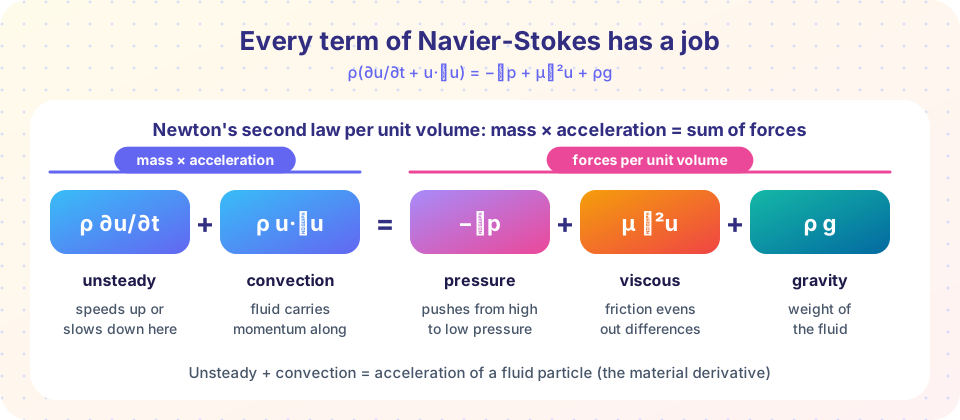
Take a fluid particle of volume dV. Its mass is ρ dV. By Newton's second law, ρ dV × (acceleration) = (sum of forces). We already know the acceleration (chapter 2): Du/Dt = ∂u/∂t + (u·∇)u. The forces per unit volume:
- Pressure. The pressure on the left face of a small box exceeds the pressure on the right face by
−(∂p/∂x) dx, so the net force per unit volume in x is−∂p/∂x. In vector form,−∇p. - Viscous friction. The shear stress on top and bottom faces of the box differ when the velocity gradient changes with position. For an incompressible fluid with constant
μ, the net force per unit volume turns out to beμ ∇²u, where∇²u = ∂²u/∂x² + ∂²u/∂y² + ∂²u/∂z²(the Laplacian). Intuitively: if the velocity at a point is lower than the average of its neighbors, the neighbors drag it forward. - Gravity.
ρ g, withg = 9.81 m/s²pointing down.
So:
ρ (∂u/∂t + u·∇u) = −∇p + μ ∇²u + ρ g, with ∇ · u = 0.
In 2D, written out for a flow in the x-y plane with g in the −y direction:
ρ (u_t + u u_x + v u_y) = −p_x + μ (u_xx + u_yy)
ρ (v_t + u v_x + v v_y) = −p_y + μ (v_xx + v_yy) − ρ g
and u_x + v_y = 0. Three equations for u, v and p. Dividing by ρ gives a common form with the kinematic viscosity: Du/Dt = −(1/ρ)∇p + ν∇²u + g.
What each term does
ρ ∂u/∂t(unsteady): the fluid speeds up or slows at a point.ρ u·∇u(convective): fluid moves to a place with a different velocity. It is nonlinear, and it creates eddies and, at high Reynolds number, turbulence.−∇p(pressure): the engine of flow, from high pressure to low pressure.μ ∇²u(viscous): it diffuses momentum, like heat diffusion, and damps velocity differences.ρ g(gravity): matters for free surfaces and buoyancy.
For a fluid at rest, u = 0 and the equation reduces to ∇p = ρ g: pressure increases with depth as p = p₀ + ρ g h. At a depth of 10 m in fresh water, ρ g h = 998 × 9.81 × 10 ≈ 9.8×10⁴ Pa, about one atmosphere on top of the surface pressure.
The pressure's strange job
In an incompressible flow, there is no equation of state for p. Instead, p is whatever it needs to be at each instant to keep ∇·u = 0. If you take the divergence of the momentum equation, you get a Poisson equation for p. Physically, pressure acts instantly everywhere (in the incompressible limit the speed of sound is infinite). This is why numerical solvers (chapter 8) spend most of their effort on the pressure.
Boundary conditions
The equations are second order in space, so each boundary needs a condition.
- No-slip at a solid wall: the fluid velocity equals the wall velocity,
u = u_wall. It is the usual condition when the Knudsen number is small. - Inlet: a given velocity profile.
- Outlet: often zero normal stress or a given pressure.
- Free surface (a water surface under air): the shear stress vanishes and the pressure equals the atmospheric pressure, plus surface-tension terms.
- Symmetry plane: normal velocity zero, normal derivative of the tangential velocity zero.
Dimensionless form and limiting cases
Scale lengths with L, speeds with V, time with L/V and pressure with ρV². The equation becomes
∂u*/∂t* + u*·∇*u* = −∇*p* + (1/Re) ∇*²u* (gravity omitted),
with Re = ρVL/μ. All the physics is now in one number.
Re → 0(Stokes or creeping flow): inertia drops out,∇p = μ∇²u. Linear equation. Examples: a bacterium swimming, honey oozing, particles settling in a thick fluid.Re → ∞(Euler): viscosity drops out, giving the ideal-fluid equations of chapter 4. It is a singular limit: the neglected term has the highest derivative, so near walls the thin boundary layers of chapter 5 appear.
Do solutions exist?
In 2D, it has been proved that smooth, unique solutions exist for all time. In 3D, it is not known whether smooth solutions always exist or whether they could develop infinite velocities in finite time. The Clay Mathematics Institute offers a prize of one million dollars for settling this (2000). It does not stop engineers: we use the equations, and numerical methods give excellent answers.
Common misconceptions
"Pressure is determined by an equation of state in water." For an incompressible flow, p is a constraint force; only pressure differences matter, and the absolute level is set by a boundary condition.
"Viscosity only slows the flow." The viscous term moves momentum from fast to slow regions; it also creates the thin shear layers where vorticity is generated at walls.
"The convective term is small because it contains no coefficient." It is ρ u·∇u, which is comparable to or much larger than the viscous term when Re is large.
Try it
An exact solution lets you check an equation completely. The Taylor-Green vortex is a decaying 2D flow with u = cos x sin y · F, v = −sin x cos y · F, p = −(ρ/4)(cos 2x + cos 2y) F² and F = e^{−2νt}. Let sympy prove it satisfies continuity and both momentum equations (the residuals should be zero).
Press Run (or Ctrl + Enter) to see the result here.
Program input · what you'd type while the program runs
Type the answers before you press Run, one per line. Each time the program reads a line (with input()), it gets the next line from this box.
Now see it. The first panel shows the velocity field and the pressure at t = 0 for ν = 0.05 m²/s (a thick fluid so decay is visible); the second shows the kinetic energy decaying as e^{−4νt}.
Press Run (or Ctrl + Enter) to see the result here.
Program input · what you'd type while the program runs
Type the answers before you press Run, one per line. Each time the program reads a line (with input()), it gets the next line from this box.
Finally, hydrostatic pressure, the only case where the full equation reduces to a one-line formula.
Press Run (or Ctrl + Enter) to see the console output here.
No output.
Check your understanding
Quick check · 5 questions
of 5 answered You scored / 5 · perfect!
-
1. In the Navier-Stokes momentum equation, which term represents friction?
The viscous term mu laplacian(u) is the net viscous force per unit volume. -
2. What is the pressure at 10 m depth in fresh water (gauge, rho = 998, g = 9.81)?
rho g h = 998 x 9.81 x 10 = 97,900 Pa, about 98 kPa, close to one atmosphere. -
3. In the limit Re tends to 0, the momentum equation becomes
Inertia is negligible; pressure forces balance viscous forces. It is a linear equation. -
4. The no-slip condition says that at a solid wall the fluid velocity
The fluid velocity equals the wall's velocity, zero for a fixed wall. -
5. Which statement about incompressible pressure is true?
Pressure acts as a constraint force that keeps the flow divergence-free.
Summary
- The Navier-Stokes equations are Newton's law for fluid:
ρ Du/Dt = −∇p + μ∇²u + ρg, with∇·u = 0. - The convective term is nonlinear and the source of turbulence; the viscous term diffuses momentum; pressure enforces incompressibility.
- No-slip at walls, specified inflow, free-surface conditions; scaling shows only
Rematters. - Exact solutions such as the Taylor-Green vortex test the equations; whether smooth 3D solutions always exist is an open Millennium Prize problem.
Track your progress
Create a free account to tick off lessons and pick up where you left off on any device.
of Fluid Dynamics lessons completed