


















Lesson 10 of 46 · Continuum and Kinematics
Chapter 2 Review: Continuum and Kinematics
Review chapter 2 of Fluid Dynamics: continuum hypothesis, Eulerian and Lagrangian views, D/Dt, flow lines, strain rate and vorticity, with a ten-question quiz.
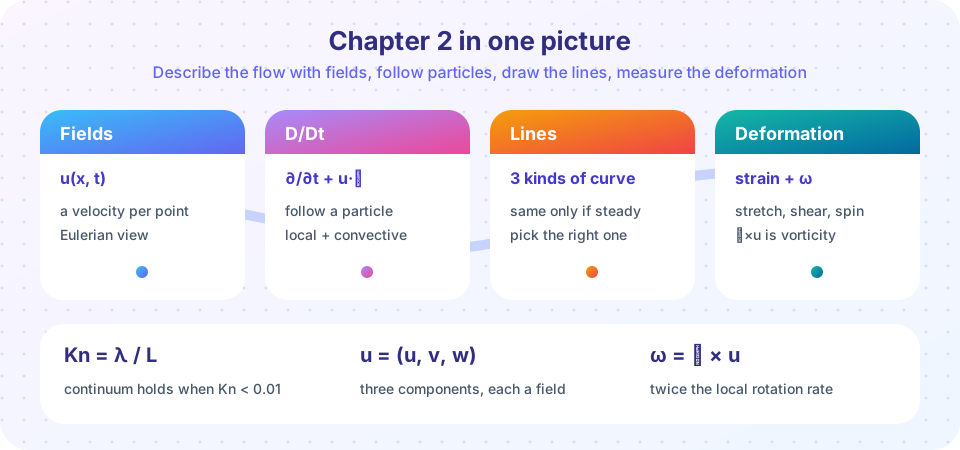
You now have the language for describing flow: smooth fields built from molecules, two ways of watching them, a derivative that follows particles, three kinds of flow line and a way to measure how fluid elements deform and spin. The one-page picture below ties these together.
What you will learn
- A recap of the five ideas of chapter 2 and the formula for each.
- Which formula to reach for in which situation.
- A self-check with a ten-question quiz.
Recap table
| Topic | Key formula or fact | Lesson |
|---|---|---|
| Continuum | Kn = λ/L < 0.01; air λ ≈ 66 nm |
Continuum |
| Material derivative | Dφ/Dt = ∂φ/∂t + u·∇φ |
Eulerian and Lagrangian |
| Acceleration | a = ∂u/∂t + (u·∇)u |
Eulerian and Lagrangian |
| Streamline | dy/dx = v/u at fixed t |
Flow lines |
| Pathline | dx/dt = u(x, t) for one particle |
Flow lines |
| Streakline | all particles through one point | Flow lines |
| Vorticity | ω_z = ∂v/∂x − ∂u/∂y |
Deformation |
| Divergence | ∇·u = 0 for incompressible flow |
Deformation |
| Circulation | Γ = ∮ u·dl = ∬ ω·n dA |
Deformation |
Key terms
Fluid particle: a small volume with many molecules, the continuum "point".
Convective acceleration: the part of acceleration caused by moving to a place with a different velocity.
Stagnation point: a point where the velocity is zero.
Irrotational: zero vorticity.
Common misconceptions
"Steady flow has no acceleration." Steady means no change at a point. Particles accelerate through spatial changes ((u·∇)u ≠ 0).
"Streamlines are particle paths." Only in steady flow.
"Circular streamlines imply a spinning fluid." The free vortex has circular streamlines and no vorticity.
Try it
Compute the strain-rate and vorticity of a combined flow, a shear plus a rotation, to see how the pieces add. The function returns the vorticity, the divergence and the shear rate for any velocity-gradient matrix.
Press Run (or Ctrl + Enter) to see the console output here.
No output.
A second example plots the streamlines of a Rankine vortex (solid core plus free vortex outside) and its speed profile, to connect the vorticity ideas to a real-looking vortex.
Press Run (or Ctrl + Enter) to see the result here.
Program input · what you'd type while the program runs
Type the answers before you press Run, one per line. Each time the program reads a line (with input()), it gets the next line from this box.
Check your understanding
Quick check · 10 questions
of 10 answered You scored / 10 · perfect!
-
1. The continuum model of air at 1 atm is good down to length scales of roughly
Kn = 66 nm / L = 0.01 gives L of about 6.6 micrometres; below roughly that scale slip effects appear. -
2. A fixed probe in a steady flow reads 3 m/s. A particle passing it will
At that point, the fluid has the velocity given by the field: 3 m/s. Elsewhere the particle may have a different speed. -
3. The acceleration of a fluid particle is
Du/Dt includes a convective part, which is nonzero even in steady flow if the velocity varies in space. -
4. In an unsteady flow, smoke from a chimney outlines a
Continuous release at a point forms a streakline. -
5. The vorticity of the shear flow u = 4y, v = 0 is
omega_z = dv/dx - du/dy = -4. -
6. A flow has u = 3x, v = 2y. For incompressible flow, w = -5z would be required. What does this check?
3 + 2 + (-5) = 0, so div u = 0, the condition for incompressibility. -
7. Circulation around a closed loop in a flow of uniform vorticity omega over area A is
By Stokes' theorem, Gamma is the vorticity flux through the surface: omega times A. -
8. Which pair of curves always coincides in a steady flow?
In steady flow, all particles through a point follow the same curve, so the three curves are identical. -
9. A free vortex u_theta = Gamma/(2 pi r) has vorticity
r u_theta is constant, so the vorticity is zero everywhere except the centre. -
10. In the Eulerian description, the velocity is written as
Eulerian quantities are functions of fixed position and time.
Summary
- Fields,
D/Dt, flow lines and deformation are the descriptive tools for the rest of the course. - Convective acceleration
(u·∇)uis the nonlinear heart of fluid dynamics. - Vorticity and circulation describe spin; irrotational flow has zero vorticity but may still circulate.
- Next you will ask which flows are allowed: conservation of mass and momentum.
Track your progress
Create a free account to tick off lessons and pick up where you left off on any device.
of Fluid Dynamics lessons completed