


















Lesson 45 of 46 · Projects and Practice
Fluid dynamics cheat sheet
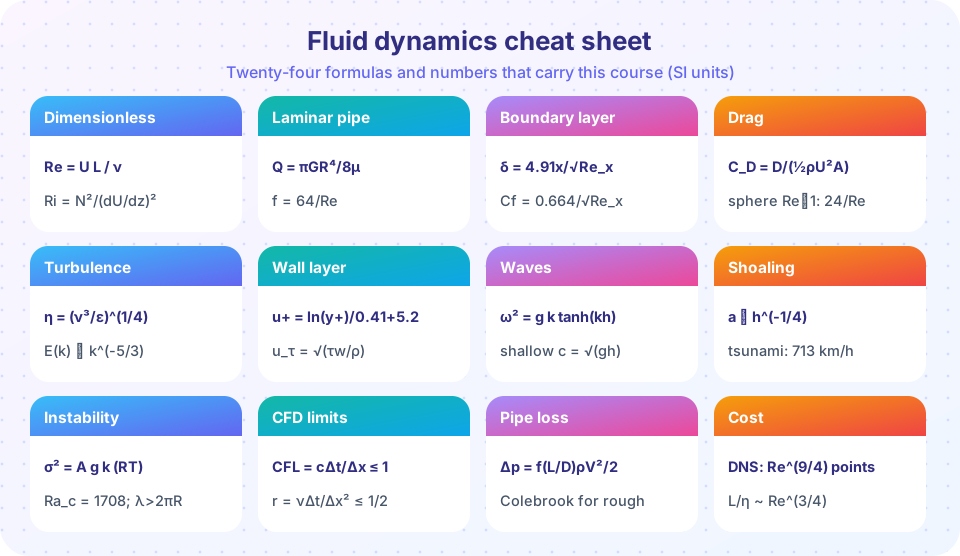
A one-page fluid dynamics recap: key formulas for viscous flow, boundary layers, turbulence, waves, instabilities and CFD, plus typical property values and a problem-solving checklist.
This page is the course on one sheet. Keep it open while solving problems, but remember the rule of this course: a formula is only as good as the assumptions behind it, so each entry below is paired with its condition.
What you will learn
- Which formula to reach for in each situation.
- The condition under which each formula holds.
- Typical property values for air and water.
- A checklist for solving a new problem.
Key terms
- Assumption: a condition (laminar, steady, small amplitude) required by a formula.
- Regime: the range of a dimensionless number in which one description applies.
- Typical value: a round number good enough for estimates, not a measurement.
Formulas with their conditions
| Topic | Formula | Condition |
|---|---|---|
| Reynolds number | Re = U L/ν |
any flow |
| Couette flow | u = U y/h, τ = μU/h |
G = 0, laminar |
| Plane Poiseuille | u = G y(h-y)/2μ, Q = Gh³/12μ |
laminar |
| Pipe laminar | Q = πGR⁴/8μ, f = 64/Re |
Re < 2,300 |
| Darcy-Weisbach | Δp = f (L/D) ρV²/2 |
any pipe flow with the right f |
| Blasius layer | δ = 4.91x/√Re_x, Cf = 0.664/√Re_x, C_D = 1.328/√Re_L |
flat plate, Re_x < ~5×10⁵ |
| Turbulent layer (fit) | δ ≈ 0.37x Re_x^(-1/5), C_D ≈ 0.074 Re_L^(-1/5) |
5×10⁵ ≲ Re_L ≲ 10⁷, turbulent from the leading edge |
| Stokes drag | F = 3πμdU |
sphere, Re ≪ 1 |
| Drag coefficient | C_D = D/(½ρU²A) |
any body |
| Kolmogorov scales | η = (ν³/ε)^(1/4), L/η ~ Re^(3/4) |
high-Re turbulence |
| Spectrum | E(k) = Cε^(2/3)k^(-5/3), C ≈ 1.5 |
inertial range |
| Wall layer | u+ = y+ (y+ < 5), u+ = ln(y+)/0.41 + 5.2 (y+ > 30) |
smooth wall |
| Water waves | ω² = gk tanh(kh); deep c = √(gλ/2π); shallow c = √(gh) |
small amplitude |
| Shoaling | a ∝ h^(-1/4) |
linear theory, no breaking |
| Kelvin-Helmholtz | Ri > 1/4 everywhere: stable |
stratified shear |
| Rayleigh-Taylor | σ² = A g k |
no surface tension |
| Convection | Ra = gαΔTd³/(νκ), Ra_c = 1708 |
rigid plates |
| Jets | unstable if λ > 2πR |
inviscid cylinder |
| Diffusion limit | r = νΔt/Δx² ≤ 1/2 (1D explicit) |
FTCS |
| Advection limit | CFL = cΔt/Δx ≤ 1 |
upwind, Lax-Wendroff |
| DNS cost | ~ Re^(9/4) grid points |
3D |
Typical values (about 20 °C, sea level)
| Quantity | Air | Water |
|---|---|---|
Density ρ (kg/m³) |
1.2 | 1,000 |
Dynamic viscosity μ (Pa s) |
1.8×10⁻⁵ | 1.0×10⁻³ |
Kinematic viscosity ν (m²/s) |
1.5×10⁻⁵ | 1.0×10⁻⁶ |
Surface tension σ (N/m) |
n/a | 0.073 |
Thermal expansion α (1/K) |
about 3.4×10⁻³ | about 2.1×10⁻⁴ |
Thermal diffusivity κ (m²/s) |
about 2.1×10⁻⁵ | about 1.4×10⁻⁷ |
A problem-solving checklist
- Sketch the situation and name the geometry, fluid and flow rate or speed.
- Compute
Re(and other dimensionless numbers) first: they decide which formulas apply. - Choose the regime: laminar or turbulent, deep or shallow, stable or unstable.
- Write the formula and its units; substitute and calculate.
- Check the assumption (for example
Re < 2,300) and the size of the answer. - State the answer with units and a sentence of interpretation.
Common misconceptions
- "One formula covers all regimes." Every formula has a range. Quote the condition with the answer.
- "A cheat sheet replaces understanding." It reminds you of results; knowing where they come from tells you when they fail.
Try it
Press Run (or Ctrl + Enter) to see the result here.
Program input · what you'd type while the program runs
Type the answers before you press Run, one per line. Each time the program reads a line (with input()), it gets the next line from this box.
Check your understanding
Quick check · 4 questions
of 4 answered You scored / 4 · perfect!
-
1. What should you compute first when you meet a new flow problem?
Dimensionless numbers tell you which regime and which formulas apply. -
2. Which formula is valid only for Re below about 2,300?
The laminar friction factor is limited to laminar pipe flow. -
3. What is the typical kinematic viscosity of water at 20 °C?
Water has ν ≈ 10⁻⁶ m²/s; air about 1.5×10⁻⁵ m²/s. -
4. Which pair matches the stability limits of the CFD chapter?
The explicit diffusion limit is r ≤ 1/2 in 1D and the advection limit is CFL ≤ 1.
Summary
- Pair every formula with its condition, and compute dimensionless numbers first.
- Keep typical values of air and water at hand for estimates.
- Follow the six-step checklist: sketch,
Re, regime, formula, check, interpret.
Next: Further study
Track your progress
Create a free account to tick off lessons and pick up where you left off on any device.
of Fluid Dynamics lessons completed