


















Lesson 35 of 46 · Waves and Instabilities
Instabilities: Kelvin-Helmholtz, Rayleigh-Taylor, Bénard and Plateau
Learn four classic fluid instabilities, the Richardson number, the Atwood number, the Rayleigh number and the jet-breakup rule, with growth rates and worked examples.
A pencil balanced on its tip is in equilibrium, yet any tiny nudge makes it fall. Many flows are like that pencil. A layer of heavy fluid above light fluid, a fast stream sliding over a slow one, a pan heated from below, a thin jet of water: each is an exact equilibrium or steady solution, and each is unstable. The instability that develops tells you what pattern the flow will take, and often it is the first step toward turbulence.
What you will learn
- The method of linear stability: perturb, linearize, find the growth rate
σ. - The Kelvin-Helmholtz instability and the Richardson number criterion
Ri < 1/4. - Rayleigh-Taylor growth
σ = √(A g k), and how surface tension limits it. - The Rayleigh number and the onset of convection; the Plateau-Rayleigh rule for jets.
Key terms
- Growth rate (σ): the rate at which a disturbance
~ e^(σt)grows. - Atwood number (A):
A = (ρ_heavy - ρ_light)/(ρ_heavy + ρ_light). - Richardson number (Ri):
Ri = N²/(dU/dz)², the ratio of buoyancy stabilization to shear. - Rayleigh number (Ra):
Ra = g α ΔT d³/(ν κ), the strength of buoyancy driving relative to dissipation. - Marginal stability: parameters where
σ = 0, the boundary between stable and unstable.
Linear stability in a nutshell
To test whether a base flow is stable, add a tiny disturbance of the form exp(ikx + σt), substitute into the equations, and drop every term that is quadratic in the disturbance. What remains is a linear problem, and the allowed σ depend on k and on the parameters. If some σ has a positive real part, the flow is unstable, and the wavelength with the largest σ often sets the pattern you will see. The method says nothing about what happens after the disturbance becomes large. That needs the full nonlinear equations.
Kelvin-Helmholtz: shear
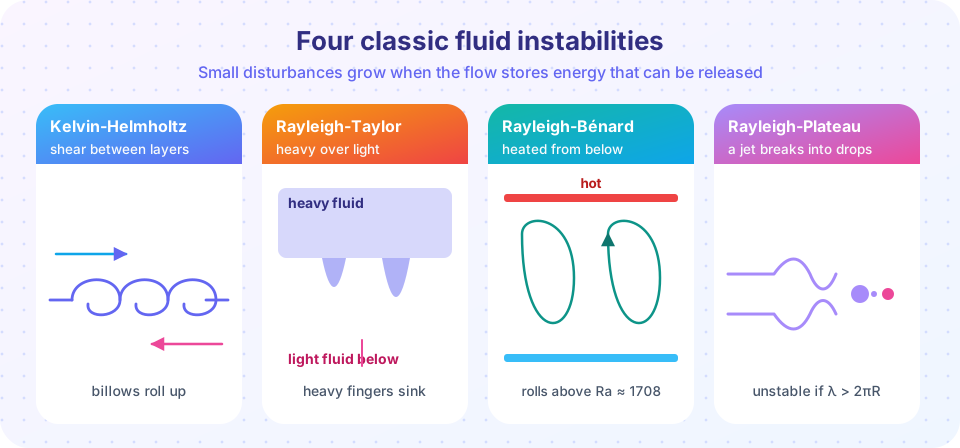
Where two layers slide past each other, the velocity profile has an inflection and the interface rolls up into a row of spiral billows. Lord Kelvin and Hermann von Helmholtz studied it in the 1860s. For a vortex sheet separating two equal-density streams with speed difference ΔU, every wavelength is unstable with growth rate
σ = k ΔU / 2
Short waves grow fastest, which is limited in real flows by the thickness of the shear layer. You see the effect in clouds that look like breaking ocean waves, in the bands of Jupiter, and in mixing at the edge of a jet.
Stable density stratification fights the instability, because lifting heavy fluid costs energy. For a smoothly stratified shear flow, Miles and Howard proved that the flow is stable if the local Richardson number is above one quarter everywhere:
Ri = N² / (dU/dz)² > 1/4 with N² = -(g/ρ) dρ/dz
N is the buoyancy frequency in 1/s. If Ri < 1/4 somewhere, instability is possible (not guaranteed).
Rayleigh-Taylor: heavy over light
Place a heavy fluid on top of a light one with a flat interface. A small ripple lets the heavy fluid move down at the crests and the light fluid up, releasing gravitational potential energy. Lord Rayleigh (1883) and G. I. Taylor (1950) showed that, with no surface tension and no viscosity,
σ² = A g k
Small scales grow faster and the flow develops mushroom-shaped plumes: the same shape appears in supernova remnants and in inertial-confinement fusion capsules. Surface tension γ stabilizes short waves: σ² = A g k - γ k³/(ρ_h + ρ_l). Waves shorter than λ_c = 2π √(γ / ((ρ_h - ρ_l) g)) do not grow. For water over air this critical wavelength is about 1.7 cm, which is why water can stay in an upside-down tube with a very narrow opening.
Rayleigh-Bénard: heating from below
A layer of fluid of depth d is heated from below. Warm fluid at the bottom is lighter and wants to rise, but viscosity and thermal diffusion resist. The balance is measured by the Rayleigh number
Ra = g α ΔT d³ / (ν κ)
where α is the thermal expansion coefficient, ΔT the temperature difference, ν the viscosity and κ the thermal diffusivity. Below the critical value, the fluid stays still and heat flows by conduction. Above it, steady convection rolls appear. For two rigid plates, Ra_c = 1708 and the rolls have a width of about twice the depth. For free surfaces on both sides, Ra_c = 657.5. Henri Bénard saw the cells in 1900 in a thin layer of liquid, and Lord Rayleigh explained the threshold in 1916. At much higher Ra, the convection becomes unsteady and eventually turbulent. The weather and the Earth's mantle are huge convection flows of this type.
Worked example
A layer of water 5 mm deep (α ≈ 2.1 × 10⁻⁴ 1/K, ν = 10⁻⁶ m²/s, κ = 1.4 × 10⁻⁷ m²/s). Then Ra = 9.81 × 2.1×10⁻⁴ × ΔT × (0.005)³ / (10⁻⁶ × 1.4×10⁻⁷) ≈ 1,840 ΔT, and Ra = 1708 at ΔT ≈ 0.93 K. A temperature difference of one degree across 5 mm is enough to start convection in water between rigid plates.
Rayleigh-Plateau: jets and drops
A cylinder of liquid is unstable because a drop of the same volume has less surface area. Joseph Plateau showed in the 19th century that a cylinder is unstable to disturbances longer than its circumference, and Rayleigh worked out the growth rate in 1878:
unstable if λ > 2π R
The fastest growth occurs for λ ≈ 9.0 R (about 4.5 jet diameters), so a thin jet breaks into drops spaced about 9 radii apart. This explains the beaded water thread from a slow tap, and it is used in inkjet printers: the nozzle vibrates at the right frequency so that drops form uniformly.
Common misconceptions
- "Instability always means disaster." Many instabilities lead to useful organized patterns: convection cells, Taylor-Couette vortices, drops of regular size.
- "Ri < 1/4 guarantees instability." It is a necessary condition for instability, not a sufficient one.
- "Warm air above cold air is unstable." It is stable. Heavy over light is unstable, so cold fluid above warm fluid (heated from below) is the unstable case.
Try it
Press Run (or Ctrl + Enter) to see the result here.
Program input · what you'd type while the program runs
Type the answers before you press Run, one per line. Each time the program reads a line (with input()), it gets the next line from this box.
Press Run (or Ctrl + Enter) to see the result here.
Program input · what you'd type while the program runs
Type the answers before you press Run, one per line. Each time the program reads a line (with input()), it gets the next line from this box.
Check your understanding
Quick check · 5 questions
of 5 answered You scored / 5 · perfect!
-
1. What is the Rayleigh-Taylor growth rate without surface tension?
σ² = A g k, with A the Atwood number. The expression k ΔU/2 is the Kelvin-Helmholtz rate. -
2. Which Richardson number threshold is a sufficient condition for stability of a stratified shear flow (Miles-Howard)?
If Ri exceeds 1/4 everywhere the flow is stable; Ri below 1/4 somewhere is necessary for instability. -
3. At which Rayleigh number does convection start between two rigid plates?
Ra_c = 1708 for rigid-rigid boundaries. -
4. A liquid jet of radius R is unstable to disturbances with wavelength:
Plateau's criterion: a disturbance longer than the circumference reduces surface area and so grows. -
5. Why does surface tension stabilize Rayleigh-Taylor flow at short wavelengths?
The term γ k³/(ρ_h + ρ_l) opposes the gravitational drive, which scales only as k.
Summary
- Linear stability asks whether a disturbance
~ e^(σt)grows; marginal stability isσ = 0. - Kelvin-Helmholtz:
σ = kΔU/2for equal densities; stable ifRi > 1/4everywhere. - Rayleigh-Taylor:
σ² = A g k(reduced by surface tension); Rayleigh-Bénard:Ra_c = 1708; jets:λ > 2πR. - Instability often produces ordered patterns before turbulence.
Next: Chapter 7 review
Track your progress
Create a free account to tick off lessons and pick up where you left off on any device.
of Fluid Dynamics lessons completed