


















Lesson 29 of 46 · Turbulence
Reynolds averaging, Reynolds stress and eddy viscosity
Split turbulent flow into mean and fluctuation, derive the RANS equations, understand the Reynolds stress and the closure problem, and meet mixing-length and k-epsilon models.
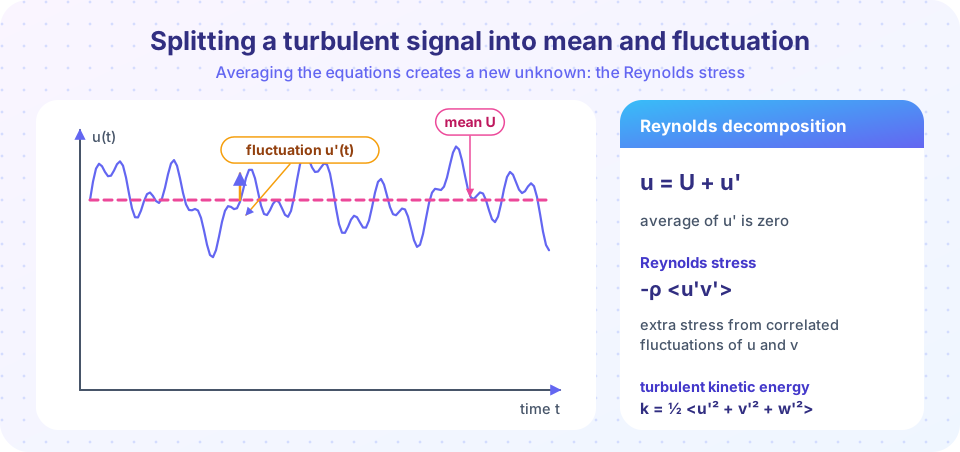
A turbulent velocity record looks like noise riding on a steady level. Often the level is what an engineer needs: the average pressure drop in a pipe, the mean force on a bridge pier, the mean temperature in a room. Osborne Reynolds proposed in 1895 to split every flow variable into its average and a fluctuation, and to average the Navier-Stokes equations. The result is a set of equations for the mean flow alone, at the price of one new term that carries the effect of all the eddies.
What you will learn
- The Reynolds decomposition
u = U + u'and the rules for averaging. - The RANS (Reynolds-averaged Navier-Stokes) equations and the Reynolds stress.
- Turbulent kinetic energy and turbulence intensity.
- Why the closure problem exists, and how eddy-viscosity, mixing-length and
k-εmodels address it.
Key terms
- Mean (U): the time average (or ensemble average) of a velocity component.
- Fluctuation (u'): the departure from the mean, with average zero.
- Reynolds stress:
-ρ <u'v'>, the mean momentum transfer by fluctuations. - Turbulent kinetic energy (k):
k = ½ (<u'²> + <v'²> + <w'²>)per unit mass. - Closure problem: the averaged equations contain more unknowns than equations.
The decomposition
Write each velocity component and the pressure as u = U + u' and p = P + p'. The mean is defined as U = <u>, so <u'> = 0. Averaging is linear and commutes with derivatives, giving these rules:
<a + b> = <a> + <b><U u'> = U <u'> = 0<u v> = U V + <u'v'>(the fluctuation correlation does not vanish).
The last line is the key. The product of two fluctuating quantities has a nonzero average if they are correlated.
The RANS equations
Average the incompressible momentum equation. The nonlinear term ∂(u_i u_j)/∂x_j gives, after averaging, ∂(U_i U_j)/∂x_j + ∂<u_i' u_j'>/∂x_j. Moving the second term to the right-hand side:
ρ (∂U_i/∂t + U_j ∂U_i/∂x_j) = -∂P/∂x_i + ∂/∂x_j ( μ ∂U_i/∂x_j - ρ <u_i' u_j'> )
The left side and the viscous stress look like those of laminar flow, but the bracket now includes the Reynolds stress tensor -ρ <u_i' u_j'>. Physically, fluctuations carry momentum across the flow: when a blob of fast fluid moves toward the wall (v' < 0, u' > 0) and a slow one moves away (v' > 0, u' < 0), the product u'v' is negative on average, so -ρ<u'v'> is a positive stress: it acts like a very large extra friction. In the middle of a pipe it is typically hundreds of times larger than the viscous stress.
The mean continuity equation is ∂U_i/∂x_i = 0, unchanged.
Worked example
Water (ρ = 1000 kg/m³) in a channel has u'rms = 0.05 m/s, v'rms = 0.03 m/s and a correlation coefficient <u'v'>/(u'rms v'rms) = -0.4. Then <u'v'> = -0.4 × 0.05 × 0.03 = -6 × 10⁻⁴ m²/s² and the Reynolds stress is -ρ<u'v'> = 0.6 Pa. If the mean speed is 1 m/s, the streamwise intensity u'rms/U is 0.05/1 = 5%. The turbulent kinetic energy, if w'rms = 0.04, is k = ½(0.0025 + 0.0009 + 0.0016) = 0.0025 m²/s².
The closure problem
Six independent components of <u_i' u_j'> appear, and no equation closes them. One can write transport equations for them, but those contain triple correlations <u'u'u'>, and so on forever. Every practical RANS method therefore needs a model that relates the Reynolds stress to the mean flow. This is the closure problem, and it is the reason turbulence has no exact theory.
Eddy viscosity and the mixing length
Joseph Boussinesq (1877) suggested treating turbulent stress as a viscous one with a much larger, flow-dependent viscosity:
-ρ <u'v'> = μ_t dU/dy
where μ_t (or ν_t = μ_t/ρ) is the eddy viscosity. Unlike μ, it is a property of the flow, not the fluid. Prandtl's mixing-length hypothesis (1925) estimates it: a blob that moves a distance l carries the velocity of its origin, so u' ~ l dU/dy and
ν_t = l² |dU/dy|
Near a wall, l = κ y with the von Karman constant κ ≈ 0.41. This simple choice already gives the logarithmic velocity profile (next lesson).
The k-ε model
Two transport equations are solved: one for the turbulent kinetic energy k and one for its dissipation rate ε (the rate at which small eddies turn energy into heat, in m²/s³). The eddy viscosity is ν_t = C_μ k² / ε with C_μ = 0.09. The standard k-ε model is robust and cheap, and widely used for industrial flows. Its weaknesses are strong curvature, separation and rotation. Other models include k-ω (ω is a frequency of dissipation) and the Spalart-Allmaras one-equation model used in aerodynamics. The more expensive alternatives, large-eddy simulation (LES) and direct numerical simulation (DNS), are discussed in chapter 8.
Common misconceptions
- "Averaging removes turbulence from the equations." It removes the detail but leaves the Reynolds stress, which has to be modeled.
- "Eddy viscosity is a property of water or air." It belongs to the flow: it is near zero at a wall and large in the core.
- "Fluctuations are small corrections." In many flows
u'is 5 to 20% of the mean, and the stress they create can exceed the viscous stress by orders of magnitude.
Try it
Press Run (or Ctrl + Enter) to see the result here.
Program input · what you'd type while the program runs
Type the answers before you press Run, one per line. Each time the program reads a line (with input()), it gets the next line from this box.
Press Run (or Ctrl + Enter) to see the console output here.
No output.
Check your understanding
Quick check · 5 questions
of 5 answered You scored / 5 · perfect!
-
1. Averaging the Navier-Stokes equations adds which new term?
The averaged nonlinear term leaves the correlation of fluctuations, which acts like an extra stress. -
2. What is the average of a fluctuation u'?
By definition the fluctuation is the departure from the mean, so its mean is zero. -
3. Why does the closure problem exist?
The Reynolds stress components are new unknowns, and equations for them introduce still higher correlations. -
4. In Prandtl's mixing-length model, how is eddy viscosity expressed?
A blob moving a distance l carries a velocity difference l dU/dy, which gives a diffusivity l²|dU/dy|. -
5. Which constants appear in the standard k-ε model's eddy viscosity?
The standard model uses ν_t = 0.09 k²/ε, with k and ε from their own transport equations.
Summary
- Reynolds decomposition
u = U + u'gives mean equations with an extra stress-ρ<u'v'>. - The Reynolds stress can be hundreds of times larger than viscous stress in the core.
- The closure problem forces models: eddy viscosity, mixing length,
k-ε,k-ω. - Models trade cost for accuracy; LES and DNS resolve more of the turbulence.
Next: The energy cascade
Track your progress
Create a free account to tick off lessons and pick up where you left off on any device.
of Fluid Dynamics lessons completed