


















Lesson 30 of 46 · Turbulence
The energy cascade and Kolmogorov scales
Follow energy from large eddies to small ones, compute Kolmogorov length, time and velocity scales, and understand the -5/3 spectrum and the cost of direct simulation.
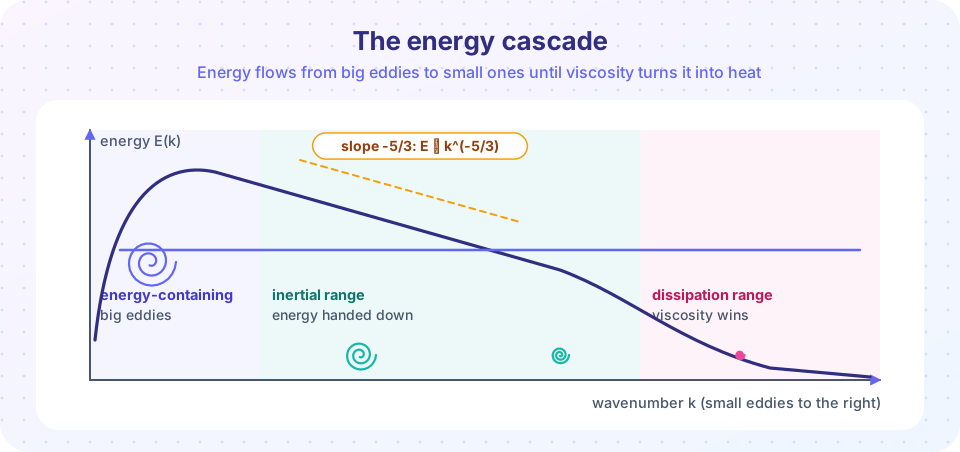
A turbulent flow holds eddies of every size between the width of the flow and a tiny scale smaller than a millimeter. Where does the energy of the large motion go? Lewis Fry Richardson pictured it in 1922 as a cascade: large eddies are unstable and break up into smaller ones, handing their energy down, until the eddies are so small that viscosity can turn their motion into heat. In 1941 Andrey Kolmogorov turned this picture into quantitative predictions that have held up well for decades.
What you will learn
- The roles of the energy-containing, inertial and dissipation ranges.
- The Kolmogorov length, time and velocity scales and how to compute them.
- The
E(k) = C ε^(2/3) k^(-5/3)spectrum. - Why direct numerical simulation costs so much, scaling like
Re^(9/4)in grid points.
Key terms
- Dissipation rate (ε): energy turned into heat per unit mass and time, in m²/s³.
- Integral scale (L): the size of the largest, energy-containing eddies.
- Kolmogorov scale (η): the size of the smallest eddies,
η = (ν³/ε)^(1/4). - Wavenumber (k):
k = 2π / (eddy size); highkmeans small eddies. - Energy spectrum E(k): the kinetic energy per unit mass and per unit wavenumber.
Richardson's picture
Imagine stirring a cup of coffee. The spoon puts energy into the large motion. That motion is itself unstable and stretches into smaller whirls, which break into smaller ones. At each step the energy is passed along without much loss, as long as the eddies are large enough that viscosity does not matter. At the smallest scales, velocity gradients are steep, viscosity acts, and the energy becomes heat.
In steady turbulence, the rate at which energy enters at the large scales equals the rate it passes down the cascade, and that equals the rate it is dissipated: all are ε. For large eddies of size L and velocity u' the turnover time is L/u' and their energy per unit mass is about u'², so
ε ~ u'³ / L
The remarkable fact is that this holds regardless of viscosity. Viscosity decides only where the cascade stops.
Kolmogorov's scales
Kolmogorov proposed that the smallest eddies depend only on ε and ν, and that they forget the details of the large scales. Dimensional analysis then fixes everything:
| Scale | Formula | Units |
|---|---|---|
| Length | η = (ν³/ε)^(1/4) |
m |
| Time | τ_η = (ν/ε)^(1/2) |
s |
| Velocity | u_η = (ν ε)^(1/4) |
m/s |
The Reynolds number of these eddies, η u_η / ν, equals 1: viscosity and inertia balance there. The ratio of largest to smallest scale follows from ε ~ u'³/L:
L / η ~ Re_L^(3/4), where Re_L = u' L / ν
Worked example
A water channel has u' = 0.05 m/s, L = 0.05 m, ν = 10⁻⁶ m²/s. Then ε ≈ u'³/L = 1.25×10⁻⁴ / 0.05 = 2.5×10⁻³ m²/s³, and
η = (10⁻¹⁸ / 2.5×10⁻³)^(1/4) ≈ 1.4×10⁻⁴ m(0.14 mm)τ_η = (10⁻⁶ / 2.5×10⁻³)^(1/2) ≈ 0.02 sRe_L = 0.05 × 0.05 / 10⁻⁶ = 2500,L/η ≈ 2500^(3/4) ≈ 350
These are order-of-magnitude estimates: the formula ε ~ u'³/L hides a constant of order one.
The inertial range and the -5/3 law
Between the large scales (size L) and the Kolmogorov scale (η), there lies an inertial range if Re is large enough, where the eddies are neither affected by the details of the forcing nor by viscosity. Kolmogorov's second hypothesis says that in this range the spectrum depends only on ε and k. Dimensions of E(k) are m³/s², those of ε are m²/s³, and those of k are 1/m, so the only combination is
E(k) = C ε^(2/3) k^(-5/3)
with the Kolmogorov constant C ≈ 1.5 found in many experiments. On a log-log plot this is a straight line with slope -5/3. This law is one of the best-confirmed results in turbulence, seen in wind tunnels, tidal channels, and the atmosphere. Corrections due to intermittency (the clumpy way dissipation is distributed in space) are small for the spectrum itself, though they matter for high-order statistics.
Why simulation is expensive
To simulate every eddy (direct numerical simulation, DNS) the grid must resolve η, and the domain must be larger than L, so each direction needs ~ L/η ~ Re^(3/4) points. In three dimensions the total is Re^(9/4). Because the time step shrinks with the grid, the total cost scales like Re³. For a channel at Re_τ = 5,200 a DNS has of order 10¹¹ grid points, but an airplane wing at Re ~ 10⁷ is far beyond reach. This is why turbulence models, introduced in the last lesson, are still necessary.
Common misconceptions
- "Energy cascades because viscosity breaks the eddies." The opposite: the cascade is driven by inertial nonlinearity. Viscosity only removes energy at the end.
- "The smallest eddies are molecules." The Kolmogorov scale is typically 0.1 to 1 mm in the lab, far larger than molecular spacing, so the continuum assumption still holds.
- "Two-dimensional turbulence cascades the same way." In 2D, energy tends to go to larger scales (an inverse cascade); the Kolmogorov picture is for 3D flow.
Try it
Press Run (or Ctrl + Enter) to see the result here.
Program input · what you'd type while the program runs
Type the answers before you press Run, one per line. Each time the program reads a line (with input()), it gets the next line from this box.
Press Run (or Ctrl + Enter) to see the result here.
Program input · what you'd type while the program runs
Type the answers before you press Run, one per line. Each time the program reads a line (with input()), it gets the next line from this box.
Check your understanding
Quick check · 5 questions
of 5 answered You scored / 5 · perfect!
-
1. What do the Kolmogorov scales depend on?
Kolmogorov's first hypothesis says the smallest eddies are set by the dissipation rate and the viscosity. -
2. What slope does the inertial-range energy spectrum have on a log-log plot?
E(k) = C ε^(2/3) k^(-5/3), a straight line with slope -5/3. -
3. If Re_L increases by a factor of 16, how does L/η change?
L/η ~ Re_L^(3/4), and 16^(3/4) = 8. -
4. Where is energy converted into heat?
The cascade passes energy down; viscosity converts it into heat at scales of order η. -
5. Why is DNS of an airplane wing at high Re impractical?
Resolving the smallest eddies in 3D requires about Re^(9/4) points, and the time steps add more cost.
Summary
- Energy cascades from large to small eddies; viscosity ends it at the Kolmogorov scale.
η = (ν³/ε)^(1/4),τ_η = (ν/ε)^(1/2),u_η = (νε)^(1/4), withε ~ u'³/L.- Inertial-range spectrum:
E(k) = C ε^(2/3) k^(-5/3),C ≈ 1.5. - Scale separation grows as
Re^(3/4), so DNS costs~Re^(9/4)points.
Next: The law of the wall
Track your progress
Create a free account to tick off lessons and pick up where you left off on any device.
of Fluid Dynamics lessons completed