


















Lesson 16 of 46 · Conservation Equations and Navier-Stokes
Chapter 3 Review: Conservation Equations and Navier-Stokes
Review chapter 3 of Fluid Dynamics: continuity, stress and viscosity, the Navier-Stokes equations and exact Couette and Poiseuille solutions, with a ten-question quiz.
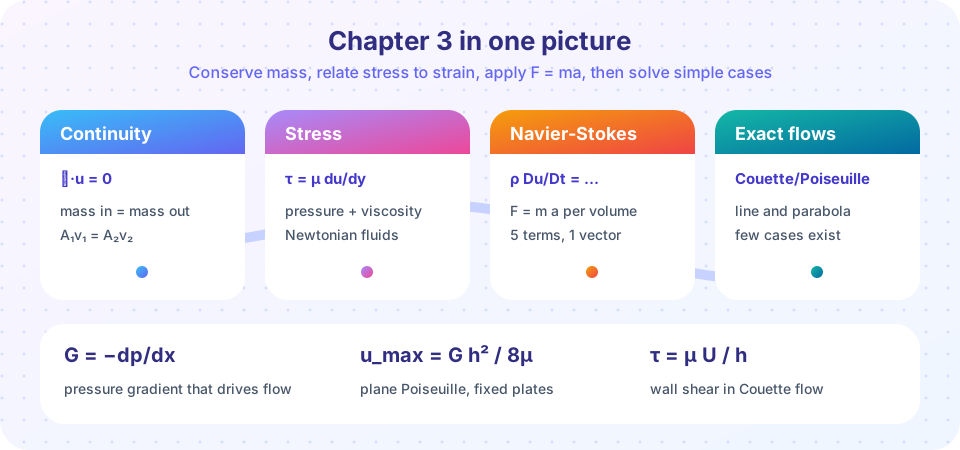
This chapter gave you the governing equations of fluid dynamics and the first problems they solve exactly. If you can explain the picture below in your own words, and reproduce the formulas in the table without looking, you are ready for ideal flow in chapter 4.
What you will learn
- A recap of the key equations with units.
- A decision guide: which equation for which question.
- A self-check with a ten-question quiz.
Recap table
| Topic | Key equation | Remember |
|---|---|---|
| Mass, duct | A₁v₁ = A₂v₂ |
narrower means faster |
| Mass, point | ∇·u = 0 (incompressible) |
particle volume kept |
| Newton's viscosity | τ = μ du/dy |
μ in Pa·s |
| Kinematic viscosity | ν = μ/ρ |
m²/s |
| Navier-Stokes | ρ Du/Dt = −∇p + μ∇²u + ρg |
N/m³ per term |
| Hydrostatics | p = p₀ + ρ g h |
98 kPa at 10 m of water |
| Couette | u = U y/h |
straight line |
| Plane Poiseuille | u = (G/2μ) y(h−y) |
u_max = Gh²/8μ |
| Pipe | u = G(R²−r²)/4μ |
Q = πR⁴G/8μ, f = 64/Re |
Key terms
Fully developed flow: the profile no longer changes along the flow.
No-slip: the fluid sticks to the wall.
Stokes flow: Re → 0, inertia negligible.
Wall shear stress τ_w: the viscous force per unit area on the wall.
Which equation for which question?
- "How fast does the flow go in the narrow part?" Use continuity (
A₁v₁ = A₂v₂). - "How big is the friction force between two moving surfaces?" Use Newton's law of viscosity with the velocity gradient.
- "What pressure drop pushes a given flow through a laminar tube?" Use Hagen-Poiseuille.
- "Is this velocity field possible?" Test
∇·u = 0. - "What decides whether inertia or viscosity wins?" The Reynolds number, from scaling Navier-Stokes.
Common misconceptions
"Navier-Stokes and Bernoulli are separate laws." Bernoulli's equation (chapter 4) follows from the Navier-Stokes momentum equation when viscosity is negligible.
"The Hagen-Poiseuille formulas work for any pipe speed." They hold only below about Re = 2,300.
"Pressure is the force that drags the flow along the wall." Wall drag from viscosity is shear stress; pressure acts perpendicular to the wall.
Try it
Check the laminar-pipe formulas on a small sweep: for flows from 0.1 mL/s to 5 mL/s in a 10 mm tube, print the Reynolds number, pressure gradient and centerline speed, and watch for the laminar limit.
Press Run (or Ctrl + Enter) to see the console output here.
No output.
Second, compare the three profiles (Couette, plane Poiseuille and pipe) with the same maximum speed, normalized, on a single plot.
Press Run (or Ctrl + Enter) to see the result here.
Program input · what you'd type while the program runs
Type the answers before you press Run, one per line. Each time the program reads a line (with input()), it gets the next line from this box.
Check your understanding
Quick check · 10 questions
of 10 answered You scored / 10 · perfect!
-
1. Water at 3 m/s in a 50 mm pipe enters a 25 mm section. The speed there is
Area ratio is (50/25)^2 = 4, so the speed is 4 x 3 = 12 m/s. -
2. Which field is NOT possible for an incompressible flow?
div(x, y, z) = 3, not zero. The others have zero divergence. -
3. Which term is the viscous force per unit volume?
mu laplacian u is the net viscous force per unit volume for constant mu. -
4. A tube of radius R gives flow rate Q at a given pressure gradient. With radius R/2, the flow rate is
Q is proportional to R^4, so halving the radius reduces Q by a factor of 16. -
5. In plane Poiseuille flow, the ratio of mean speed to maximum speed is
u_mean = G h^2/(12 mu) and u_max = G h^2/(8 mu), so the ratio is 8/12 = 2/3. -
6. The Reynolds number appears in Navier-Stokes when the equation is
Scaling gives the viscous term a coefficient 1/Re. -
7. The shear stress in Couette flow with plate speed U and gap h is
u = U y/h so du/dy = U/h and tau = mu U/h. -
8. At 20 m depth in fresh water the gauge pressure is about
rho g h = 998 x 9.81 x 20 = 195,800 Pa, about 196 kPa. -
9. Which condition holds at a fixed solid wall in a continuum flow?
The fluid adjacent to a fixed wall has zero velocity. -
10. When is the incompressible form of continuity a good model for air?
At low Mach number the density changes are small, so div u = 0 holds well.
Summary
- Continuity, the stress law and Newton's second law give the Navier-Stokes equations.
- Fully developed laminar flows are solved exactly: Couette (line), Poiseuille (parabola), Hagen-Poiseuille (
R⁴law). - Dimensionless scaling shows that
Recontrols the balance of inertia and viscosity. - Ideal flow, with no viscosity, is the next simplification.
Track your progress
Create a free account to tick off lessons and pick up where you left off on any device.
of Fluid Dynamics lessons completed