


















Lesson 20 of 46 · Ideal and Potential Flow
Elementary Flows and Superposition
Learn uniform flow, source, vortex and doublet, then add them to build half-bodies, spirals and ovals using the linearity of Laplace's equation.
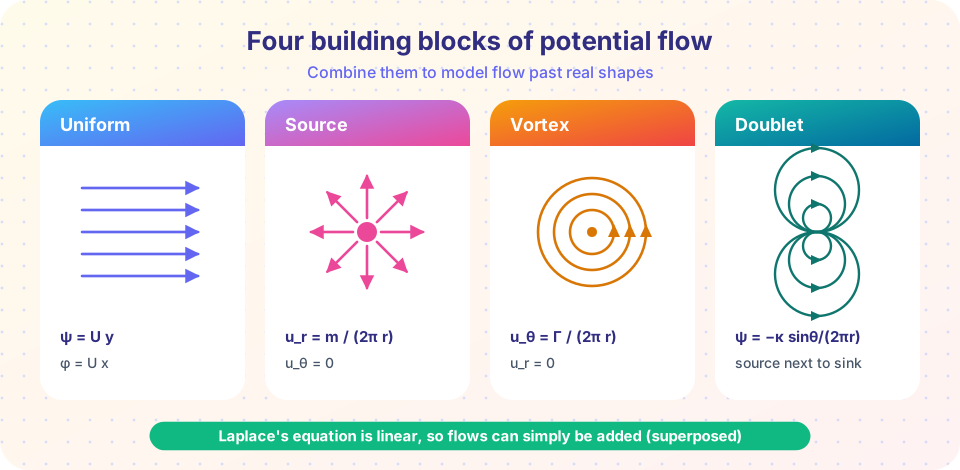
Because Laplace's equation is linear, you can build complicated flows by adding simple ones. This is the central trick of classical aerodynamics. A small kit of four elementary flows is enough to produce flow past a half-body, a spinning cylinder or an airfoil. Each of the four has a clear physical picture, and each has simple formulas for both the stream function and the potential. The kit is the subject of this lesson.
What you will learn
- The potential, stream function and velocity of each elementary flow.
- The physical meaning of source strength and circulation.
- How to superpose flows and find stagnation points and body shapes.
- Worked examples: the Rankine half-body and a spiral vortex.
Key terms
Uniform flow: constant velocity everywhere.
Source (sink): a point from which fluid flows radially outward (inward); strength m is volume flow rate per unit depth.
Free vortex: circular flow with u_θ = Γ / (2πr); strength Γ is the circulation.
Doublet: the limit of a source and sink brought together; the basis of the flow around a cylinder.
Superposition: the sum of solutions of Laplace's equation is a solution.
The four elementary flows
1. Uniform stream
φ = U x, ψ = U y, giving u = U, v = 0. With an angle α to the x axis: φ = U(x cosα + y sinα). Streamlines are straight lines.
2. Source and sink
Fluid is created at the origin at a rate m (m²/s, per metre of depth) and flows radially outward. By mass conservation, the flow rate through a circle of radius r is u_r × 2πr = m:
u_r = m / (2π r), u_θ = 0, φ = (m / 2π) ln r, ψ = (m / 2π) θ.
Speed falls as 1/r, and it is infinite at the origin (a mathematical singularity, which is fine as long as the origin lies inside the body or is not part of the flow region). A negative m is a sink.
3. Free vortex
Circular streamlines, with the speed falling as 1/r:
u_r = 0, u_θ = Γ / (2π r), φ = (Γ/2π) θ, ψ = −(Γ/2π) ln r.
Γ is the circulation around any loop enclosing the origin (positive means counter-clockwise). Away from the origin the flow is irrotational. Note the neat duality with the source: the roles of φ and ψ are exchanged (compare ψ of the source with φ of the vortex).
4. Doublet
Put a source of strength m at (−ε, 0) and an equal sink at (+ε, 0), then let ε → 0 while keeping κ = 2 m ε fixed. The result is
ψ = −κ sinθ / (2π r), φ = κ cosθ / (2π r).
Streamlines are circles tangent to the x axis at the origin. A doublet by itself looks odd (speed falls as 1/r²), but added to a uniform stream it gives flow around a cylinder, as the next lesson shows.
Superposition in practice
Add stream functions (or potentials), and the velocities add as vectors. Stagnation points are found by setting u = 0; the dividing streamline through them often outlines a body, and we can replace it by a solid surface because no fluid crosses a streamline.
Worked example 1: the Rankine half-body
Add a uniform stream U (flowing in +x) and a source of strength m at the origin: ψ = U r sinθ + (m/2π) θ. On the x axis (θ = π, upstream of the source) the speed is u = U + m / (2π x) with x < 0. It is zero when x = −m / (2πU): the stagnation point. For U = 10 m/s and m = 31.4 m²/s (that is, 10π), the stagnation point is at x = −31.4 / (2π × 10) = −0.5 m. Far downstream, the source fluid is confined between two streamlines carrying m/2 each; each side has width h with U h = m/2, so the total width is m/U = 3.14 m. The streamline through the stagnation point encloses a bluff nose that widens to this asymptotic width: a half-body. Everything inside the nose is source fluid, everything outside is the oncoming stream. It models the front of a bridge pier or the nose of a streamlined body.
Worked example 2: the spiral vortex
Add a sink of strength m (negative) and a vortex Γ at the same point. The velocity components are u_r = −|m|/(2πr) and u_θ = Γ/(2πr). The streamlines are logarithmic spirals. This is a first model of the flow in a bathtub drain or a simple model of a tropical cyclone's inflow. The angle between a streamline and the radial direction is arctan(u_θ/u_r) and is the same at all r.
Worked example 3: source plus sink
A source +m at (−a, 0) and a sink −m at (+a, 0), together with a uniform stream U, give the Rankine oval: a closed streamline that encloses all the source fluid, a long smooth body with stagnation points at its nose and tail. Everything the source emits is swallowed again by the sink, so the body is closed. As the pair is pushed together until it is a doublet, the oval becomes a circle: that is the cylinder of the next lesson.
Common misconceptions
"A source is a pipe in the fluid." It is a mathematical idealization of fluid appearing at a point; in practice, use it where the singular point is inside a body you then replace by a solid.
"Superposition holds for the pressure." Superposition holds for ψ, φ and the velocity. Pressure is quadratic in the velocity (Bernoulli), so pressures cannot be added: compute the total velocity first, then the pressure.
"The vortex has strong vorticity everywhere." It has circulation but zero vorticity away from the origin; all the vorticity is concentrated at the centre.
Try it
First, plot the Rankine half-body: compute the stagnation point from the formula, and draw the dividing streamline ψ = m/2 together with the other streamlines.
Press Run (or Ctrl + Enter) to see the result here.
Program input · what you'd type while the program runs
Type the answers before you press Run, one per line. Each time the program reads a line (with input()), it gets the next line from this box.
Second, an interactive flow builder: uniform stream plus a source (or sink) plus a vortex at the origin. Move the sliders and watch the streamlines. Try U = 1, source m = 3: a half-body. Try U = 0, m = −2 and Γ = 4: a spiral drain.
Check your understanding
Quick check · 5 questions
of 5 answered You scored / 5 · perfect!
-
1. A source of strength m produces a radial speed at distance r of
Mass conservation through a circle of radius r: u_r 2 pi r = m. -
2. The free vortex has tangential speed
u_theta = Gamma / (2 pi r). -
3. For a uniform stream U = 10 m/s and a source m = 62.8 m^2/s (20 pi), the stagnation point is at
x = -m / (2 pi U) = -62.8 / (62.8) = -1 m. -
4. Why can pressure NOT be superposed?
p = p0 - 1/2 rho |u|^2 depends on the square of the total velocity, so pressures do not add. -
5. A doublet is
The limit of a close source-sink pair with fixed product (strength x separation).
Summary
- Uniform stream, source/sink, free vortex and doublet are the four building blocks.
u_r = m/(2πr)for a source andu_θ = Γ/(2πr)for a vortex; the doublet is a source-sink pair in the limit.- Superpose
ψ,φand velocities (not pressures); stagnation points and dividing streamlines outline bodies. - Rankine half-body (stream plus source), spiral vortex (sink plus vortex) and, next, the cylinder (stream plus doublet).
Next: Flow Past a Cylinder
Track your progress
Create a free account to tick off lessons and pick up where you left off on any device.
of Fluid Dynamics lessons completed