


















Lesson 44 of 46 · Projects and Practice
Fluid dynamics glossary
A glossary of the key terms from the fluid dynamics course (viscosity, Reynolds number, boundary layer, turbulence, dispersion, CFL, validation) with a searchable filter.
Fluid dynamics has its own vocabulary, and many words are used in everyday speech with a different meaning. This glossary collects the terms from the whole course in one place, with short definitions and the symbol or formula where there is one. Use it for revision, and try the search box below to find a term quickly.
What you will learn
- The precise meaning of the course's key terms.
- Which symbols and formulas go with each term.
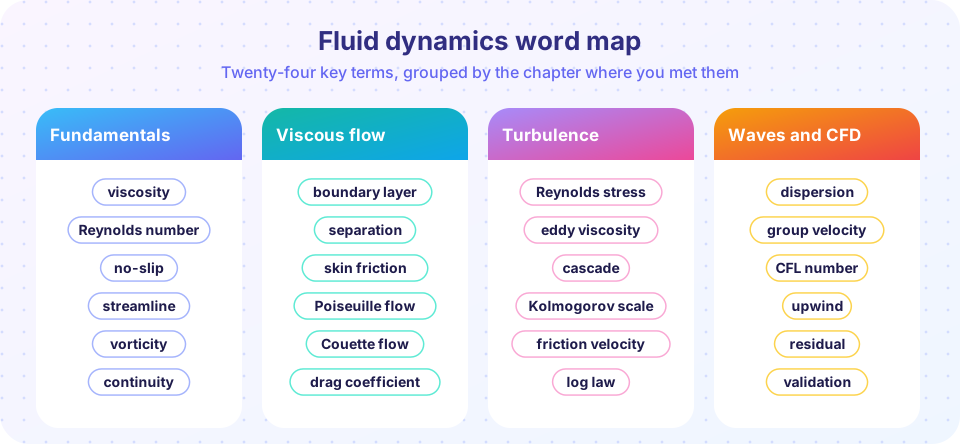
- How the terms group into four families.
Key terms
- Continuum: treating a fluid as smooth matter rather than separate molecules.
- Control volume: a fixed region of space through which fluid flows, used for balance laws.
- Dimensionless number: a combination of quantities with no units, such as
Re. - Scaling: judging which terms in an equation matter by comparing sizes.
Fundamentals
| Term | Meaning |
|---|---|
Viscosity (μ) |
Property that turns velocity differences into shear stress: τ = μ du/dy. Units Pa s. |
Kinematic viscosity (ν) |
ν = μ/ρ, the diffusivity of momentum, in m²/s. |
Reynolds number (Re) |
U L/ν; ratio of inertial to viscous effects. |
| No-slip condition | Fluid touching a solid has the velocity of the solid. |
| Streamline | A curve tangent to the velocity at every point, at one instant. |
Vorticity (ω) |
The curl of the velocity; twice the local rotation rate of the fluid. |
| Continuity equation | Conservation of mass; ∇·u = 0 for incompressible flow. |
Viscous flow
| Term | Meaning |
|---|---|
| Boundary layer | Thin region next to a wall where viscosity changes the velocity from zero to the free-stream value. |
| Separation | The boundary layer leaves the surface where wall shear falls to zero. |
Skin friction coefficient (Cf) |
τw/(½ρU²). |
| Poiseuille flow | Pressure-driven laminar flow between plates or in a pipe. |
| Couette flow | Laminar flow driven by a moving wall, with a linear profile. |
Drag coefficient (C_D) |
D/(½ρU²A). |
Displacement thickness (δ*) |
How far the outer flow is displaced by the slow layer. |
Turbulence
| Term | Meaning |
|---|---|
| Reynolds decomposition | Writing u = U + u' (mean plus fluctuation). |
| Reynolds stress | -ρ<u'v'>, momentum transport by fluctuations. |
Eddy viscosity (ν_t) |
A modeled viscosity that represents the effect of turbulence. |
| Energy cascade | Transfer of energy from large eddies to small ones. |
Kolmogorov scale (η) |
(ν³/ε)^(1/4), the smallest eddy size. |
Friction velocity (u_τ) |
√(τw/ρ). |
| Law of the wall | Universal mean-velocity profile in wall units; log region u+ = ln(y+)/κ + B. |
Waves and computation
| Term | Meaning |
|---|---|
| Dispersion | Dependence of wave speed on wavelength. |
Group velocity (c_g) |
dω/dk, the speed of wave energy. |
| Instability | A state in which small disturbances grow. |
Richardson number (Ri) |
N²/(dU/dz)², stratification against shear. |
| CFL number | c Δt/Δx; the stability limit for explicit advection is 1. |
| Numerical diffusion | Smoothing caused by the discretization. |
| Residual | How badly the current iterate fails to satisfy the discrete equations. |
| Verification / validation | Solving the equations right / solving the right equations. |
Try it
Press Run (or Ctrl + Enter) to see the console output here.
No output.
Common misconceptions
- "Streamlines are paths of particles." Only in steady flow. In unsteady flow, streamlines, pathlines and streaklines differ.
- "Vorticity means the fluid swirls in circles." A straight shear flow has vorticity even though the streamlines are straight.
Check your understanding
Quick check · 4 questions
of 4 answered You scored / 4 · perfect!
-
1. What does the no-slip condition require?
Fluid in contact with a solid moves with it. -
2. What is the Reynolds stress?
It represents momentum transport by velocity fluctuations. -
3. Which term means 'solving the equations right'?
Verification checks numerical correctness; validation checks the model against reality. -
4. Which of these is a dimensionless number?
Re = UL/ν has no units; the others have units m²/s and m/s.
Summary
- Terms fall into four families: fundamentals, viscous flow, turbulence, waves and computation.
- Many are ratios (
Re,Ri,Ra, CFL) that compare competing effects. - Learn each with its symbol, units and formula.
Next: Cheat sheet
Track your progress
Create a free account to tick off lessons and pick up where you left off on any device.
of Fluid Dynamics lessons completed