


















Lesson 40 of 46 · Computational Fluid Dynamics
Chapter 8 review: computational fluid dynamics
Review the CFD workflow, finite differences, stability limits, numerical diffusion and the cavity solver with a summary picture, a time-step calculator and a ten-question quiz.
You now know how a flow problem becomes a computation, and what can go wrong: poor discretization, unstable time steps, smearing, wrong boundary conditions and untested models. This review collects the key rules of thumb and checks them.
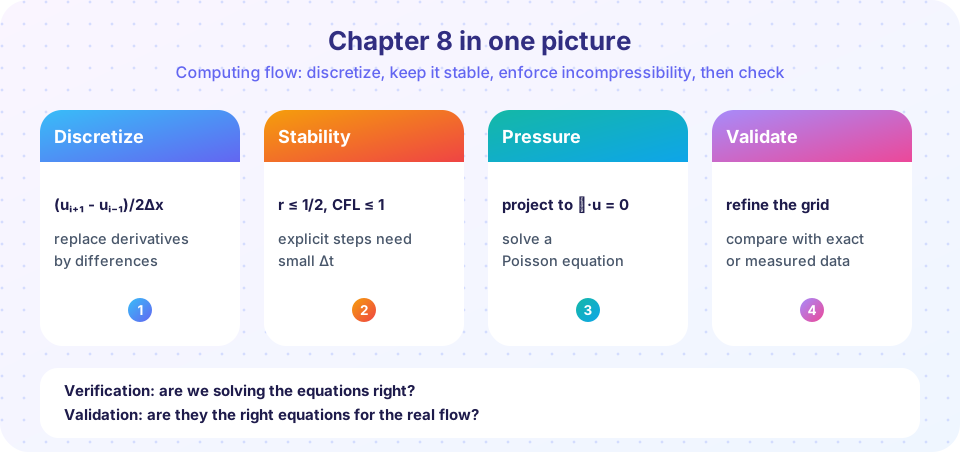
Recap
| Lesson | Key results |
|---|---|
| Overview | Workflow of five steps; finite difference, volume and element; DNS, LES, RANS; verification versus validation |
| Finite differences | Central difference O(Δx²); explicit diffusion r ≤ 1/2; CFL ≤ 1; upwind numerical diffusion cΔx(1-CFL)/2; order from refinement |
| Cavity solver | u = ψ_y, v = -ψ_x, ∇²ψ = -ω; Thom's wall formula; projection and SIMPLE; grid refinement |
How experts reason
An experienced CFD practitioner asks before any run: which physics matters, what is the cheapest model that captures it, and how will I know the answer is right? They check boundary conditions first, then mesh quality at walls and wakes, then run three meshes and compare, and only then believe the picture. When something looks odd they simplify: a 1D version, a known exact solution, or a smaller Re.
Common misconceptions
- "A bigger computer fixes everything." Doubling the resolution in 3D with time stepping costs 16 times more, and does nothing for a wrong model or boundary condition.
- "Numerical diffusion is a bug." It is a property of the scheme and shrinks with refinement or higher order, but it is present in every calculation.
Try it
Press Run (or Ctrl + Enter) to see the result here.
Program input · what you'd type while the program runs
Type the answers before you press Run, one per line. Each time the program reads a line (with input()), it gets the next line from this box.
Press Run (or Ctrl + Enter) to see the console output here.
No output.
Check your understanding
Quick check · 10 questions
of 10 answered You scored / 10 · perfect!
-
1. Which workflow order is correct?
You must define the domain, divide it into cells, form the algebraic equations, solve them and then verify and validate. -
2. First-order upwind for advection is stable for:
Upwind is stable up to CFL = 1. -
3. The explicit diffusion step in two dimensions has the limit:
In 2D the limit is Δx²/(4ν), twice as strict as the 1D limit Δx²/(2ν). -
4. What does the pressure Poisson equation enforce in a projection method?
Solving ∇²p = ∇·u*/Δt and correcting u = u* - Δt∇p makes ∇·u = 0. -
5. A second-order scheme's error falls from 4×10⁻³ to 1×10⁻³ when Δx is halved. Is that consistent?
Error ∝ Δx² gives a factor 2² = 4 when the mesh is halved. -
6. What does Godunov's theorem say?
This is why higher-order schemes use nonlinear limiters to avoid oscillations. -
7. RANS models differ from LES in that RANS:
RANS averages over all turbulence; LES resolves large eddies and models the small ones. -
8. What is the cell Péclet number?
Pe = cΔx/ν compares advection and diffusion across a cell; central differencing needs Pe ≤ 2. -
9. Residuals of an iterative solver fall to 10⁻⁶. What do you know?
Residuals measure convergence of the algebraic equations only, not discretization error or modeling error. -
10. Which statement distinguishes validation from verification?
Verification is about solving the equations right; validation is about whether they describe reality.
Summary
- A CFD study has five steps; errors enter at each.
- Stability:
r ≤ 1/2(1D diffusion),CFL ≤ 1; upwind smears, Lax-Wendroff oscillates. - Incompressibility is handled through
ψ-ωin 2D or pressure projection in general. - Trust a result only after grid refinement, benchmark tests and validation.
Track your progress
Create a free account to tick off lessons and pick up where you left off on any device.
of Fluid Dynamics lessons completed