


















Lesson 1 of 46 · Getting Started
Course Map: Your Route Through Fluid Dynamics
See the whole Fluid Dynamics course at a glance: who it is for, what you need first, how the nine chapters connect, and a study routine that works.
Fluid dynamics is the science of moving liquids and gases. It tells you why a plane stays in the air, why a river carves bends, why a golf ball has dimples, how blood is pumped through arteries and how a weather forecast is computed. Behind all of it sit a few ideas that you can learn step by step: fluids obey conservation of mass and Newton's second law, and everything else is careful bookkeeping and clever simplification.
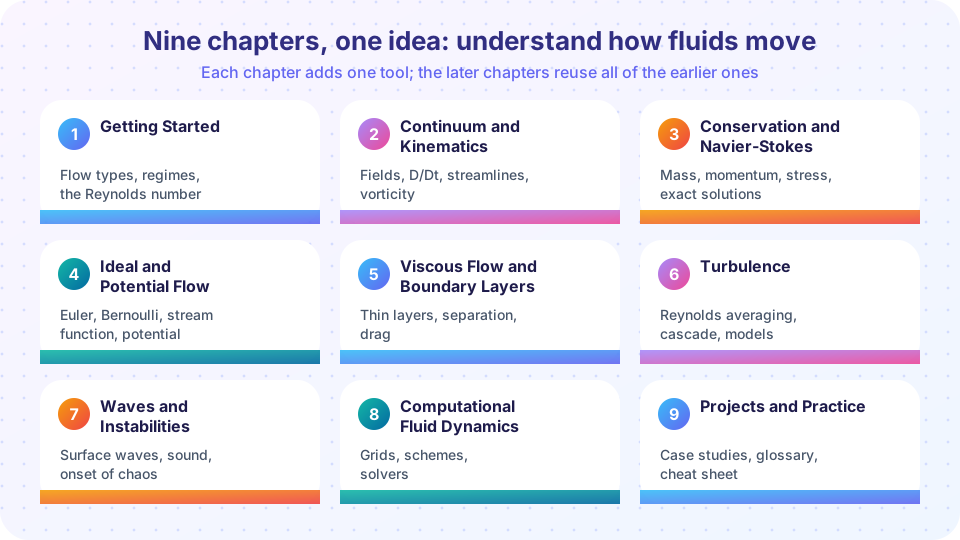
This course starts from the definition of a fluid and ends with turbulence, waves and computer simulation. Where a fact has a famous name attached (Reynolds, Navier, Stokes, Bernoulli, Prandtl) we tell you who found it and what they actually showed.
What you will learn
- What the course covers and how the nine chapters build on one another.
- Which math and physics you should know before you begin.
- A four-step routine for solving any fluid problem: sketch, set up, solve, check.
- How the live examples, plots and quizzes on each page fit into your learning.
Key terms
Fluid: a substance that deforms continuously when a shear stress is applied, however small. Liquids and gases are fluids.
Flow field: the velocity (and pressure, density) of the fluid given as a function of position and time.
Conservation law: a statement that a quantity such as mass or momentum cannot appear or vanish, only move.
Dimensionless number: a pure number, such as the Reynolds number, that tells you which physical effect dominates.
Boundary layer: the thin region next to a surface where viscosity matters even when it can be ignored elsewhere.
Who this course is for
The course follows the common core of university fluid dynamics and of the fluid sections in physics and engineering syllabi taught worldwide: Cambridge A Level and further physics, the IB, US AP Physics and first-year engineering. You might be an engineering or physics student, a pilot or sailor who wants to understand the physics, or an adult returning to science. You do not need to have met fluid dynamics before.
What you need first
- Algebra and basic calculus. Derivatives and simple integrals appear from chapter 2. We always say in words what a symbol means before we use it.
- Newtonian mechanics. Force, mass, acceleration, work, energy and momentum. A fluid is just a substance that can change shape, and Newton's laws apply to every little piece of it.
- Vectors. A velocity has a size and a direction. We use the notation
u = (u, v, w)for its components. - A little Python (optional). Many examples run live in your browser. You can read the code like pseudocode; you never have to write long programs.
The nine chapters
Foundations
- Getting Started
- Kinematics
- Conservation
Theory of ideal and thin-layer flow
- Potential Flow
- Boundary Layers
- Turbulence
Beyond the basics
- Waves
- CFD
- Projects
Chapters 1 to 4 teach you to describe a flow and to use the equations. Chapter 5 shows where the simple theory fails (near surfaces) and how a thin layer fixes it. Chapter 6 faces the hardest problem in classical physics, turbulence. Chapters 7 and 8 add waves and numerical methods. Chapter 9 puts everything to work.
How to study each lesson
Every content lesson has the same shape: a short list of outcomes, key terms, worked examples with real numbers, common misconceptions, live examples, a quiz and a summary. Use this routine for every problem you meet.
- Sketch. Draw the flow, label the fluid, the speeds and the sizes. Half of all mistakes disappear when the picture is right.
- Set up. Choose the right law: mass conservation, momentum, Bernoulli. Write it before you plug in numbers.
- Solve. Do the algebra with symbols first, numbers last, and carry units through every step.
- Check. Is the answer the right size? Does it have the right units? What does it do in the limits (zero speed, huge size)?
Work SI units throughout: metres, kilograms, seconds, pascals (Pa). A pressure of 1 atm is 101,325 Pa. When a problem gives millimetres or litres per minute, convert first.
Common misconceptions
"Fluid dynamics is only about water." Air, oil, blood, molten steel, magma and even crowds of people are modelled with the same equations. The numbers differ, the laws do not.
"Equations give exact answers for real flows." The governing equations are exact, but real flows are often turbulent and too detailed to solve exactly. A big part of the subject is knowing which simplification is safe.
Try it
First, a flow you will learn to derive in chapter 3: slow water through a narrow pipe has a parabolic velocity profile. The code only evaluates the formula u(r) = G (R² − r²) / (4μ). Change the pressure gradient G and watch the speed scale.
Press Run (or Ctrl + Enter) to see the result here.
Program input · what you'd type while the program runs
Type the answers before you press Run, one per line. Each time the program reads a line (with input()), it gets the next line from this box.
Second, a first look at the single most important number in the course, the Reynolds number Re = ρ V L / μ. This console example classifies a few flows. You will understand the thresholds in the next lessons.
Press Run (or Ctrl + Enter) to see the console output here.
No output.
Check your understanding
Quick check · 4 questions
of 4 answered You scored / 4 · perfect!
-
1. Which statement best describes a fluid?
A fluid keeps deforming (flowing) as long as a shear stress acts, however small. Gases are fluids and are compressible, so the first option is wrong. -
2. What are the four steps of the problem-solving routine in this course?
Sketch the flow, set up the right law, solve with symbols first, then check size, units and limits. -
3. Which chapter introduces the idea that viscosity matters mostly in a thin layer near surfaces?
The boundary layer idea is the subject of chapter 5, after chapter 4 shows what ideal flow can and cannot explain. -
4. A pressure of 1 atm in SI units is about
One standard atmosphere is 101,325 pascals, about 101 kPa.
Summary
- Fluid dynamics applies conservation of mass and Newton's second law to liquids and gases.
- The course has nine chapters, from definitions to turbulence, waves, simulation and projects.
- You need algebra, basic calculus, vectors and Newtonian mechanics; Python is optional.
- Use SI units and the routine sketch, set up, solve, check on every problem.
Track your progress
Create a free account to tick off lessons and pick up where you left off on any device.
of Fluid Dynamics lessons completed