


















Lesson 36 of 46 · Waves and Instabilities
Chapter 7 review: waves and instabilities
Review surface-wave dispersion, tsunami speed, Kelvin-Helmholtz, Rayleigh-Taylor, Rayleigh-Benard and jet instabilities with a summary picture, calculators and a quiz.
Waves and instabilities share one mathematical home: perturb an equilibrium, linearize, and find how disturbances behave in time. If the perturbation oscillates (σ imaginary) you have a wave. If it grows (σ real and positive) you have an instability. The review below collects the formulas and checks your understanding.
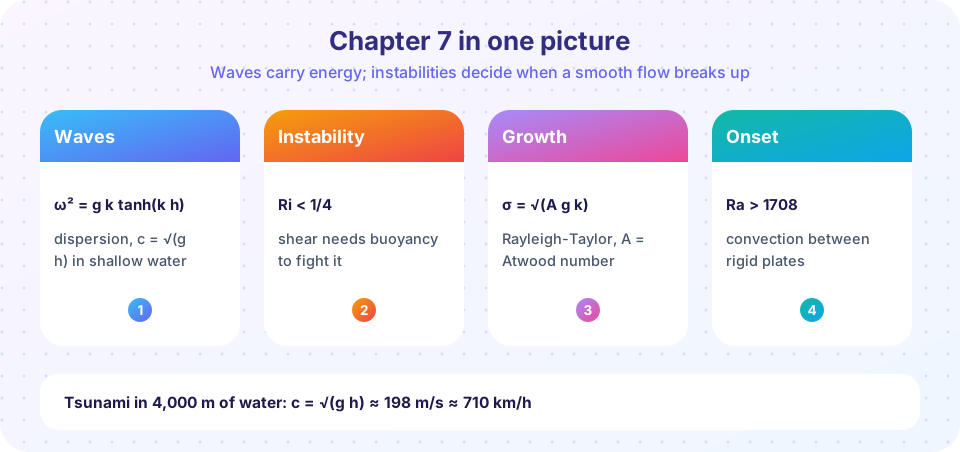
Recap
| Lesson | Key results |
|---|---|
| Overview | Restoring forces make waves; instabilities grow like e^(σt); c = ω/k, c_g = dω/dk |
| Surface waves | ω² = g k tanh(kh); deep c = √(gλ/2π), c_g = c/2; shallow c = √(gh); tsunami 713 km/h at 4 km depth; Green's law a ∝ h^(-1/4) |
| Instabilities | KH: σ = kΔU/2, Ri > 1/4 stable; RT: σ² = Agk; Bénard: Ra_c = 1708; jets: λ > 2πR |
How experts reason
When an expert meets a new flow, they identify the restoring force and the energy source. Is there a restoring force (gravity, tension, compression, buoyancy)? Then waves are possible. Is there a source of energy (shear, an unstable density layering, heating, surface energy) that a disturbance can tap? Then instability is possible. The dimensionless numbers (Ri, A, Ra, Re) compare the two.
Common misconceptions
- "Waves and instabilities are unrelated." Wind blowing over water excites waves through a shear instability, and many instabilities begin as growing waves.
- "Linear theory predicts the final pattern." It predicts when growth starts and the fastest-growing scale, not the nonlinear end state.
Try it
Press Run (or Ctrl + Enter) to see the result here.
Program input · what you'd type while the program runs
Type the answers before you press Run, one per line. Each time the program reads a line (with input()), it gets the next line from this box.
Press Run (or Ctrl + Enter) to see the console output here.
No output.
Check your understanding
Quick check · 10 questions
of 10 answered You scored / 10 · perfect!
-
1. In deep water, doubling the wavelength changes the phase speed by what factor?
c = √(gλ/2π) ∝ √λ, so doubling λ multiplies c by √2. -
2. What is the group velocity of deep-water gravity waves relative to the phase velocity?
c_g = dω/dk = c/2 for ω = √(gk). -
3. A tsunami crosses a 100 m deep shelf. What is its approximate speed?
c = √(9.81 × 100) ≈ 31.3 m/s, about 113 km/h. -
4. What does Green's law say about shoaling amplitude?
Conservation of energy flux gives amplitude growing as depth to the power minus one quarter in linear theory. -
5. Which condition ensures Kelvin-Helmholtz stability for a stratified shear flow (Miles-Howard)?
A local Richardson number above one quarter everywhere guarantees stability. -
6. What does the Atwood number A measure?
A = (ρ_heavy - ρ_light)/(ρ_heavy + ρ_light). -
7. What is the critical Rayleigh number between rigid plates?
Ra_c = 1708 for two rigid boundaries; 657.5 applies to two free surfaces. -
8. For a thin liquid jet, which wavelength is the fastest-growing, approximately?
The fastest-growing wavelength is about 9.0 R (4.5 jet diameters). -
9. What limits Rayleigh-Taylor growth at very short wavelengths?
Surface tension gives a restoring term proportional to k³ that dominates at small scales. -
10. A disturbance that oscillates in time without growing indicates:
Imaginary σ means oscillation, i.e. a wave; positive real σ means growth.
Summary
- Waves: restoring forces; dispersion relations;
cversusc_g; shallow-water tsunamis. - Instabilities: Kelvin-Helmholtz (
Ri), Rayleigh-Taylor (A), Rayleigh-Bénard (Ra), Rayleigh-Plateau (λ > 2πR). - Linear theory tells you when and at what scale growth starts.
- Next we turn to computing flows on a computer.
Track your progress
Create a free account to tick off lessons and pick up where you left off on any device.
of Fluid Dynamics lessons completed