


















Lesson 42 of 46 · Projects and Practice
Project: sizing a pipe system with Darcy-Weisbach
Size a water pipe system step by step: Reynolds number, Colebrook friction factor, pressure drop, minor losses, parallel branches and pump power, with runnable code.
This project turns the theory of the course into a tool that engineers use every day: computing the pressure drop in a pipe system and choosing a pump. It uses laminar and turbulent friction from chapters 5 and 6, and the problem-solving habits from chapter 8: write a small program, check it, and test the limits.
What you will learn
- How to compute a friction factor from the Reynolds number and relative roughness (Colebrook equation).
- How to turn friction into pressure drop with the Darcy-Weisbach formula and add minor losses.
- How to solve for the flow split between parallel pipes.
- How to estimate pump head and shaft power.
Key terms
- Darcy-Weisbach equation:
Δp = f (L/D) (ρ V²/2). - Relative roughness (ε/D): the wall roughness height divided by the diameter.
- Colebrook equation:
1/√f = -2 log₁₀( (ε/D)/3.7 + 2.51/(Re √f) ), an implicit formula for turbulentf. - Minor loss: extra loss in fittings,
Δp = K ρ V²/2. - Head (H): pressure expressed as a height of fluid,
H = Δp/(ρ g).
The model
For a pipe of diameter D, length L and flow rate Q, the mean speed is V = 4Q/(π D²) and the Reynolds number Re = V D/ν. The friction factor is
- laminar (
Re < 2,300):f = 64/Re - turbulent: Colebrook, solved iteratively (for smooth pipes it reduces to Prandtl's law of chapter 6)
The pressure drop is Δp = (f L/D + ΣK) ρ V²/2. A typical K is about 0.9 for a standard 90° elbow and about 0.2 for an open gate valve, though real values depend on the fitting; use manufacturer data for a real design. For a pump with efficiency η_p, the hydraulic power is ρ g Q H and the shaft power ρ g Q H/η_p.
Parallel branches
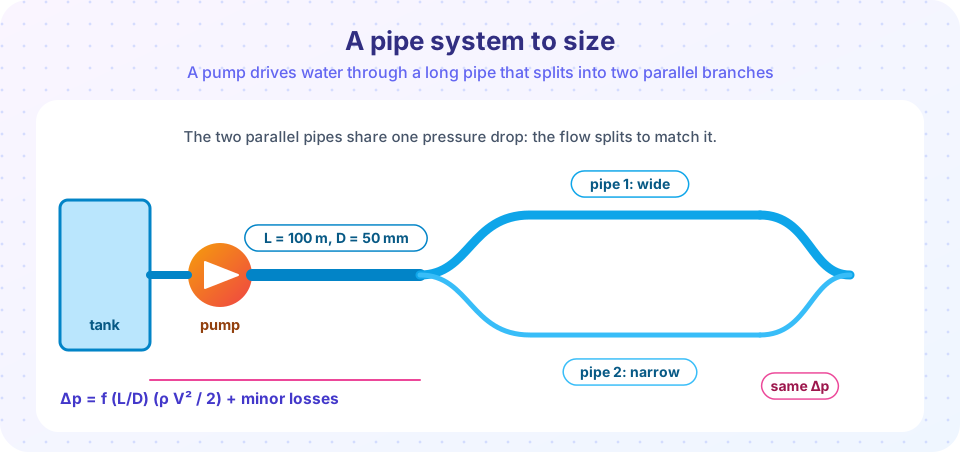
If two pipes connect the same two points, both have the same pressure drop, and the flows add: Q = Q₁ + Q₂. Because Δp increases with Q, there is one split that satisfies equal Δp. Solve it numerically: guess Q₁, compute Δp₁(Q₁) and Δp₂(Q - Q₁), and adjust until they match.
Try it
Press Run (or Ctrl + Enter) to see the result here.
Program input · what you'd type while the program runs
Type the answers before you press Run, one per line. Each time the program reads a line (with input()), it gets the next line from this box.
Press Run (or Ctrl + Enter) to see the result here.
Program input · what you'd type while the program runs
Type the answers before you press Run, one per line. Each time the program reads a line (with input()), it gets the next line from this box.
Press Run (or Ctrl + Enter) to see the console output here.
No output.
The code uses standard textbook formulas. Roughness values, K factors and efficiencies are typical values, not data for any particular product.
Exercises
- In the second program, change the wide pipe to 40 mm and describe how the flow split changes. Why does the narrow pipe still carry a significant share?
- Replace the steel roughness
0.045 mmby0.0015 mm(smooth plastic) and recomputefand the pump power. - Find the flow rate at which the flow in the 50 mm pipe becomes laminar (
Re = 2,300) and compute the pressure drop withf = 64/Re. Compare it with the Colebrook value atRe = 2,300, and comment. - Add a second pump in series and discuss how the required head changes.
Common misconceptions
- "Parallel pipes split the flow equally." They split it so the pressure drops match, which sends more flow through the wider, smoother branch.
- "Friction factor is a constant." It depends on
Reand roughness; in turbulent flow it changes slowly, but it does change. - "Pump power equals ρ g Q H." That is the hydraulic power delivered to the fluid; the shaft needs more because the pump is not 100% efficient.
Check your understanding
Quick check · 4 questions
of 4 answered You scored / 4 · perfect!
-
1. What is the Darcy-Weisbach formula for pressure drop in a straight pipe?
Darcy-Weisbach: friction factor times length over diameter times dynamic pressure. -
2. For two parallel branches, which quantity is the same in both?
Both branches connect the same two points, so the pressure drop must match; the flow rates add. -
3. At fixed flow rate, how does turbulent head loss scale with pipe diameter (roughly)?
V ∝ 1/D², so V²/D ∝ 1/D⁵ with f roughly constant. -
4. Why is shaft power larger than hydraulic power?
Shaft power = hydraulic power / pump efficiency.
Summary
- Friction factors come from
64/Re(laminar) or Colebrook (turbulent); pressure drop follows from Darcy-Weisbach plus minor losses. - Parallel branches share one pressure drop; solve for the split numerically.
- Pump head is
Δp/(ρg); shaft power isρgQHdivided by efficiency. - Larger pipes reduce losses very strongly.
Track your progress
Create a free account to tick off lessons and pick up where you left off on any device.
of Fluid Dynamics lessons completed