


















Lesson 9 of 43 · Water, pH and Biomolecules
Chapter 2 review: Water, pH and Biomolecules
Review chapter 2: water structure and hydrogen bonds, the hydrophobic effect, weak-force energies, pH, pKa and buffer calculations, with a ten-question quiz.
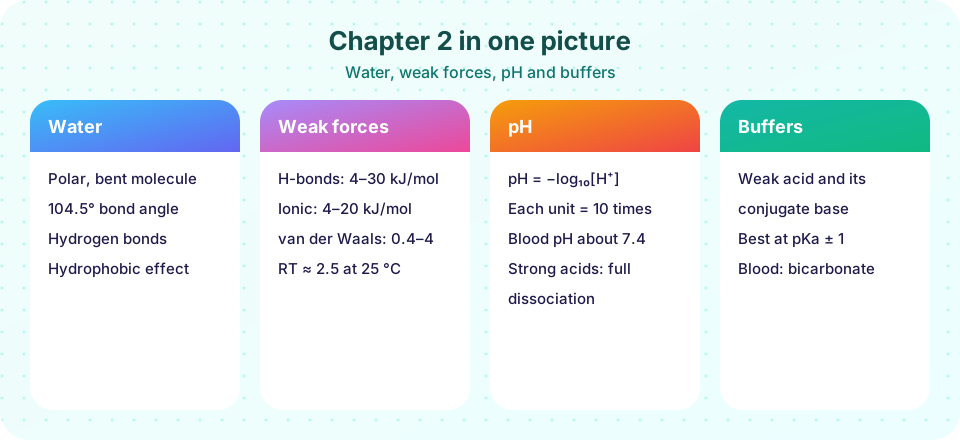
Chapter 2 gave you the setting for every biochemical reaction and the numbers to describe it. Use this page to consolidate: skim the picture and the table, try the tools, then take the quiz before checking the lessons.
What you will learn
- Recall the key facts and equations of chapter 2.
- Practice pH, pKa and buffer calculations.
- Identify any topic to revisit before proteins in chapter 3.
Recap table
| Topic | What to remember |
|---|---|
| Water | bent, 104.5°; polar; up to four hydrogen bonds; high specific heat (4.18 J/(g·K)); ice less dense than liquid |
| Solvent | dissolves ions and polar molecules; excludes nonpolar ones |
| Hydrophobic effect | entropy-driven clustering of nonpolar groups; makes micelles, bilayers and protein cores |
| Weak forces | covalent 150–500, H-bond 4–30, ionic 4–20, van der Waals 0.4–4 kJ/mol; RT ≈ 2.5 kJ/mol |
| Electrostatics | E = −138.9/(ε r) kJ/mol (r in nm); water ε ≈ 78 screens charges |
| pH | −log₁₀[H⁺]; tenfold per unit; Kw = 10⁻¹⁴ |
| Henderson–Hasselbalch | pH = pKa + log([A⁻]/[HA]) |
| Buffers | work within pKa ± 1; capacity grows with concentration |
| Binding | Kd = e^(ΔG/RT); many weak contacts add up |
Key terms
Hydrogen bond: attraction between an N–H or O–H hydrogen and a lone pair on N or O.
Hydrophobic effect: entropy-driven burial of nonpolar surfaces.
pKa: the pH at which an acid is half dissociated.
Buffer: a weak acid and its conjugate base that resist pH change.
Amphipathic: with both polar and nonpolar regions.
Common misconceptions
"A pH of 6 is only slightly more acidic than pH 7." It has ten times the H⁺ concentration.
"Strong means concentrated." A strong acid dissociates fully; a concentrated weak acid can still be only partly dissociated.
"Weak forces cannot hold structure." Together they do, and their reversibility is what lets structures change.
Try it
Here is a quick pH ↔ concentration converter and a buffer-recipe tool. Use it to check your homework answers.
Press Run (or Ctrl + Enter) to see the result here.
Program input · what you'd type while the program runs
Type the answers before you press Run, one per line. Each time the program reads a line (with input()), it gets the next line from this box.
The second tool is a hydrogen-bond and energy reminder: pick an interaction and see how many RT it is.
Check your understanding
Quick check · 10 questions
of 10 answered You scored / 10 · perfect!
-
1. Which property of water explains why ice floats?
In ice each molecule forms four hydrogen bonds in an open lattice, lowering density. -
2. A molecule with both a polar head and a nonpolar tail is:
Amphipathic molecules have both regions and form micelles and bilayers. -
3. The hydrophobic effect is driven mainly by:
Burying nonpolar surfaces releases ordered water and raises entropy. -
4. Which interaction has energy closest to thermal energy RT?
van der Waals contacts are 0.4 to 4 kJ/mol, comparable to RT (2.5 kJ/mol). -
5. A solution has pH 3. Another has pH 6. The first has how much more H+?
Three pH units is a factor of 10^3 = 1000. -
6. A weak acid has pKa 5.0. At pH 6.0, the ratio [A-]/[HA] is:
pH - pKa = 1, so the ratio is 10^1 = 10. -
7. Which pair makes the most effective buffer at pH 7.0?
Phosphate's pKa (6.86) is within one unit of 7.0. -
8. Why does water weaken salt bridges?
With ε about 78, water reduces the electrostatic attraction between opposite charges. -
9. ΔG of binding of -45 kJ/mol at 25 °C gives Kd of about:
Kd = exp(ΔG/RT) = exp(-45/2.479), about 1.3 × 10^-8 M. -
10. What happens to buffer pH when a small amount of strong acid is added?
The conjugate base consumes added H+, so the ratio and pH change only slightly.
Summary
- Water's polarity and hydrogen bonds underlie solvent power, density behavior and the hydrophobic effect.
- Noncovalent forces are weak individually but give strong, selective and reversible binding collectively.
- pH, pKa and the Henderson–Hasselbalch equation let you design and analyze buffers.
- Next: proteins, the molecules that use all of these rules to do work.
Track your progress
Create a free account to tick off lessons and pick up where you left off on any device.
of Biochemistry lessons completed