


















Lesson 24 of 43 · Carbohydrates and Lipids
Lipids: fats, fatty acids and membranes
Understand fatty acid structure, why unsaturation lowers melting point, how triacylglycerols store energy and how phospholipids self-assemble into cell membranes.
Lipids are not one chemical family; they are the molecules defined by what they do around water: they dissolve poorly in it and well in organic solvents. That single physical property explains an enormous amount of biology. It lets fats pack away energy without a water shell, and it makes phospholipids spontaneously assemble into the thin, flexible sheets that wrap every cell.
What you will learn
- Read fatty acid shorthand such as
18:1(Δ9)and relate chain features to melting point. - Describe triacylglycerols and why they are an efficient energy store.
- Explain how phospholipids form bilayers and what cholesterol does to membranes.
- Describe the fluid mosaic model and the main classes of membrane lipid.
Key terms
Fatty acid: a long hydrocarbon chain with a carboxylic acid group at one end, usually 12 to 24 carbons.
Triacylglycerol (triglyceride): glycerol with three fatty acids attached through ester bonds.
Phospholipid: a lipid with a hydrophobic tail region and a phosphate-containing polar head group.
Hydrophobic effect: the tendency of nonpolar groups to cluster together in water, driven by the entropy gain of released water.
Fluid mosaic model: membranes are a fluid lipid bilayer with proteins floating in it.
Fatty acids
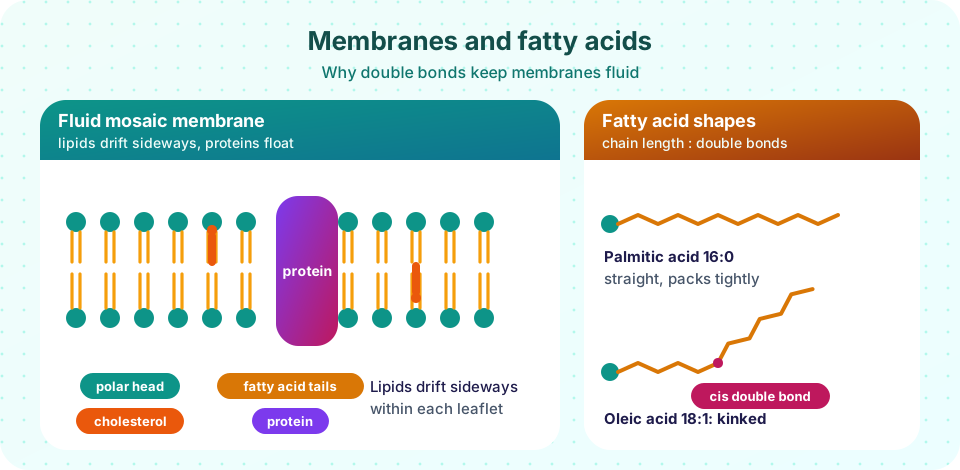
A fatty acid is a hydrocarbon chain ending in a carboxyl group. The shorthand 18:1(Δ9) means 18 carbons and one double bond between carbons 9 and 10, counting from the carboxyl carbon. Most natural fatty acids have an even number of carbons, and their double bonds are cis, which bends the chain.
- Saturated (no double bonds, e.g. palmitic acid 16:0, stearic acid 18:0): straight chains that pack tightly and melt at higher temperatures.
- Monounsaturated (one double bond, e.g. oleic acid 18:1): one kink.
- Polyunsaturated (two or more, e.g. linoleic acid 18:2 and α-linolenic acid 18:3): several kinks, very low melting points.
Humans cannot insert double bonds beyond carbon 9, so linoleic (an ω-6 acid) and α-linolenic (an ω-3 acid) are essential fatty acids that must come from the diet. Industrial partial hydrogenation of oils can create trans double bonds, which leave the chain nearly straight; trans fats behave physically like saturated ones.
Triacylglycerols: compact energy stores
Three fatty acids attach to the three hydroxyl groups of glycerol by ester bonds, giving a neutral, completely nonpolar molecule. Because it is nonpolar, a triacylglycerol is stored in lipid droplets with essentially no water around it. Glycogen, by contrast, holds a large amount of water. Per gram of dry mass fat stores more than twice the energy of carbohydrate, and because it is stored dry the practical advantage is much larger. That is why animals that fast or travel far (bears, migrating birds) store fat, and why plants pack seeds with oil.
Hydrolysis of the ester bonds by lipases frees fatty acids; alkaline hydrolysis of fats gives soaps (saponification), whose amphipathic carboxylates form micelles around grease.
Phospholipids and the bilayer
A glycerophospholipid such as phosphatidylcholine has glycerol, two fatty acid tails and a phosphate head group carrying a polar group such as choline. A sphingolipid uses the amino alcohol sphingosine as backbone. Both are amphipathic: the head is attracted to water, the tails are not.
Place such molecules in water and they assemble on their own. The tails hide from water by facing each other, and the heads face the water on both sides, forming a bilayer about 5 nm thick. The driving force is the hydrophobic effect: tails are buried, which frees water molecules and increases entropy. The bilayer also tends to close up into a sealed sphere (a vesicle or liposome), because open edges would expose tails to water.
Cholesterol and membrane fluidity
Cholesterol is a steroid with four fused rings and a short hydroxyl "head". It sits between phospholipid tails in animal membranes. At body temperature it makes the bilayer less floppy, and at low temperature it stops tails from packing into a gel, so it acts as a fluidity buffer. Cholesterol is also the starting point for steroid hormones, bile acids and (in skin) vitamin D.
The fluid mosaic model
In 1972 Singer and Nicolson proposed the fluid mosaic model: proteins float in a two-dimensional fluid of lipids. Lipids diffuse sideways quickly within a leaflet, but flipping from one leaflet to the other is slow and needs enzymes (flippases). Membranes are also asymmetric: the lipid and sugar composition of the outer leaflet differs from the inner. Some proteins span the bilayer with α-helices of hydrophobic amino acids. Whether stable "lipid rafts" exist in living cells is still debated.
Common misconceptions
"Fat is just stored sugar." Cells can make fat from carbohydrate, but fat is a different class of molecule with different bonds and a different metabolism.
"Cholesterol is bad." Cholesterol is essential for membranes and hormone synthesis. Health questions concern the amounts carried in the blood, not whether the molecule is needed.
"Membranes are rigid walls." They are fluid, with lipids and many proteins moving continually.
Try it
Melting points of common fatty acids (approximate literature values) show how chain features matter. Saturated acids melt well above body temperature; unsaturated ones are liquids.
Press Run (or Ctrl + Enter) to see the result here.
Program input · what you'd type while the program runs
Type the answers before you press Run, one per line. Each time the program reads a line (with input()), it gets the next line from this box.
A small calculator for fatty acid formulas. A chain with n carbons and d double bonds is CnH(2n−2d)O2.
Press Run (or Ctrl + Enter) to see the console output here.
No output.
Check your understanding
Quick check · 4 questions
of 4 answered You scored / 4 · perfect!
-
1. What does the notation 18:1(Δ9) mean?
The first number is the carbon count, the second the number of double bonds, and Δ9 gives the position of the double bond. -
2. Why does a cis double bond lower a fatty acid's melting point?
The kink prevents close packing, so less thermal energy is needed to disrupt the arrangement. -
3. What drives phospholipids to form a bilayer in water?
Burying the nonpolar tails releases ordered water, increasing entropy; heads stay in contact with water. -
4. Which statement about cholesterol in membranes is correct?
Cholesterol restrains tail motion when it is warm and prevents tight gel packing when it is cold.
Summary
- Fatty acids are carboxylic acids with long hydrocarbon chains; cis double bonds kink them and lower melting points.
- Triacylglycerols (glycerol plus three fatty acids) are stored dry in lipid droplets and are the densest energy store.
- Phospholipids are amphipathic and assemble into bilayers through the hydrophobic effect.
- Cholesterol buffers membrane fluidity and is the precursor of steroid hormones.
- The fluid mosaic model describes membranes as fluid lipids with floating, asymmetric proteins.
Next: Chapter 5 review
Track your progress
Create a free account to tick off lessons and pick up where you left off on any device.
of Biochemistry lessons completed