


















Lesson 31 of 43 · Nucleic Acids and Information Flow
Nucleic acids and information flow: the big picture
Get a map of the central dogma: how DNA is copied, transcribed into RNA and translated into protein, and what the next lessons on replication and expression cover.
Every cell carries a set of instructions, and every cell has to read them. In nearly all life the information lives in DNA, is copied into RNA, and is used to build proteins. Francis Crick called this the central dogma of molecular biology: information flows from nucleic acid to protein, not back from protein to nucleic acid. This chapter shows the biochemistry of each step: the molecules, the enzymes and the energy.
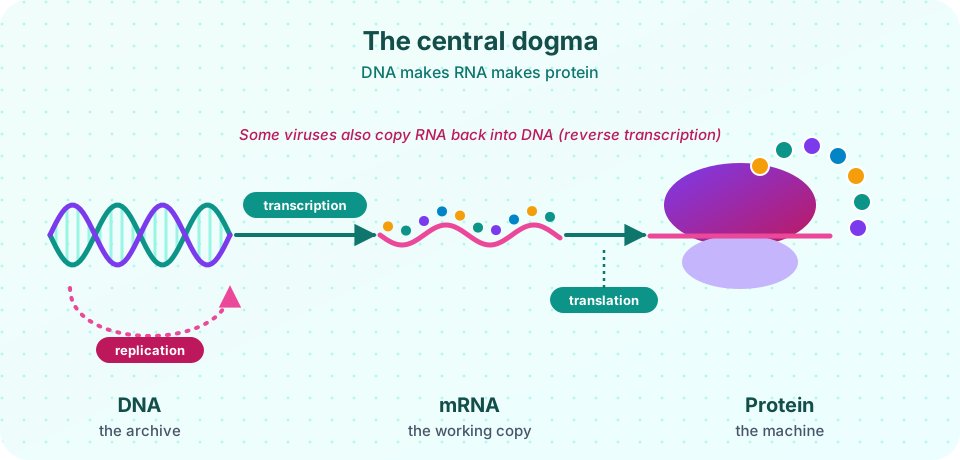
The chapter at a glance
Three processes
The molecules
The machines
One rule
Proteins grow from N to C terminus.
What each lesson covers
| Lesson | What you will learn |
|---|---|
| DNA structure and replication | Nucleotides, base pairing, the double helix and how the replication fork copies it |
| Transcription, the genetic code and translation | How RNA polymerase makes mRNA and how ribosomes decode it |
| Chapter review | One picture of the three processes |
Why a biochemist cares
The central dogma is chemistry. Each step is an enzyme-catalyzed polymerization that spends energy (nucleoside triphosphates, GTP and ATP), builds a new polymer one unit at a time, and uses base pairing as a template. Understanding the chemical logic explains why antibiotics can block bacterial ribosomes, why antiviral drugs mimic nucleotides and why a single changed base can alter a protein. It also leads into the next field, molecular biology, which studies how genes are controlled and manipulated.
Key terms
Nucleotide: a base, a five-carbon sugar and one or more phosphate groups; the monomer of nucleic acids.
Central dogma: the flow of sequence information from DNA to RNA to protein.
Gene: a stretch of DNA that encodes a functional product, usually a protein or a functional RNA.
Template: a strand whose sequence directs the sequence of the new strand by base pairing.
Check your understanding
Quick check · 3 questions
of 3 answered You scored / 3 · perfect!
-
1. What does the central dogma state?
The dogma describes the usual direction: DNA to RNA to protein; protein sequence is not used to specify nucleic acid. -
2. In which direction do nucleic acid chains grow?
Polymerases add nucleotides to the 3′ hydroxyl of the growing chain. -
3. Which process makes RNA from a DNA template?
Transcription is catalyzed by RNA polymerase.
Summary
- Information flows DNA to RNA to protein; each step is a template-directed polymerization.
- Nucleic acids grow 5′ to 3′ using nucleoside triphosphates.
- This chapter covers DNA structure and replication, transcription, the genetic code and translation.
Track your progress
Create a free account to tick off lessons and pick up where you left off on any device.
of Biochemistry lessons completed