


















Lesson 20 of 43 · Enzymes and Kinetics
Chapter 4 review: Enzymes and Kinetics
Review chapter 4: transition-state catalysis, Michaelis-Menten kinetics, kcat and Km, inhibitor types and enzyme regulation, with a ten-question quiz.
Enzymes are where chemistry becomes biology: they decide which reactions happen, how fast and when. This review gathers chapter 4 into one page. Try the quiz first without looking back, then use the recap table to find gaps.
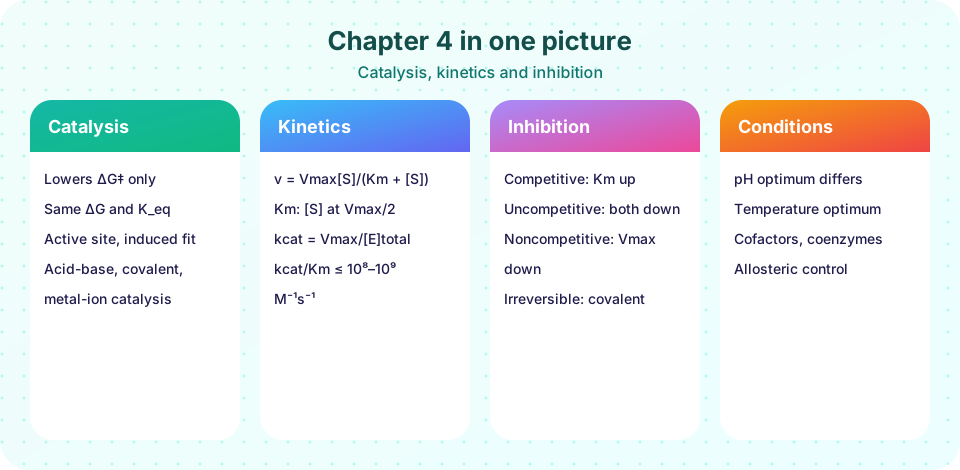
What you will learn
- Recall the key concepts and equations of chapter 4.
- Practice kinetic calculations and inhibitor identification.
- Prepare for chapter 5 (carbohydrates and lipids) and chapter 6 (metabolism).
Recap table
| Topic | What to remember |
|---|---|
| Catalysis | enzymes lower ΔG‡ by stabilizing the transition state; ΔG and K unchanged; 5.7 kJ/mol ≈ factor 10 at 25 °C |
| Active site | induced fit; proximity, strain, acid-base, covalent and metal-ion catalysis |
| Chymotrypsin | Ser195-His57-Asp102 triad, oxyanion hole, acyl-enzyme intermediate |
| Michaelis–Menten | v = Vmax[S]/(Km + [S]); Vmax = kcat[E]t; Km = [S] at Vmax/2 |
| Efficiency | kcat/Km; diffusion limit about 10⁸ to 10⁹ M⁻¹ s⁻¹ |
| Lineweaver–Burk | slope Km/Vmax; y-intercept 1/Vmax; x-intercept −1/Km |
| Competitive | Km up, Vmax same; overcome by [S] |
| Uncompetitive | Km and Vmax both down; parallel lines |
| Noncompetitive | Vmax down, Km same |
| Regulation | allostery, feedback, phosphorylation, zymogens, pH, temperature, cofactors |
Key terms
Transition state: the highest-energy point on the reaction path.
Km / Vmax / kcat: half-saturation substrate concentration, maximum rate, turnover number.
Ki: inhibitor dissociation constant.
Zymogen: inactive precursor of an enzyme.
Holoenzyme: apoenzyme plus its cofactor.
Common misconceptions
"Enzymes change the equilibrium." They only change how fast equilibrium is reached.
"Km measures speed." Km is a concentration; kcat measures speed.
"All inhibitors can be overcome with more substrate." Only competitive ones.
Try it
Compare enzymes by catalytic efficiency. The numbers are typical literature-style values rounded to powers of ten (approximate); the code computes kcat/Km and checks against the diffusion limit.
Press Run (or Ctrl + Enter) to see the result here.
Program input · what you'd type while the program runs
Type the answers before you press Run, one per line. Each time the program reads a line (with input()), it gets the next line from this box.
Self-test with flashcards. Click to flip.
Check your understanding
Quick check · 10 questions
of 10 answered You scored / 10 · perfect!
-
1. What is the effect of an enzyme on the equilibrium constant?
Enzymes speed both directions equally; K depends only on delta G. -
2. An enzyme has Vmax = 60 µmol/min and Km = 3 mM. What is v at [S] = 9 mM?
v = 60 × 9/(3 + 9) = 45 µmol/min. -
3. Which parameter is proportional to total enzyme concentration?
Vmax = kcat [E]t, whereas Km and kcat are per-enzyme properties. -
4. A drug that binds only the ES complex and gives parallel Lineweaver-Burk lines is:
Uncompetitive inhibitors lower both Km and Vmax equally, giving parallel lines. -
5. In chymotrypsin the oxyanion hole stabilizes:
Backbone N-H groups hydrogen-bond the developing negative oxygen of the transition state. -
6. Lowering ΔG‡ by 11.4 kJ/mol at 25 °C speeds a reaction by about:
11.4 kJ/mol is two times 5.7, i.e. a factor of 10^2. -
7. Aspirin inhibits cyclooxygenase by:
Aspirin irreversibly acetylates a serine in the enzyme. -
8. Which describes feedback inhibition?
The final product of a pathway shuts down an early step. -
9. The Lineweaver-Burk y-intercept equals:
At 1/[S] = 0, 1/v = 1/Vmax. -
10. Which enzyme is catalytically near the diffusion limit?
Values around 10^8 to 10^9 M^-1 s^-1 are at the diffusion limit.
Summary
- Enzymes lower activation energy by stabilizing the transition state; thermodynamics is unchanged.
- Michaelis–Menten kinetics describe saturation; Km, Vmax, kcat and kcat/Km summarize an enzyme.
- Inhibitor type is revealed by how Km and Vmax change and by Lineweaver–Burk patterns.
- Cells regulate enzymes by allostery, feedback, modification, zymogens, pH, temperature and cofactors.
- You have now finished the first four chapters of this track; chapters 5 to 9 continue with carbohydrates, lipids, metabolism, nucleic acids, signaling and projects.
Track your progress
Create a free account to tick off lessons and pick up where you left off on any device.
of Biochemistry lessons completed